In a day marked by significant developments across the globe, international headlines were dominated by a high-stakes counterterrorism operation in the United Kingdom, a brutal escalation of conflict in Ukraine, and major shifts within the United States’ federal law enforcement apparatus. As geopolitical tensions simmer, the economic landscape also saw a cooling of trade friction between the world’s two largest economies, even as the technological sector grappled with the volatile nature of space exploration.
I. Counterterrorism Alert: The RAF Fairford Investigation
Security Concerns at a Critical U.S. Airbase
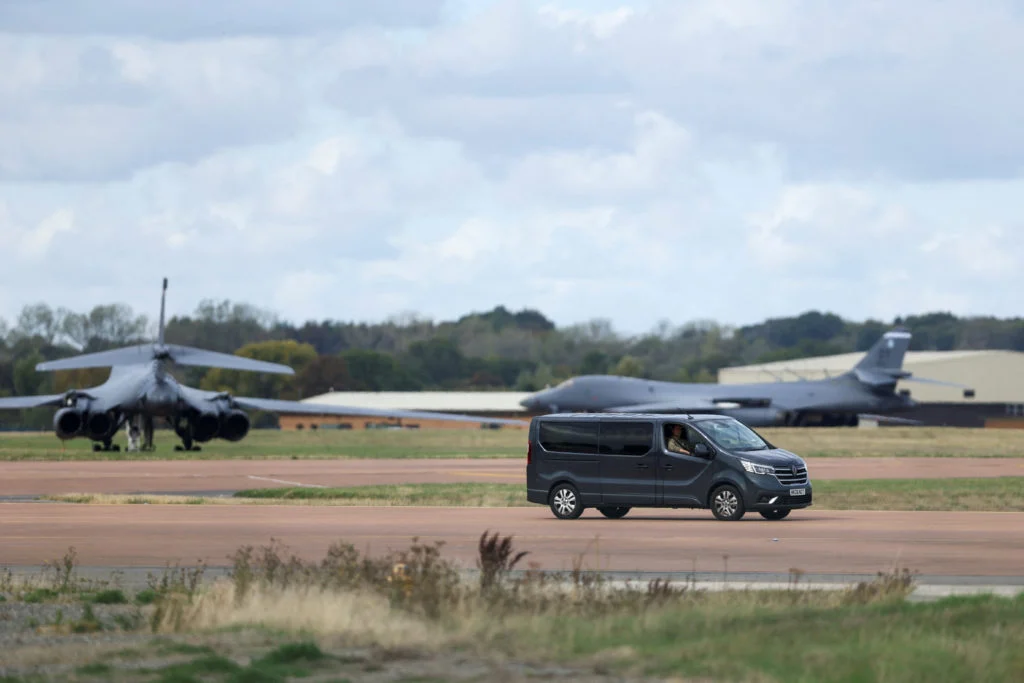
British counterterrorism authorities are currently navigating a complex investigation involving five British nationals who were arrested and subsequently released on bail in connection with a suspected plot targeting RAF Fairford. The base, a vital facility for U.S. strategic bomber operations, has been at the center of heightened security protocols following the arrests, which were initially triggered by suspicions regarding the possession of explosives.
The incident prompted a massive emergency response, resulting in the temporary evacuation of dozens of residential properties as bomb disposal units secured three suspicious vehicles near the perimeter. While residents have been permitted to return home, the investigation remains active under what officials described as "stringent conditions."
Foreign Actor Involvement and Official Responses
The proximity of the plot to a base housing bombers involved in ongoing regional conflicts has led to widespread speculation regarding the involvement of foreign state actors. While the Iranian embassy in London has issued a formal denial of any connection to the plot, U.K. authorities are maintaining a broad investigative scope.
Laurence Taylor, Head of the U.K. Counterterrorism Coordination Committee, emphasized the gravity of the situation, stating: "Be assured we are considering this from every possible angle, including that this may be actively committed by proxies or individuals either knowingly or unknowingly working on behalf of a foreign state." The investigation continues to scrutinize potential links to Russia, Iran, or various nonstate entities, marking a tense period for U.K.-based U.S. military installations.
II. The Ukraine Conflict: A Day of Terror
The humanitarian toll of the ongoing war in Ukraine deepened today as Russian forces launched a series of devastating strikes across the nation. Official reports indicate that at least seven people were killed, with over 80 individuals sustaining injuries, as infrastructure in Kyiv and Kharkiv became the primary targets.
The Assault on Kyiv
In the capital, the destruction was visceral. A Russian jet-powered drone struck the National Academy of Sciences, forcing survivors to cling to window ledges in a harrowing display of the conflict’s reach into civilian and historic centers. A separate strike ignited a medical facility, further taxing the city’s emergency response teams.
Kyiv Mayor Vitali Klitschko characterized the day’s events as "pure terror," noting that Russian strikes have ceased to distinguish between residential complexes and historic landmarks. "Every Ukrainian is the enemy’s target," Klitschko stated during an interpreter-assisted press briefing.
Kharkiv’s Overnight Trauma
The violence was not confined to the capital. Overnight, a residential apartment block in Kharkiv was struck, leaving 35 people injured, including 10 children. These strikes, viewed by local authorities as a calculated attempt to destabilize the social fabric of Ukraine, underscore the persistent vulnerability of major urban centers as the war enters a new phase of intensity.
III. Domestic Developments: Justice and Bureaucracy
Reopening the Cornell University Fraternity Case
In a significant move for accountability, prosecutors in Central New York have announced the reopening of a criminal investigation into an alleged sexual assault at a Cornell University fraternity dating back to 2024. The decision follows a civil lawsuit filed earlier this month by a former student who alleges she was drugged and assaulted by seven members of the fraternity. The Tompkins County District Attorney has indicated that the case is now slated for presentation to a grand jury, which will determine if formal indictments are warranted.
Leadership Turnover at the FBI
The U.S. federal government also saw a notable leadership change today with the resignation of FBI Deputy Director Andrew Bailey. Bailey, the former Missouri Attorney General, held the position for roughly one year. His departure highlights internal friction within the Bureau, particularly regarding his working relationship with FBI Director Kash Patel.
Reports suggest that Bailey had been increasingly sidelined within the agency’s unique dual-deputy structure. While Bailey initially appeared to be a potential successor to Director Patel, that path has now closed. In a social media statement, Bailey cited a desire to return to his family in Missouri as the primary reason for his resignation, though political analysts remain focused on the potential impact of this leadership vacuum on the Bureau’s long-term stability.
IV. Geopolitical and Economic Shifts: U.S.-China Trade
In a rare moment of tangible diplomatic progress, the United States and China have moved to lower tariffs on approximately $60 billion worth of goods. This de-escalation follows last week’s state visit by President Xi Jinping.
Breakdown of Trade Adjustments
The revised tariff structure includes:
- U.S. Exports to China: Over 1,600 categories, including key agricultural commodities, medical equipment, and coal.
- Chinese Exports to the U.S.: Nearly 80 categories, ranging from consumer goods like soccer balls and fireworks to holiday decorations.
Despite the move toward normalization, both nations have maintained a protective stance on "sensitive" sectors. Notably, trade restrictions remain firmly in place for rare earth minerals and advanced artificial intelligence technologies, signaling that while the two powers are willing to trade, they are not yet prepared to bridge the divide on critical national security and technological infrastructure.
V. Innovation and Market Volatility
SpaceX Starship: A Milestone in Aerospace
SpaceX reached a major milestone today with the first orbital launch of its massive Starship rocket. Despite the successful deployment of over two dozen Starlink satellites, the mission faced significant technical hurdles.
The launch, the 14th test flight in three years, was marred early on by the failure of one of the 33 engines. While the spacecraft successfully reached orbit—a moment greeted with jubilation at mission control—the conclusion of the flight was less than ideal. Upon its return to Earth, the vehicle tipped over and erupted into flames. Despite the dramatic finish, SpaceX officials have framed the mission as a success, viewing the data gathered as an essential step toward the company’s long-term goal of lunar and Martian colonization.
Wall Street’s Reaction
The markets reacted with caution to the day’s varied news cycle. Wall Street ended the session in the red as investors processed the geopolitical uncertainty and economic shifts. The Dow Jones Industrial Average shed nearly 350 points, while the Nasdaq declined by approximately 1 percent. The S&P 500 also finished in negative territory, reflecting a broader climate of investor risk-aversion.
VI. Implications and Future Outlook
The events of the past 24 hours illustrate a world in a state of delicate flux. From the potential for state-sponsored sabotage in the U.K. to the human cost of the Russian offensive in Ukraine, the global security environment is increasingly unpredictable. Simultaneously, the U.S. faces internal administrative challenges, even as it attempts to recalibrate its massive trade relationship with China.
As the Cornell investigation proceeds to the grand jury and SpaceX continues its rapid iteration of aerospace technology, the global community remains tethered to these evolving narratives. The coming weeks will likely see further developments regarding the U.K. terror investigation, the ongoing conflict in Ukraine, and the long-term impacts of the U.S.-China tariff adjustments on global supply chains. For now, the world remains in a state of watchful waiting.