












Just as the alphabet serves as the foundational architecture for language and literacy, our psychological frameworks serve as the building blocks for navigating the complex terrain of human emotion. Yet, while most of us are taught the mechanics of reading and writing at a formative age, we are rarely provided with a formal curriculum for emotional regulation. Nowhere is this deficit more pronounced than in our understanding of anxiety—a fundamental, evolutionary response that is frequently misunderstood, mismanaged, and stigmatized.
For many, anxiety is an overwhelming, amorphous force. However, clinical experts are increasingly championing a structured approach to demystifying this experience. By utilizing the ABCtracker™—an acronym representing Alarm, Belief, and Coping—individuals can transform anxiety from a chaotic, uncontrollable state into a manageable series of observable events.
The Evolutionary Roots of Anxiety: Why We Alarm
To manage anxiety, one must first respect its origins. Anxiety is not a flaw in human design; it is a sophisticated survival mechanism. Throughout human evolution, our ancestors relied on an internal "alarm system" to survive predation and environmental hazards. In the modern era, however, the threats have shifted from physical predators to abstract stressors like career pressure, social dynamics, and financial instability.
The A: Alarm
The "Alarm" phase is the body’s instinctive, biological response to perceived danger. Much like a high-sensitivity security system in a modern vehicle, our autonomic nervous system is designed to trigger a "fight-or-flight" response at the slightest hint of trouble.
The physiological manifestations are well-documented: a rapid heart rate, shallow breathing, muscle tension, and heightened sensory alertness. For individuals with clinical anxiety, this alarm system is often "hyper-calibrated." It interprets benign situations—such as an unread email or a crowded room—as existential threats. Recognizing the "Alarm" is the first step in the ABC framework. It involves moving from a state of reactive panic to one of objective observation: “My body is sounding an alarm; why is it firing, and is there a genuine danger present?”
The Cognitive Architecture: How Beliefs Shape Reality
If the alarm is the spark, the "Belief" is the fuel that determines whether a small flicker of worry becomes a full-blown inferno of anxiety. The human brain is a meaning-making machine, constantly evaluating the environment to determine the significance of sensory input.
The B: Belief
When an alarm sounds, the brain performs a split-second appraisal of the situation. This is the "Belief" phase. It is the narrative we construct to explain why our bodies feel the way they do.
In the context of anxiety, this cognitive appraisal is frequently distorted. A person might feel their heart race (the Alarm) and immediately conclude, "I am going to have a panic attack and lose control" or "People are judging me right now." These beliefs are often automatic and subconscious. Because they feel true, we treat them as facts rather than hypotheses.
By applying the ABCtracker™ method, individuals learn to interrupt this process. Instead of accepting the automatic thought, they are encouraged to interrogate it: “Is this belief based on concrete evidence, or is it a catastrophic prediction?” By acknowledging that our beliefs are subjective interpretations rather than absolute truths, we create the necessary cognitive distance to quiet the alarm.
The Behavioral Response: The Role of Coping Mechanisms
The final component of the ABC framework focuses on the tangible actions we take in response to our internal alarms and beliefs. This is where the cycle of anxiety is either broken or reinforced.
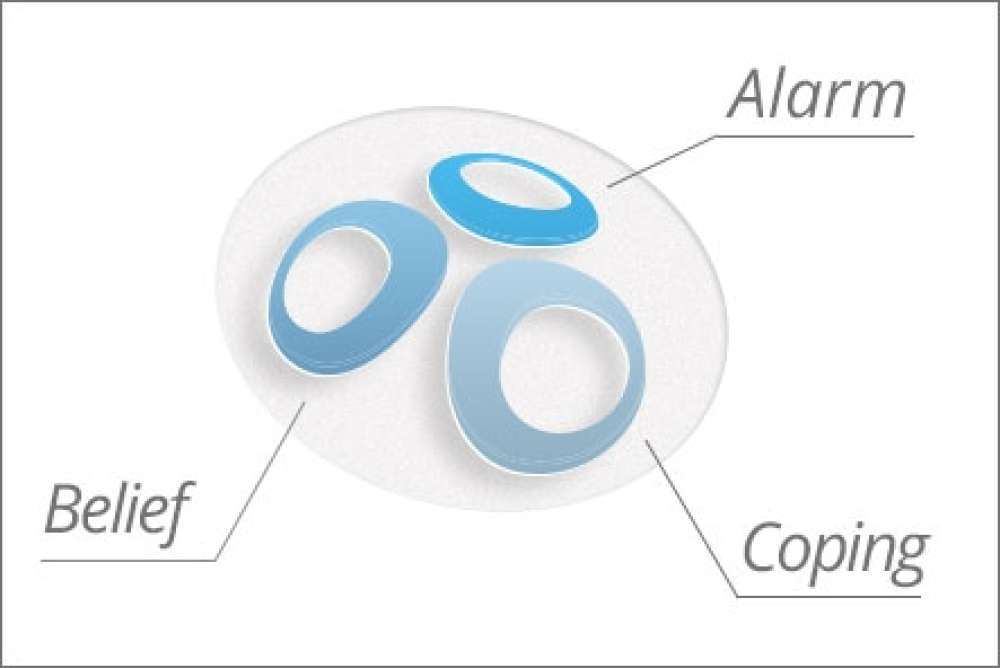
The C: Coping
"Coping" refers to any mechanism, conscious or unconscious, employed to restore a sense of safety. Coping strategies are the behavioral manifestation of our desire to escape discomfort. In the field of psychology, these strategies are broadly categorized as either adaptive or maladaptive.
- Adaptive Coping: These are constructive, long-term solutions that address the root cause of the anxiety. Examples include mindfulness meditation, physical exercise, cognitive restructuring, and professional therapy. These strategies allow individuals to process the emotion without being subsumed by it.
- Maladaptive Coping: These are short-term "quick fixes" that provide immediate relief but perpetuate the anxiety cycle in the long run. Common examples include avoidance of trigger situations, substance use, or excessive reassurance-seeking. While avoidance makes the person feel safe in the moment, it inadvertently reinforces the belief that the situation was, in fact, dangerous, thereby ensuring the alarm will sound even louder the next time.
Clinical Implications and Professional Oversight
The ABCtracker™ is not intended as a replacement for clinical therapy, but rather as a collaborative tool to be used in conjunction with guidance from physicians, psychologists, or licensed healthcare professionals.
The Path to Mastery
The journey toward emotional mastery is iterative. Every master begins as a beginner, and the ABCs are no exception. The process involves consistent tracking and reflection. By maintaining a log of these occurrences, patients can provide their therapists with high-quality data regarding their triggers, cognitive patterns, and behavioral responses.
This data-driven approach allows for more precise therapeutic interventions. For instance, if a patient consistently identifies a specific "Belief" that triggers an alarm, a therapist can utilize Cognitive Behavioral Therapy (CBT) to systematically dismantle that specific irrational thought.
Expert Insight: The Neurobiological Perspective
Dr. Carla Nasca, a distinguished researcher in Neuroendocrinology at The Rockefeller University, emphasizes that understanding these cycles is rooted in the body’s biological response to stress. Dr. Nasca, whose work spans molecular biology and neurobiology, notes that the interplay between our physiological alarms and our cognitive processing is a complex system involving hormonal and neural pathways.
Her research into the biological underpinnings of stress suggests that we are not merely "victims" of our biology. By understanding the "why" behind the alarm, we can begin to leverage our brain’s plasticity to change how we respond. When we identify and address the "Belief" and "Coping" phases of the cycle, we are effectively signaling to the nervous system that the threat is not imminent, thereby downregulating the stress response.
Implications for Modern Mental Health
The broader implication of the ABC approach is the democratization of mental health tools. For too long, the mechanics of anxiety have been shrouded in jargon, leaving the average person feeling powerless.
Moving Toward Proactive Management
- Normalization: By viewing anxiety as a standard human emotion with a logical structure (Alarm, Belief, Coping), we reduce the shame associated with the condition.
- Agency: The framework shifts the individual from a passive victim of anxiety to an active participant in their own recovery.
- Prevention: When practiced consistently, the ABCs serve as a preventative measure, helping individuals identify the early warning signs of a downward spiral before it escalates into a crisis.
Conclusion: A Lifetime of Learning
Just as one must practice the ABCs to master a language, one must practice the ABCs of anxiety to achieve emotional equilibrium. The transition from maladaptive, instinctive reactions to adaptive, thoughtful responses is a skill that requires repetition, patience, and professional support.
In an age characterized by unprecedented levels of stress and digital saturation, the need for accessible, evidence-based tools has never been greater. The ABCtracker™ represents a vital step forward in this endeavor. It provides a simple, structured, and effective way to parse the complex signals our bodies send us. By learning to name our alarms, challenge our beliefs, and choose our coping strategies with intention, we do more than just manage anxiety—we reclaim our ability to live fully, regardless of the challenges we face.
The path to mastery is rarely linear, but with the right tools in hand, it is entirely possible to navigate the complexities of the human experience with clarity, resilience, and newfound peace.