









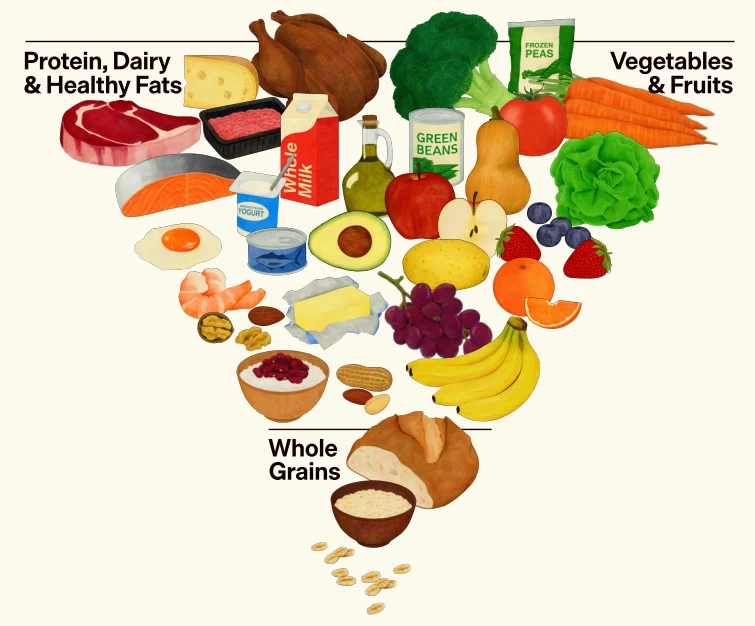
The release of the 2025–2030 Dietary Guidelines for Americans (DGAs) was met with immediate, polarized scrutiny from the scientific and public health communities. While the document carries a clear, headline-grabbing mandate to "eat real food" and imposes stricter limitations on added sugars and ultra-processed items, it has simultaneously ignited a firestorm of controversy. At the heart of the debate is a new visual graphic—a "flipped" pyramid—that seemingly prioritizes red meat, full-fat dairy, and butter, creating a jarring disconnect between the text of the guidelines and their visual representation.
For nutritionists, policy makers, and the average consumer, these inconsistencies are more than just aesthetic choices; they represent a fundamental challenge to the clarity required to curb the rising tide of diet-related chronic diseases in the United States.
Main Facts: The Core of the New Guidelines
The 2025–2030 edition of the DGAs introduces several significant shifts in how the federal government advises the public to eat. The overarching philosophy moves toward a "real food" paradigm, explicitly targeting the consumption of highly processed goods.
The War on Sugar and Processed Foods
For the first time in the history of the DGAs, the document explicitly calls out "highly processed foods" as a category to be minimized. While the definition remains somewhat flexible due to the broad spectrum of food processing, the guidelines are prescriptive in their targets: sugar-sweetened beverages, ready-to-eat snacks, and refined carbohydrates like white bread are explicitly discouraged.
Perhaps more aggressive is the stance on added sugars. The guidelines now state that no amount of added sugar or non-nutritive sweetener is considered part of a healthy diet. Most notably, the guidelines now advise that children avoid all added sugars until age 10, a dramatic shift from the previous threshold of age 2. The document also introduces a suggestion that no single meal should contain more than 10 grams of added sugar—a metric that, while well-intentioned, lacks practical implementation strategies for the average consumer.
The Protein Pivot
The new guidelines have significantly raised the recommended intake of protein, now suggesting 1.2 to 1.6 grams per kilogram of body weight per day. This represents a 50% to 100% increase over previous minimum recommendations. While the guidelines advocate for a "variety" of protein sources, they fail to distinguish between the health impacts of plant-based proteins and processed red meats, a move that critics argue ignores the "protein package"—the total nutritional composition, including fats and sodium, that accompanies the protein source.
Chronology: A Deviated Path to Publication
To understand the current controversy, one must look at the process behind the publication. The development of the DGAs typically follows a rigorous, five-year cycle led by an independent Dietary Guidelines Advisory Committee (DGAC). This committee, composed of esteemed nutrition scientists, is tasked with synthesizing current scientific evidence without political or industry interference.
- The Advisory Phase: The 2025–2030 DGAC conducted an extensive, two-year review of scientific literature, resulting in a comprehensive Scientific Report.
- The Rejection: In an unprecedented move, the current administration rejected the findings of the independent committee.
- The Supplemental Analysis: Rather than adhering to the committee’s report, the administration commissioned a "supplemental scientific analysis" conducted by a group of individuals selected via a federal contracting process.
- The Release: The final document was published in January 2026, incorporating this supplemental analysis. Critics, including former DGAC members, have highlighted a distinct lack of transparency regarding the methodology used in this supplemental report and have pointed to the disclosed financial ties between some of the selected reviewers and the beef and dairy industries.
Supporting Data: The Saturated Fat Paradox
The most contentious element of the new guidelines is the visual "New Food Pyramid." Despite the text maintaining the long-standing scientific consensus that saturated fat intake should be capped at 10% of total daily calories, the graphic features steak, cheese, and butter in prominent, high-volume positions.
The Mathematics of Saturated Fat
When one breaks down the "saturated fat math," the conflict becomes apparent. For a 2,000-calorie diet, the 10% limit allows for approximately 22 grams of saturated fat.
- The Dairy Baseline: The guidelines recommend three servings of dairy per day. If a consumer opts for the full-fat versions depicted in the pyramid (e.g., 8 oz of whole milk, 3/4 cup of full-fat Greek yogurt, and 1 oz of cheddar cheese), they reach 17 grams of saturated fat—nearly 80% of their daily limit—before consuming a single other food item.
- The Cooking Fat Trap: The addition of a single tablespoon of butter (7 grams) or beef tallow (6 grams) for cooking immediately pushes the consumer over the 10% threshold.
Dr. Frank Hu, chair of the Department of Nutrition at the Harvard T.H. Chan School of Public Health, warns that these mixed messages are dangerous. "The mixed messages surrounding saturated-fat-rich foods such as red meat, butter, and beef tallow may lead to confusion and potentially higher intake of saturated fat, which is directly linked to increased LDL cholesterol and cardiovascular risk," Hu stated.
Official Responses and Professional Skepticism
The response from the scientific community has been one of deep concern regarding the erosion of scientific integrity in the guidelines. Deirdre Tobias, an assistant professor at Harvard who served on the 2025–2030 DGAC, has been vocal about the process.
"There has not been transparency in who wrote the new DGAs," Tobias noted in a recent Q&A. She emphasized that the reviews conducted during the supplemental phase deviate significantly from the rigorous standards established by the HHS to ensure that recommendations remain replicable, unbiased, and free from non-scientific influences.
Furthermore, investigative reports have surfaced documenting that several contributors to the supplemental analysis have active financial ties to the beef and dairy industries. While these ties were disclosed in the appendix of the document, their influence on the visual hierarchy of the pyramid has raised questions about whether the guidelines are serving public health or private sector interests.
Implications for Public Health
The consequences of these guidelines extend far beyond academic disagreement.
The Confusion Factor
The public relies on these guidelines to inform school lunches, institutional food programs, and personal health choices. When a graphic suggests that steak and butter are foundational, while the text simultaneously warns about heart disease, the consumer is left in a state of paralysis or, worse, makes choices that inadvertently increase their risk of chronic disease.
Sustainability and Equity
A major criticism of this edition is the complete omission of environmental and socioeconomic factors. The production of red meat is significantly more resource-intensive than plant-based proteins, and dietary choices are heavily influenced by the food environment. By failing to address the environmental impact of diet—or the socioeconomic barriers that prevent many Americans from accessing "real food"—the guidelines fail to offer a holistic approach to the nation’s health.
The "Bottom Line" for Consumers
Historically, compliance with federal dietary guidelines in the U.S. has been low. This new, potentially confusing iteration may further alienate the public. Experts, including those at Harvard, continue to point toward the Healthy Eating Plate as a more reliable, science-based alternative to the government’s official guidance.
In summary, while the 2025–2030 DGAs take a commendable step forward by targeting ultra-processed foods and added sugars, the document is hampered by a lack of transparency in its creation and a baffling visual representation that contradicts its own nutritional warnings. Until federal guidance can reconcile the gap between industry influence and nutritional science, the responsibility for navigating a healthy diet remains, unfortunately, firmly in the hands of the individual consumer and their healthcare provider.