










The release of the 2025–2030 Dietary Guidelines for Americans (DGAs) marks a pivotal moment in federal nutrition policy. With a refreshed tagline—"eat real food"—and an explicit crackdown on the consumption of ultra-processed items and added sugars, the document arrives with the promise of modernizing American health. However, beneath the polished, consumer-friendly interface lies a complex web of contradictions, particularly regarding the role of saturated fats and the transparency of the guidelines’ development process. As health professionals and the public attempt to parse these new standards, questions regarding scientific rigor and the influence of industry interests have come to the forefront.
The Evolution of Federal Nutrition Standards: A Chronology
The Dietary Guidelines are intended to serve as the bedrock of U.S. federal nutrition programs, shaping everything from school lunch menus to public health initiatives. Every five years, the U.S. Departments of Agriculture (USDA) and Health and Human Services (HHS) undergo a rigorous update process.
Historically, this process begins with an independent Dietary Guidelines Advisory Committee (DGAC)—a panel of experts who synthesize the latest nutrition science. Their recommendations form the basis of the final policy. However, the 2025–2030 cycle deviated sharply from this tradition. After the original Committee released its comprehensive Scientific Report, the current administration opted to reject several of its core findings. Instead, a supplemental scientific analysis was conducted by a panel selected through a private federal contracting process.
This shift has sparked significant controversy. Critics, including former committee members, have highlighted a lack of transparency regarding the selection of these supplementary reviewers. Notably, reports have surfaced regarding the financial ties between some of these reviewers and the beef and dairy industries—a development that many experts argue is reflected in the final, "meat-forward" visual representation of the new guidelines.
The "New Food Pyramid": A Visual Contradiction
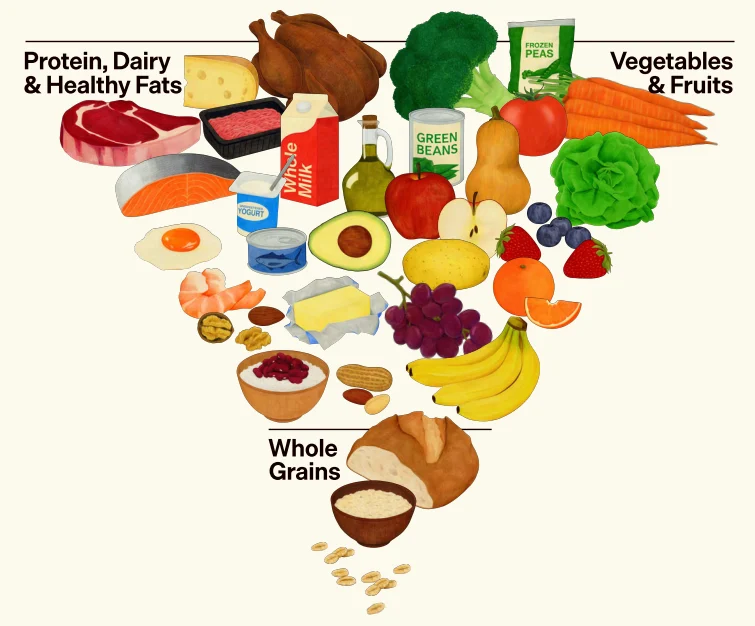
One of the most striking features of the 2025–2030 DGAs is the return of a pyramid-style graphic, albeit one that appears "flipped on its head." While previous iterations emphasized grains and produce, this new visual promotes a prominent role for steak, full-fat milk, and butter.
For the average consumer, this visual hierarchy creates a jarring disconnect. While the written text of the Guidelines maintains the long-standing scientific consensus—that saturated fat intake should not exceed 10% of total daily calories—the visual emphasis on animal products suggests a more permissive approach. Dr. Frank Hu, chair of the Department of Nutrition at the Harvard T.H. Chan School of Public Health, warns that this "mixed messaging" is not merely a stylistic choice; it carries real-world consequences for cardiovascular health.
"The visual prominence of saturated-fat-rich foods could lead to confusion and a potentially higher intake of saturated fats, which is a known driver of elevated LDL cholesterol and cardiovascular risk," says Dr. Hu.
Unpacking the Key Policy Shifts
The 2025–2030 DGAs do introduce some positive, albeit narrow, improvements in public health guidance.
1. Targeting "Highly Processed" Foods
For the first time, the DGAs explicitly target the broad category of "highly processed" foods. While the term remains somewhat nebulous—as food processing exists on a spectrum—the guidance provides actionable advice: avoid sugar-sweetened beverages and reduce reliance on packaged, salty, or sweet snacks. The emphasis on fiber-rich whole grains over refined carbohydrates like white bread represents a move toward more nutrient-dense dietary patterns.
2. A Strict Stance on Added Sugars
The new edition takes a notably hard line on sugar. It explicitly states that "no amount of added sugars or non-nutritive sweeteners is recommended or considered part of a healthy or nutritious diet." Furthermore, the guidelines now recommend that children avoid added sugars entirely until age 10—a significant jump from the previous age-two threshold. While this goal is laudable, critics point out that the Guidelines fail to provide a practical roadmap for families to implement these restrictions in an environment where added sugar is ubiquitous in the food supply.
3. The Math of Saturated Fat
The disconnect between the 10% saturated fat limit and the recommended serving sizes remains a point of contention. In a 2,000-calorie diet, the 10% cap equates to approximately 22 grams of saturated fat. If a consumer follows the DGAs’ recommendation for three servings of dairy—opting for the full-fat versions highlighted in the pyramid—they reach 17 grams of saturated fat before considering cooking fats or protein sources. Adding a tablespoon of butter or beef tallow, both suggested in the guidelines, pushes the consumer well over the threshold, even before factoring in other meals.
The Protein Paradox
The 2025–2030 guidelines suggest a significant increase in recommended protein intake, moving to 1.2–1.6 grams per kilogram of body weight. This is a 50–100% increase over previous minimum intake recommendations. While protein is essential for muscle maintenance and metabolic health, the guidelines lack nuance regarding the "protein package."
"Substantially raising overall protein intake without distinguishing between different protein sources may have unintended long-term health implications," Dr. Hu notes. When consumers select protein, they are also consuming the accompanying saturated fats, sodium, and lack of fiber found in certain meats. Evidence consistently shows that plant-based proteins and fish are associated with superior health outcomes compared to diets heavy in red meat, yet the new DGAs treat these sources as largely interchangeable.
Implications for Public Health
The impact of these guidelines extends far beyond the federal level; they shape the American palate and the national food economy. The omission of environmental and socioeconomic considerations remains a glaring weakness. As food production systems face increasing pressure from climate change, the refusal of the DGAs to link dietary choices with planetary health is viewed by many sustainability experts as a missed opportunity.
Furthermore, the lack of transparency in the development process has undermined the credibility of the document among academic researchers. Deirdre Tobias, an assistant professor at Harvard who served on the original 2025–2030 Advisory Committee, has been vocal about the departure from rigorous, peer-reviewed standards. "There is no transparency in the methodology and rigor that was employed," Tobias stated in a recent Q&A. "The reviews themselves deviate significantly from the rigorous process… [needed] to ensure the evidence base and its conclusions were replicable, unbiased, and free from non-scientific influences."
Conclusion: A Call for Caution
While the 2025–2030 Dietary Guidelines for Americans take a firm stand against the most egregious offenders in the American diet—specifically added sugars and ultra-processed snacks—the overall document is marred by internal inconsistencies and a visual hierarchy that contradicts established cardiovascular science.
For the average American, the message is effectively bifurcated. On one hand, the text encourages a return to whole, unprocessed foods. On the other, the "New Food Pyramid" offers a blueprint that could inadvertently increase the intake of saturated fats and decrease the consumption of essential nutrients found in whole grains and legumes.
Given the history of low compliance with federal dietary guidelines, it remains to be seen whether this edition will move the needle on the nation’s chronic disease epidemic. However, the expert consensus remains clear: consumers should look beyond the catchy taglines and simplified graphics. For those seeking to optimize their health, the most reliable path remains a diet centered on whole plant foods, healthy unsaturated fats, and high-quality protein sources, guided by evidence-based resources like the Healthy Eating Plate rather than the potentially industry-influenced "New Food Pyramid." As the country moves into this new cycle of nutrition policy, the need for independent, transparent, and science-driven guidance has never been more urgent.