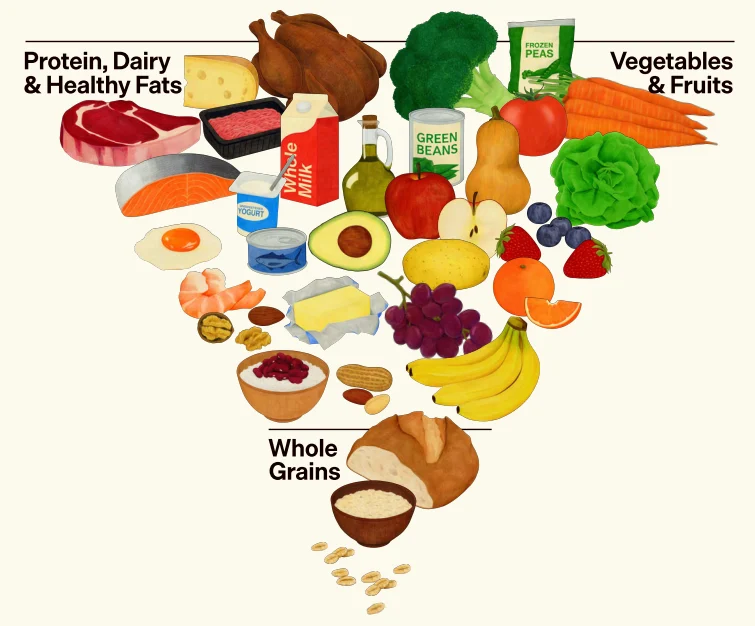
The release of the 2025–2030 Dietary Guidelines for Americans (DGAs) was met with high anticipation, arriving under the banner of "eat real food." Designed to serve as the cornerstone of federal nutrition policy, these guidelines aim to steer the American public toward healthier eating patterns. However, the latest iteration has sparked intense debate among public health experts, nutritionists, and policy analysts. While the document makes significant strides in addressing the perils of ultra-processed foods and added sugars, it simultaneously introduces a visual hierarchy that critics argue undermines established cardiovascular health science.
The Main Facts: A Shift in Tone and Visuals
The 2025–2030 edition is distinct in its presentation. It is leaner, more consumer-oriented, and accompanied by an interactive digital suite. Central to this launch is the "New Food Pyramid"—a graphic that flips the traditional model on its head. While the base of the pyramid rightfully emphasizes fruits and vegetables, the mid-to-upper sections place a visual premium on animal-derived products, including steak, full-fat dairy, and butter.
For the average consumer, this imagery creates an immediate cognitive dissonance. The visual prominence of saturated-fat-heavy items suggests a departure from the long-standing scientific consensus that limits saturated fat intake to 10% of total daily calories. Yet, the written text of the guidelines remains technically aligned with this 10% cap. This "visual-textual gap" represents the primary point of contention for nutrition experts, who fear that the simplicity of the graphic will overshadow the complexity of the dietary advice.
Chronology: The Road to a Disputed Document
The development of the DGAs is typically a rigorous, multi-year process overseen by the U.S. Departments of Agriculture (USDA) and Health and Human Services (HHS). Traditionally, this involves an independent Dietary Guidelines Advisory Committee (DGAC)—a panel of experts tasked with synthesizing current nutritional science without interference.
- Evidence Synthesis: The DGAC spent two years conducting a comprehensive review of the latest literature, resulting in a robust Scientific Report.
- Administrative Intervention: In a departure from established precedent, the findings of the expert-led committee were effectively set aside or "relitigated" by the administration.
- The Supplemental Analysis: Instead of relying solely on the DGAC’s report, a new, separate scientific analysis was commissioned. This process utilized a "federal contracting process" rather than the traditional committee structure.
- Launch: The final 2025–2030 Guidelines were released in early 2026, incorporating these supplemental findings, which included input from reviewers who have disclosed financial ties to the beef and dairy industries.
This shift has led to vocal criticism regarding the lack of transparency in the methodology used to create the final document. As Dr. Deirdre Tobias, a member of the original 2025–2030 DGAC, noted, the process deviated from the replicable and unbiased standards typically required to ensure that government nutrition policy remains free from non-scientific or industry-driven influence.
Supporting Data: The Saturated Fat Conundrum
To understand the potential impact of the new guidelines, one must look at the "saturated fat math." A standard 2,000-calorie diet allows for roughly 22 grams of saturated fat daily. The new DGA visual suggestions, if followed strictly, pose an immediate risk of exceeding this threshold.
For example, if a consumer adopts the recommended three daily servings of dairy—opting for the "full-fat" versions featured in the imagery—they could consume 17 grams of saturated fat from milk, yogurt, and cheese alone. Adding a single tablespoon of butter or beef tallow—both explicitly featured as suggested cooking fats in the new materials—adds another 6 to 7 grams. The consumer has effectively hit or exceeded their daily limit before accounting for any other proteins or incidental fats consumed throughout the day.
Dr. Frank Hu, chair of the Department of Nutrition at the Harvard T.H. Chan School of Public Health, warns that this creates a dangerous contradiction. "The mixed messages surrounding saturated-fat-rich foods may lead to confusion and potentially higher intake of saturated fat, which is directly linked to increased LDL cholesterol and cardiovascular risk," Dr. Hu stated.
Official Responses and Expert Critique
The scientific community’s response has been largely one of cautious critique. While experts applaud the guidelines for finally taking a harder stance on "highly processed" foods—a term that encompasses sugar-sweetened beverages and refined, low-fiber carbohydrates—they remain troubled by the broader implications of the document’s structure.
On Protein and Quality
The guidelines suggest a significant increase in daily protein intake, now targeting 1.2 to 1.6 grams per kilogram of body weight. While this may benefit specific demographics, such as the elderly or high-performance athletes, experts warn that a blanket recommendation for the general population ignores the "protein package." When we consume protein, we also consume the fats, sodium, and fiber attached to it. The guidelines fail to distinguish between the health benefits of plant-based proteins or fish versus the inflammatory potential of processed red meats.
On Alcohol
The guidelines offer the advice to "consume less alcohol for better health." However, the lack of a quantitative definition for "less" leaves the public without actionable guidance. In public health, vagueness is often the enemy of behavior change.
On Environmental Sustainability
A significant omission in this edition is the lack of consideration for the environmental impact of food choices. As the global scientific community increasingly highlights the connection between dietary patterns and planetary health, the decision to exclude sustainability metrics leaves the U.S. DGAs lagging behind international standards.
Implications for the American Public
The ultimate goal of the DGAs is to provide a roadmap for a healthier nation. However, history shows that Americans struggle to adhere to these guidelines even when they are clear. The 2025–2030 edition, with its contradictory messaging and potential industry influence, faces an uphill battle in credibility.
For the average consumer, the implications are three-fold:
- Conflicting Signals: The visual "New Food Pyramid" may encourage dietary habits that contradict the written health goals regarding saturated fat.
- The "Highly Processed" Trap: While the move away from refined grains and added sugars is a positive development, the lack of clarity on what constitutes a "healthy" processed food remains a hurdle for shoppers navigating complex supermarket aisles.
- The Need for Independent Guidance: Given the political and industry-related tensions that shaped this document, there is a growing need for consumers to rely on independent, evidence-based resources. Tools like the Healthy Eating Plate, developed by researchers at the Harvard T.H. Chan School of Public Health, offer a more consistent, science-backed alternative that prioritizes whole foods and healthy fats without the influence of commercial interests.
Conclusion
The 2025–2030 Dietary Guidelines represent a paradoxical moment in American nutrition policy. On one hand, the government has taken a commendable, long-overdue step in explicitly calling out the dangers of ultra-processed foods and added sugars. On the other, the inclusion of a confusing, potentially misleading visual guide that promotes high-saturated-fat foods—coupled with the lack of transparency regarding the drafting process—casts a shadow over the document’s scientific integrity.
As the nation grapples with rising rates of diet-related chronic diseases, the role of federal guidance has never been more critical. Whether these guidelines will effectively steer the public toward better health or merely contribute to the existing confusion remains to be seen. For now, the most prudent path for the informed consumer is to prioritize whole, plant-forward nutrition and seek personalized advice from registered dietitians rather than relying solely on a government-issued graphic that may be more influenced by policy than by biology.