










By Anil Oza
May 21, 2026
Introduction: A High-Stakes Confrontation on Capitol Hill
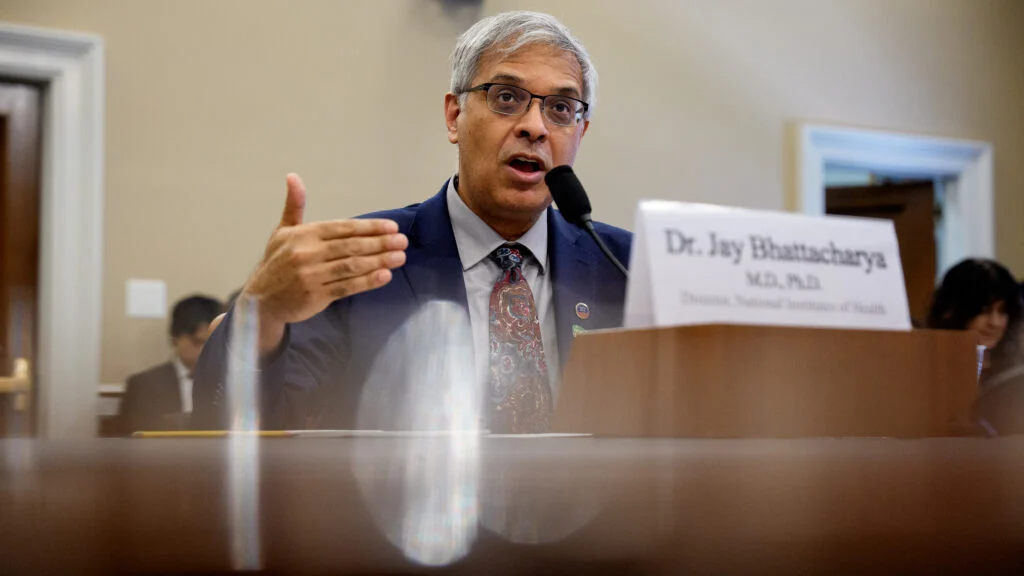
The halls of the Senate Appropriations Committee were charged with tension on Wednesday morning as National Institutes of Health (NIH) Director Jay Bhattacharya appeared before lawmakers. The hearing, which commenced at 10 a.m. ET, serves as a pivotal moment in the ongoing fiscal tug-of-war between the Trump administration and the nation’s premier biomedical research agency.
At the center of the discourse is President Trump’s fiscal year 2027 budget proposal, a document that has sent shockwaves through the scientific community. Released in April, the administration’s blueprint calls for a staggering $5 billion reduction in NIH funding and the wholesale elimination of five of the agency’s 27 research institutes. While seasoned observers on Capitol Hill suggest these drastic measures are unlikely to clear the legislative hurdle, the very presence of such proposals has catalyzed an atmosphere of profound uncertainty and institutional stress.
Chronology: A Trajectory of Fiscal Turbulence
To understand the current crisis, one must look at the recent timeline of the NIH’s fiscal erosion:
- Early 2026: A STAT survey of NIH-funded researchers reveals widespread instability, with 43% of investigators canceling planned projects and nearly half forced to reduce the scope of their ongoing studies.
- March 2026: Data emerges highlighting a significant "slowdown" in grant distribution, with new awards and training grants languishing in administrative limbo.
- April 2026: The Trump administration officially releases the FY2027 budget proposal, formalizing the $5 billion cut and the consolidation plan for the agency’s institutes.
- May 2026: As of May 17, internal data revealed that the NIH had only allocated $10.09 billion of its $47 billion budget, a significant dip compared to historical averages for the same period.
- May 21, 2026: Director Bhattacharya appears before the Senate to defend the budget, joined by a delegation of institute directors amid growing concerns regarding the agency’s leadership vacuum.
Supporting Data: The Anatomy of a Research Slowdown
The fiscal challenges facing the NIH are not merely theoretical; they are manifesting as tangible disruptions in laboratories across the United States.
The Spending Gap
According to data provided by Grant Witness, the current pace of NIH spending is alarmingly sluggish. By mid-May, the agency had distributed roughly $10.09 billion of its $47 billion appropriation. In stark contrast, between 2021 and 2024, the NIH had spent an average of $14.75 billion by this point in the fiscal year. This nearly $4.7 billion shortfall represents a significant bottleneck that has left scientists waiting for funds that are, on paper, already available.
The Human Cost of Austerity
The impact of this fiscal strategy is best illustrated by the researchers themselves. A comprehensive survey conducted earlier this year painted a bleak picture of the current research environment:
- Layoffs: More than a quarter of surveyed researchers reported having to lay off lab personnel, including post-doctoral fellows and technicians.
- Project Attrition: 43% of respondents confirmed that they had abandoned planned projects entirely.
- Scope Reduction: Approximately 50% of labs have had to scale back the depth or breadth of their ongoing investigations.
These metrics suggest that even when the budget is "held steady" on paper, the strategic allocation of those funds by the White House has led to a functional reduction in output, particularly in grant-dependent sectors.
Leadership Instability: A Hollowed-Out Agency
One of the most vocal concerns from the Senate Appropriations Committee—shared across both sides of the aisle—is the current leadership structure of the NIH.

Director Bhattacharya was accompanied at the hearing by five of the 12 remaining permanent institute directors: Richard Hodes, Anthony Letai, Griffin Rodgers, Joni Rutter, and Nora Volkow. This group represents a dwindling cohort of institutional memory. Currently, 15 of the NIH’s 27 institutes are led by "acting" directors.
Senators have expressed grave concern that this vacuum of permanent leadership impairs the agency’s ability to conduct long-term strategic planning. "How can we expect a research agency to navigate a $5 billion budget cut when over half of its constituent institutes lack a confirmed, permanent head?" asked one committee member during the morning session. The presence of acting directors, who often lack the authority or the mandate to initiate major policy shifts, is being viewed by many as a deliberate tactic to further neutralize the agency’s influence.
Official Responses and Political Implications
During the hearing, Director Bhattacharya attempted to frame the budget proposal as an effort to streamline operations and eliminate administrative redundancies. He argued that the NIH must become more efficient in the wake of the post-pandemic fiscal landscape.
However, the response from the Senate was notably chilly. Many lawmakers reminded the Director that the 2026 budget proposal—which featured even steeper cuts—was rejected by Congress last year. There is a strong, bipartisan sentiment that the NIH is a pillar of national security and economic growth.
"Biomedical research is not a line item to be slashed for political theater," noted a senior ranking member of the committee. "The disruptions we are seeing in laboratories today are the direct result of a White House policy that seems intent on de-prioritizing long-term scientific investment."
The Broader Implications
The implications of this struggle extend far beyond the NIH campus in Bethesda. The uncertainty surrounding grant funding is forcing a "brain drain" as young researchers look toward the private sector or international institutions for stability. Furthermore, the delay in funding new awards means that breakthroughs in oncology, neurology, and infectious diseases are being deferred, with unknown consequences for public health outcomes in the coming decade.
Conclusion: The Road Ahead
As the hearing continues, the NIH remains in a state of suspended animation. While the Senate is widely expected to reject the most draconian aspects of the FY2027 proposal—much as they did with the previous year’s attempt—the damage caused by the current "slow-walk" of funds and the climate of instability is already evident.
The biomedical research community is watching closely, waiting to see if the NIH can regain its footing or if it will continue to be a casualty of the broader political polarization. For now, the message from the research community is clear: a budget is more than just a ledger—it is a statement of national priorities. As the Senate Appropriations Committee weighs the future of the NIH, the question remains whether they will choose to protect the infrastructure of American science or allow it to be dismantled, piece by piece, under the guise of fiscal discipline.
The outcome of these hearings will not only determine the budget for 2027 but will likely set the tone for the relationship between the executive branch and the scientific establishment for the remainder of the decade. As the testimony continues, the primary concern for many remains the same: how much of the agency’s institutional capacity can be lost before the damage becomes irreversible?