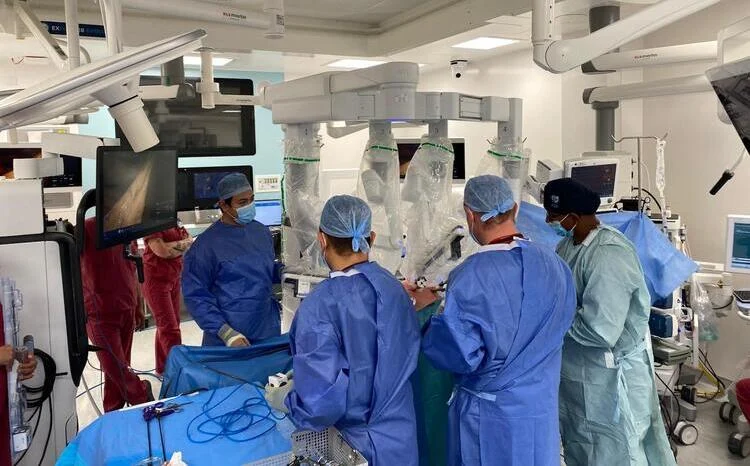
In a landmark advancement for clinical outcomes within the National Health Service (NHS), the West Hertfordshire Teaching Hospitals NHS Trust has officially integrated the Intuitive DV5 (da Vinci 5) robotic surgical platform into its daily operations. This state-of-the-art technology, designed to push the boundaries of minimally invasive procedures, is not merely an upgrade in hardware; it represents a fundamental shift in the surgical philosophy of the Trust. By leveraging enhanced tactile feedback, high-definition 3D visualization, and a robust remote-monitoring infrastructure, the Trust aims to address the dual challenges of surgical backlogs and prolonged patient recovery times.
The Technological Leap: What is the Intuitive DV5?
The Intuitive DV5 platform stands as the fifth generation of the da Vinci surgical system, a series that has redefined the landscape of robotic-assisted surgery over the past two decades. However, the DV5 introduces features that address the "sensory gap" that has historically existed between a surgeon and their instruments.
Unlike its predecessors, the DV5 provides surgeons with force-feedback technology. This allows the surgeon to physically "feel" the resistance of the tissue as they operate. In clinical terms, this means the surgeon can apply significantly less force, reducing the likelihood of inadvertent trauma to healthy tissue. By minimizing the physiological footprint of an incision, the system inherently reduces the risk of postoperative complications, infections, and inflammation.
For the patient, the clinical implication is profound. The reduction in tissue trauma translates directly to a faster recovery trajectory. Patients who might have previously spent several days in recovery are now, in some instances, being discharged within 24 hours of complex procedures, such as bowel cancer resections.
Chronology: A Trajectory of Innovation
The implementation of the DV5 is the latest chapter in a long-term strategic investment by West Hertfordshire Teaching Hospitals.
- Pre-2022: The Trust began laying the groundwork for a comprehensive robotic programme, recognizing that surgical efficiency would be the key to managing post-pandemic waiting lists.
- March 2022: The Trust formally committed to expanding its robotic surgery footprint, aligning with national NHS initiatives to embrace digital health and automation.
- Mid-2024: Following international regulatory approvals, the Trust secured the acquisition of the DV5, marking the beginning of an intensive training and integration period for surgical staff.
- 2025 (Current Phase): The system is now fully operational at Watford General Hospital. Simultaneously, the Trust has executed a logistical pivot, relocating its previous-generation robotic system to St Albans City Hospital to handle high-volume, day-case procedures.
This phased rollout demonstrates a "hub-and-spoke" model of surgical care, where the most complex, high-acuity surgeries are performed with the newest technology at the flagship site, while secondary systems are repurposed to optimize throughput across the wider Trust.
Supporting Data and Clinical Scope
The application of the DV5 is wide-ranging, targeting some of the most challenging areas of surgical oncology and general surgery. The platform is currently being utilized for:
- Colorectal Oncology: Specifically focusing on complex bowel cancer resections.
- Urological Oncology: Kidney cancer surgeries that require extreme precision.
- General Surgery: Gallbladder removals and complex hernia repairs.
The efficacy of this system is bolstered by the integration of the Trust’s "Virtual Hospital." By combining robotic precision with remote digital monitoring, the Trust is moving toward a model of "hospital-at-home." Patients recovering from major surgery are monitored via wearable technology that tracks vitals, allowing clinical teams to intervene early if a complication arises. This continuous loop of data—from the operating theatre to the patient’s home—is transforming the definition of a "successful surgery" from a successful procedure to a successful, home-based recovery.
The Surgeon’s Perspective: Dr. Vanash Patel
Dr. Vanash Patel, a consultant colorectal surgeon and the lead of the Trust’s robotic programme, serves as the primary advocate for this technological integration. For Dr. Patel, the motivation is deeply human-centric.
"What patients care most about is when they’ll be able to get back to normal after surgery," Dr. Patel stated. "The fatigue and tiredness from an operation can last up to two months in some cases, and that creates uncertainty and stress for many patients who worry about when they can get back to work and effectively restart their lives again."
Dr. Patel emphasizes that the DV5 is not just about faster throughput; it is about restoring the quality of life for the patient. By mitigating the "surgical hit" on the body, the system reduces the physiological fatigue that often plagues cancer patients. He argues that the combination of the DV5 and the culture of innovation at West Herts has created a "centre of excellence" that is drawing global attention. Surgeons from as far as India and the United States have visited the Trust to observe the workflow, proving that the NHS remains a leader in surgical innovation.
Implications for the NHS and Healthcare Policy
The integration of the DV5 carries significant implications for the broader NHS landscape, particularly in the context of record-breaking waiting lists.
1. Throughput and Efficiency
By moving the previous robotic system to St Albans City Hospital, the Trust has effectively increased its total surgical capacity. This allows for a more streamlined scheduling process, where complex cases (which require more theatre time) do not crowd out simpler, high-volume day cases. This modular approach to surgical resources could serve as a template for other Trusts across the UK.
2. Global Connectivity and Training
One of the most transformative features of the DV5 is its high-definition 3D vision system. This is not only for the operating surgeon; the system allows for remote viewing, meaning a specialist from another hospital—or even another continent—can virtually "scrub in" to provide guidance. This democratization of expertise is a game-changer for rare or highly complex cases, where a local surgeon might benefit from the real-time mentorship of a world-renowned expert.
3. Culture Change as a Prerequisite
Dr. Patel is careful to note that technology is only one part of the success story. "Our focus has been on training, upskilling, and culture change," he says. The success of the robotic programme at West Herts relies on a "joined-up" approach where multidisciplinary teams—nurses, anaesthetists, physiotherapists, and surgeons—work in unison. The transition to robotic surgery requires a shift in how operating theatre teams communicate and how postoperative care is managed. Without this organizational cultural shift, the high-tech equipment would remain underutilized.
Future Outlook: The Virtual Hospital and Beyond
As the Trust continues to refine its use of the DV5, the long-term goal is clear: to make surgery as minimally disruptive as possible. The use of wearable technology within the Virtual Hospital is perhaps the most exciting frontier. By shifting the recovery process from an expensive, resource-heavy inpatient environment to the comfort of the patient’s home, the Trust is freeing up hospital beds for those who need them most.
The financial and clinical burden of postoperative complications is a significant issue for the NHS. By utilizing the precision of the DV5, the Trust expects to see a marked decrease in readmission rates. If a patient recovers faster and experiences fewer complications, the cost-benefit analysis of such a high-end investment becomes clear: the initial capital outlay is offset by long-term savings in ward costs and increased patient turnover.
Conclusion
The deployment of the Intuitive DV5 at West Hertfordshire Teaching Hospitals NHS Trust is a testament to the power of combining cutting-edge robotics with a patient-first philosophy. By focusing on the entire patient journey—from the moment of surgery to the final days of recovery at home—the Trust is providing a blueprint for the future of elective and cancer surgery.
As the NHS continues to navigate the complexities of modern medicine and demographic pressures, the integration of systems like the DV5 will be essential. It is a clear signal that the future of surgery is not just about the size of the incision, but the speed of the return to a life well-lived. For the patients in West Hertfordshire, the future is already here, and it is defined by a higher standard of care, faster recovery times, and the reassuring expertise of a team that has embraced the robotic age with open arms.