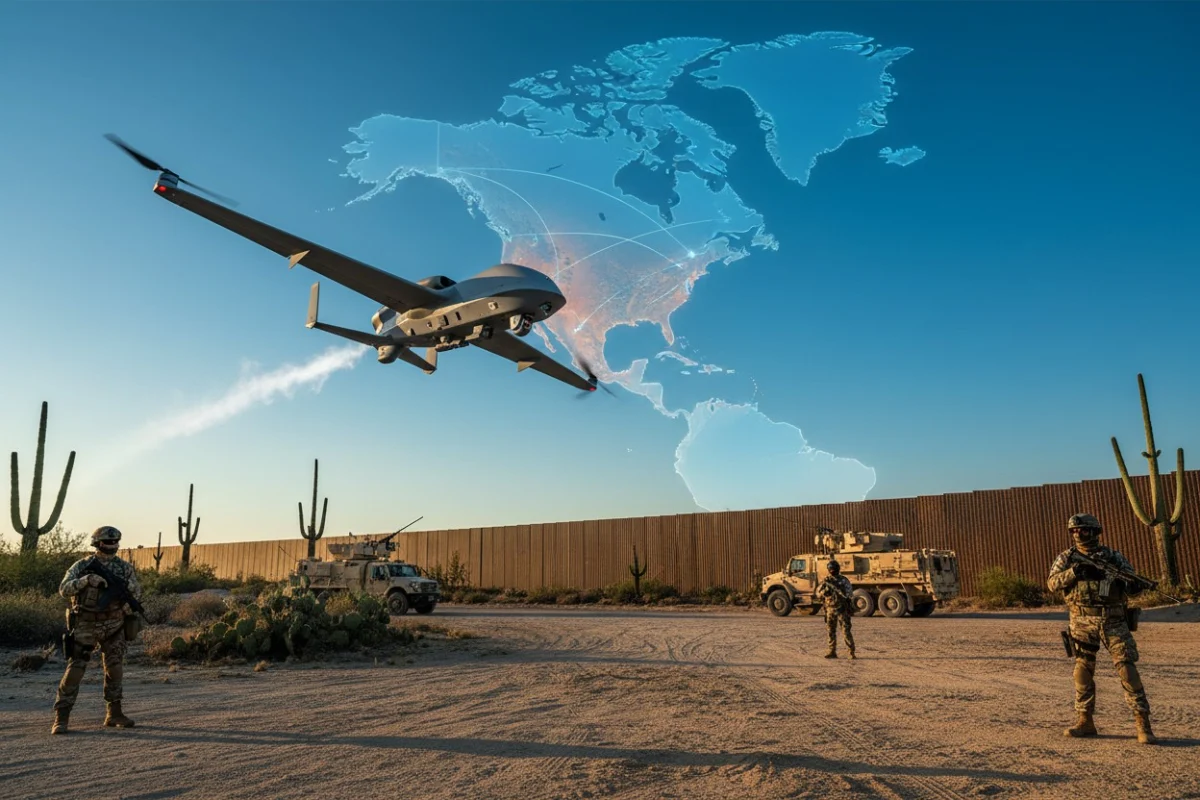
WASHINGTON, D.C. — The Trump administration has effectively shelved plans for unilateral U.S. airstrikes on Mexican soil, marking a significant recalibration of the White House’s strategy toward its southern neighbor. According to reports from the New York Times citing both U.S. and Mexican officials, the administration has paused preparations for direct military action, opting instead to prioritize enhanced intelligence sharing and collaborative security operations.
While the White House has yet to issue a formal statement confirming the cessation of strike planning, the move signals a notable departure from the aggressive rhetoric that defined the early months of President Donald Trump’s second term. The shift appears to be driven by a measurable decrease in illegal border crossings and a burgeoning diplomatic alignment between Washington and Mexico City, effectively shifting the administration’s primary geopolitical pressure point toward Canada.
A Belligerent Beginning: The Rhetoric of Kinetic Intervention
The threat of military intervention in Mexico was a cornerstone of President Trump’s campaign and early governance strategy. In January 2026, during an interview with Fox News host Sean Hannity, the President articulated a bold vision for the border, stating that the U.S. would begin "hitting land" against the cartels. This followed earlier declarations in November 2025, where Trump expressed a willingness to target cartel infrastructure directly, claiming the U.S. possessed the "addresses of every drug lord."
These were not merely empty threats. Behind the scenes, the administration had been orchestrating a systematic pressure campaign. In August 2025, a classified directive instructed the Department of Defense to finalize operational plans for lethal strikes against cartels by mid-September. This military buildup was supported by the formal designation of the Jalisco New Generation Cartel (CJNG), the Juárez cartel, and Los Viagras as Foreign Terrorist Organizations (FTOs), providing the legal framework necessary for potential kinetic operations.
Chronology of Escalation and Cooperation
The trajectory of the U.S.-Mexico relationship over the past two years has been a volatile mix of threats, sanctions, and unprecedented cooperation.
- December 2024: President-elect Trump issues a $15 million bounty for the capture of CJNG leader Nemesio Rubén Oseguera Cervantes, known as "El Mencho."
- August 2025: The Pentagon receives a directive to prepare for lethal operations inside Mexico.
- February 2026: In a major intelligence victory, U.S. assets assist Mexican special forces in a high-stakes operation to capture "El Mencho." The operation, which resulted in the cartel leader’s death and the loss of over 70 lives, serves as a turning point in bilateral security cooperation.
- July 2026: Secretary of State Marco Rubio announces the formal designation of two additional cartels as FTOs.
- August 2026: The U.S. and Mexico launch joint "mirror" patrols along the border, utilizing armored vehicles and specialized military units. Simultaneously, the U.S. military utilizes high-energy laser systems to neutralize cartel drones near the Texas border.
- September 2026: Following a direct line of communication between President Trump and President Claudia Sheinbaum, the White House signals that strike plans are being shelved in favor of a new, comprehensive trade and security agreement.
The "El Mencho" Operation: A Catalyst for Change
The death of "El Mencho" in February 2026 stands as the most significant event in the recent history of the drug war. While the operation was a tactical success, it triggered a wave of retaliatory violence that engulfed large swaths of Mexico. CJNG operatives, reeling from the loss of their leader, launched reprisal attacks that left hundreds of locations in flames, including tourist hubs in Puerto Vallarta.
Despite the chaos, the operation solidified the utility of U.S. intelligence in Mexican security efforts. Reports indicate that the CIA and other intelligence agencies have been providing real-time data on fentanyl production labs, while the U.S. Navy has increased reconnaissance flights off the Pacific coast. This level of cooperation suggests that while the "kinetic" option of airstrikes is off the table, the U.S. has moved toward a model of "shadow intervention"—where American intelligence and technology guide Mexican forces rather than U.S. munitions.
Economic Leverage and Targeted Sanctions
The Trump administration’s strategy has relied heavily on the use of economic statecraft to supplement security goals. The Treasury Department has aggressively expanded its sanctions regime, moving beyond known cartel leaders to target the financial infrastructure of the drug trade. This has included sanctions on tequila manufacturers and even niche enterprises like baby shoe companies suspected of money laundering for the CJNG.
Trade tensions have served as a barometer for security cooperation. The brief suspension of avocado inspections in Michoacán in August 2026 sent a clear message to the Mexican government regarding the necessity of securing supply chains. However, as of late 2026, the rhetoric has softened. President Trump recently touted the "great strides" made with the Mexican government at the United Nations, suggesting that the administration is satisfied with the current level of cooperation.
Implications: The Risk of a "Quagmire"
Despite the apparent improvement in relations, the potential for future escalation remains a subject of intense debate among security analysts. Critics of the administration’s earlier, more aggressive posture have warned that a move toward kinetic conflict would have been catastrophic.
Mike Adams, a vocal commentator on security affairs, warned in a February 2025 broadcast that normalization of military conflict within Mexico could lead to a scenario akin to the Vietnam War. "Mexico becomes Vietnam," Adams argued, "a quagmire from which there’s no easy escape." The concern is that while airstrikes might temporarily cripple cartel logistics, they would likely trigger a permanent state of insurgency, drawing the United States into a multi-year conflict that would necessitate a massive increase in ground troops.
Furthermore, the economic interdependence between the U.S. and Mexico makes a sustained military conflict highly damaging to the American consumer. Any disruption to the border—the world’s busiest—would have immediate, inflationary consequences for the U.S. economy, potentially neutralizing the political gains the administration has made on domestic security.
The Path Forward: Diplomacy over Destruction
As the U.S. enters the final quarter of 2026, the focus has pivoted toward international pressure on supply chains. Recent developments involving China, which has agreed to implement new export permits for precursor chemicals, suggest that the Trump administration is viewing the fentanyl crisis through a broader, global lens rather than purely as a border security issue.
The current strategy appears to be a hybrid: heavy economic pressure, targeted intelligence-driven operations by local forces, and high-level diplomatic negotiation. For now, the prospect of U.S. warplanes over Mexican territory has been averted. Whether this détente can survive the next inevitable surge in cartel violence remains to be seen. For the inhabitants of border communities and the leadership in Mexico City and Washington, the shift from a war footing to a diplomatic one offers a rare, if fragile, opportunity for stability in a region long plagued by the shadow of the cartels.
The administration’s decision to shelve the strikes is not merely a tactical pivot—it is a recognition of the limits of unilateral military force in an era of complex, transnational organized crime. By betting on the stability of the current Mexican government and the efficacy of joint patrols, Washington is attempting to craft a durable solution that avoids the risks of a localized war while maintaining the pressure necessary to curb the flow of illicit substances.