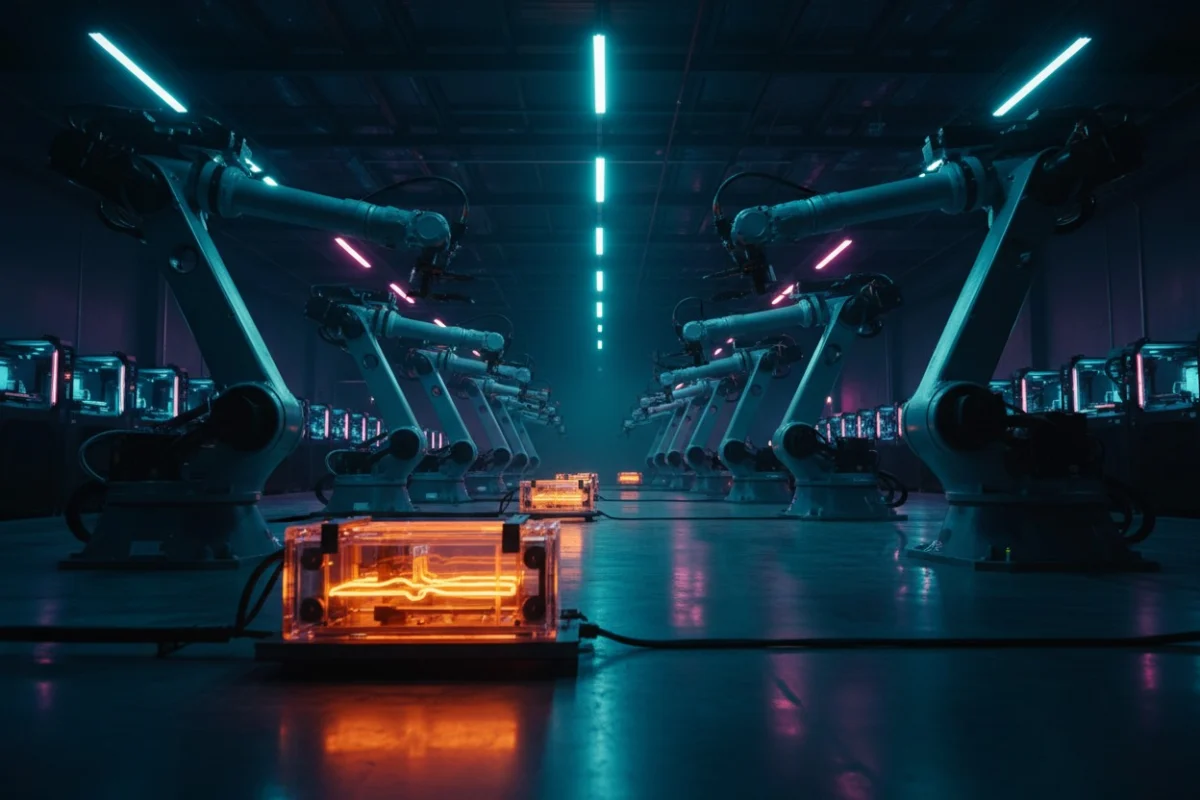
A paradigm shift in industrial production is currently rattling the foundations of the global economy. A newly published manifesto, The Void Age Bootstrap Protocol by Daniel D. Lee, has introduced an open-source framework for "dark factories"—fully automated, decentralized manufacturing hubs capable of operating with minimal human oversight and, crucially, without reliance on the proprietary cloud and logistics monopolies of Big Tech.
As the world grapples with fragile supply chains and rising geopolitical instability, Lee’s work provides more than just a theoretical framework; it offers a technical roadmap for communities to bypass the centralized systems that have governed industrial output for decades. By leveraging robotics, AI-driven logistics, and advanced localized energy storage, the protocol suggests that the era of the monolithic supply chain may be drawing to a close.
The Core Concept: The Dark Factory Revolution
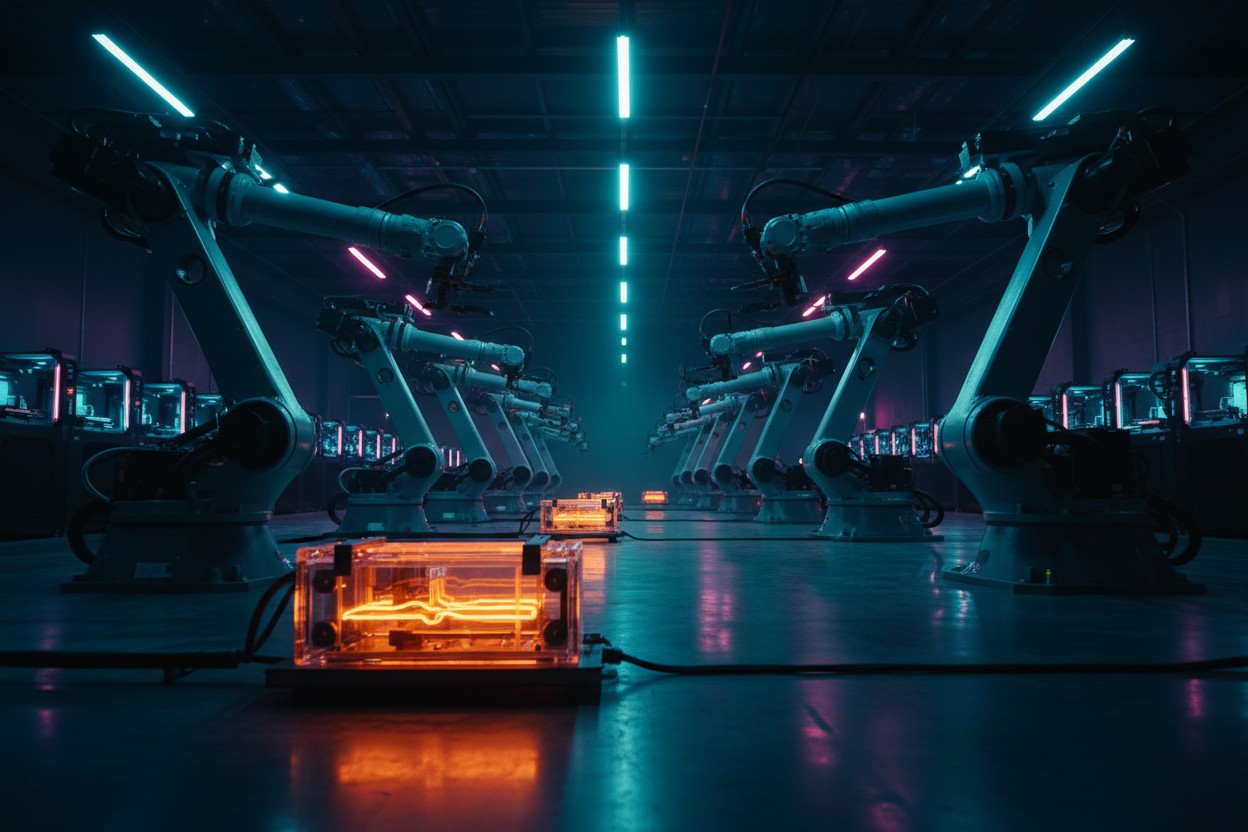
At the heart of The Void Age Bootstrap Protocol is the concept of the "dark factory"—an automated manufacturing environment that functions in the dark, requiring no lighting, human heating, or cooling, and operating entirely independent of the "Big Three" cloud providers (Amazon Web Services, Google Cloud, and Microsoft Azure).
Lee argues that the digital infrastructure currently used by tech titans to manage global supply chains can be inverted. By utilizing open-source designs, these automated cells can manufacture essential hardware—from electronics to mechanical components—at the point of use. This effectively decouples production from the long-haul shipping routes and data-dependent logistics platforms that define modern commerce.
The immediate result is a direct threat to the high-profit business models of major technology firms. If production is localized and managed via decentralized protocols, the demand for centralized, high-latency cloud management and massive, energy-intensive data centers diminishes significantly.
Chronology of the Shift: From Centralization to Autonomy
The transition toward decentralized manufacturing has been brewing for years, catalyzed by a series of global disruptions.
- 2020–2022 (The Supply Chain Crisis): The pandemic-induced breakdown of global logistics highlighted the extreme fragility of "Just-in-Time" manufacturing. This period served as the primary catalyst for researchers and technologists to begin exploring truly localized, resilient production models.
- 2024 (Technological Convergence): Advancements in solid-state battery technology and AI-driven robotics reached a maturity level that allowed for small-scale, high-precision manufacturing.
- 2026 (The Infrastructure Wall): As energy costs skyrocketed, a 2026 report from ZeroHedge indicated that 50% of U.S. data centers slated for construction were canceled or delayed. The energy requirements of the "AI boom" hit a physical limit, forcing a rethink of centralized computing.
- Mid-2026 (The Publication): The Void Age Bootstrap Protocol is released, formalizing the methodology for building independent, off-grid production cells.
- Present Day: The protocol gains traction among grassroots movements and survivalist networks, forcing tech giants to assess whether to suppress the information or attempt to incorporate the protocol into their own closed systems.
Supporting Data and Energy Breakthroughs
The feasibility of Lee’s protocol rests on significant recent breakthroughs in energy storage and materials science. The primary criticism of decentralized manufacturing has historically been the lack of reliable, high-density, off-grid power. Two major developments have dismantled this argument.
1. The Donut Lab Solid-State Breakthrough
Recent reports from the Finnish startup Donut Lab have confirmed the viability of solid-state batteries capable of sustaining industrial-level output without the fire risks or thermal management requirements of traditional lithium-ion packs. These batteries are uniquely suited for "dark factories" because they can operate in extreme temperatures, allowing these factories to be placed in unconventional, low-cost locations.
2. Sodium-Sulfur Energy Density
Researchers at Jiao Tong University in Shanghai have achieved energy densities with sodium-sulfur (NaS) batteries that surpass those of standard lithium-ion units. Because sodium is abundant and inexpensive compared to lithium, this technology lowers the barrier to entry for localized energy grids. By pairing these batteries with renewable energy capture, communities can power sophisticated CNC machines and 3D printers without connecting to the national grid—thereby insulating their production from the energy market volatility that plagues major industrial nations.
The Existential Threat to the Petrostates
The implications for the energy sector are profound. The Void Age Bootstrap Protocol explicitly details methods for producing hardware without reliance on petroleum-based plastics or oil-dependent transportation. By highlighting the vulnerability of strategic chokepoints, such as the Strait of Hormuz, Lee argues that the geopolitical power of petrostates is fundamentally rooted in the inefficiency of the current global shipping model.
If a community can manufacture its own essential goods using locally sourced materials and localized energy, the "oil-for-protection" pact that has defined global geopolitics since the 1940s loses its leverage. This, the book posits, is an existential threat to the globalist status quo.
The Battle of the Gatekeepers: Official Responses and Censorship
The publication of The Void Age Bootstrap Protocol has placed major tech corporations in a strategic bind. These companies act as the primary gatekeepers of digital information. If they host or distribute the blueprint, they are effectively facilitating the obsolescence of their own logistics and cloud-hosting revenue streams. If they censor the protocol, they risk being branded as enemies of free speech and open-source innovation.
To date, officials from Amazon, Google, and Microsoft have remained silent. However, industry analysts suggest that behind the scenes, legal teams are likely evaluating whether the protocol constitutes an "instructional hazard" or a violation of intellectual property laws—a common tactic used to suppress disruptive technologies.
Critics of the current system, such as those writing for NaturalNews, have framed this as a "systemic escape." They argue that the current industrial paradigm is actively hostile to individual autonomy and that the only path to survival is to build parallel systems.
Implications: Democratizing the Means of Production
The historical context provided by Lee is telling. He references the Henry Ford era, where the River Rouge plant achieved vertical integration by owning every link in the supply chain—from mines to forests. While Ford used this to centralize power, Lee argues that the new protocol uses the same logic to achieve the exact opposite: the total decentralization of power.
Marcin Jakubowski, founder of Open Source Ecology, has long championed this philosophy. In his view, the "Global Village Construction Set"—a suite of open-source machines—was the precursor to this current wave of dark factories. The difference today is the maturity of AI. Where previous efforts required expert engineering knowledge, current protocols use AI to calibrate machines, troubleshoot mechanical failures, and optimize output, effectively lowering the barrier to entry for the average person.
The Shift in Economic Leverage
The gatekeepers of industry—those who control capital, patents, and distribution—have historically held the power to dictate pricing and availability. By making manufacturing protocols open-source, the leverage shifts from the corporation to the individual.
- Pricing: Goods produced locally do not carry the "logistics tax" of global shipping.
- Resilience: Supply chains are no longer vulnerable to global crises, pandemics, or trade wars.
- Innovation: Because the designs are open-source, the "network effect" of constant, crowdsourced improvements accelerates the evolution of the hardware, something a closed corporation cannot compete with.
Conclusion: The Path Ahead
The Void Age Bootstrap Protocol is more than a technical manual; it is a declaration of independence from the centralized, fragile systems that have defined the 21st century. The success of this movement will not be determined by market adoption in the traditional sense, but by the ability of these decentralized networks to withstand the inevitable pressure from institutions that view this shift as a direct threat to their survival.
As data centers continue to face energy constraints and global logistics routes remain volatile, the incentive for localized, automated manufacturing will only grow. The question is no longer whether these technologies can work—the prototypes and data suggest they can—but whether society will be permitted to adopt them, or if the gatekeepers will successfully maintain the status quo through a new era of digital and physical surveillance.
For those looking to escape the vulnerabilities of the modern global supply chain, the blueprint is now public. The "Void Age" may well be defined by who controls the factory, and for the first time in history, that power is finally returning to the people.