











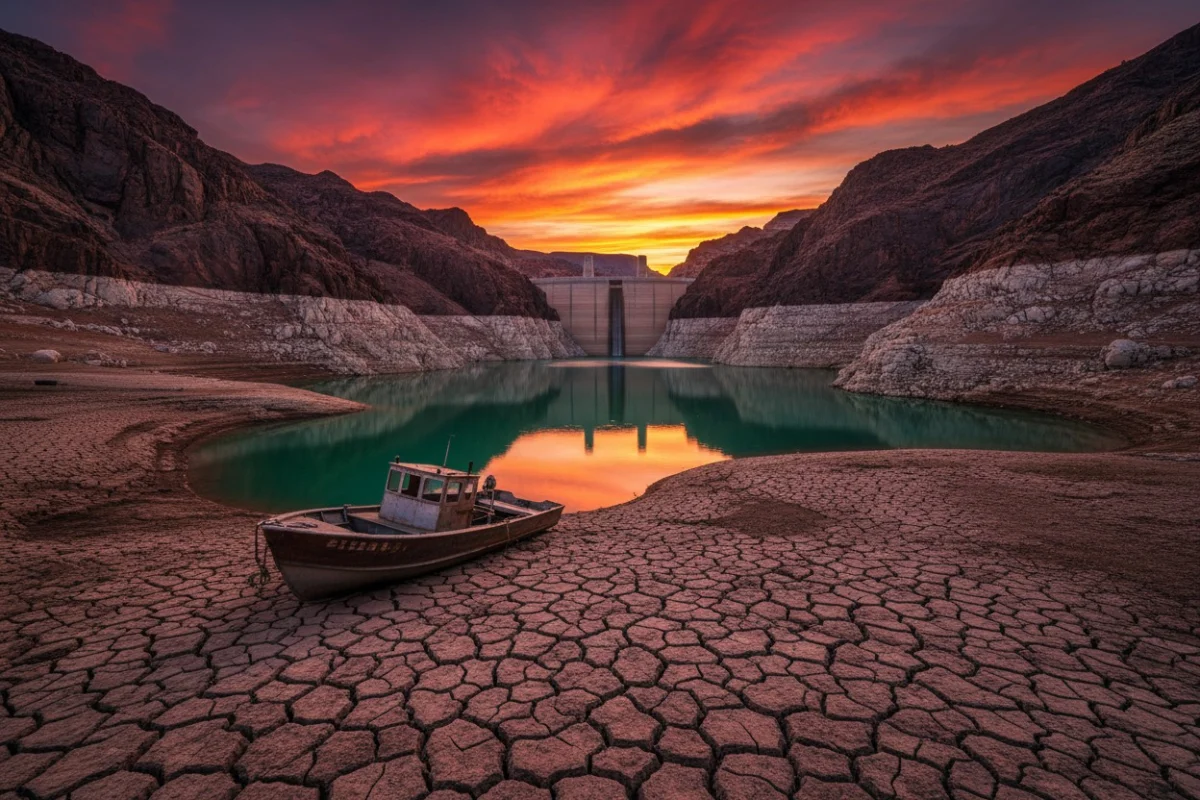
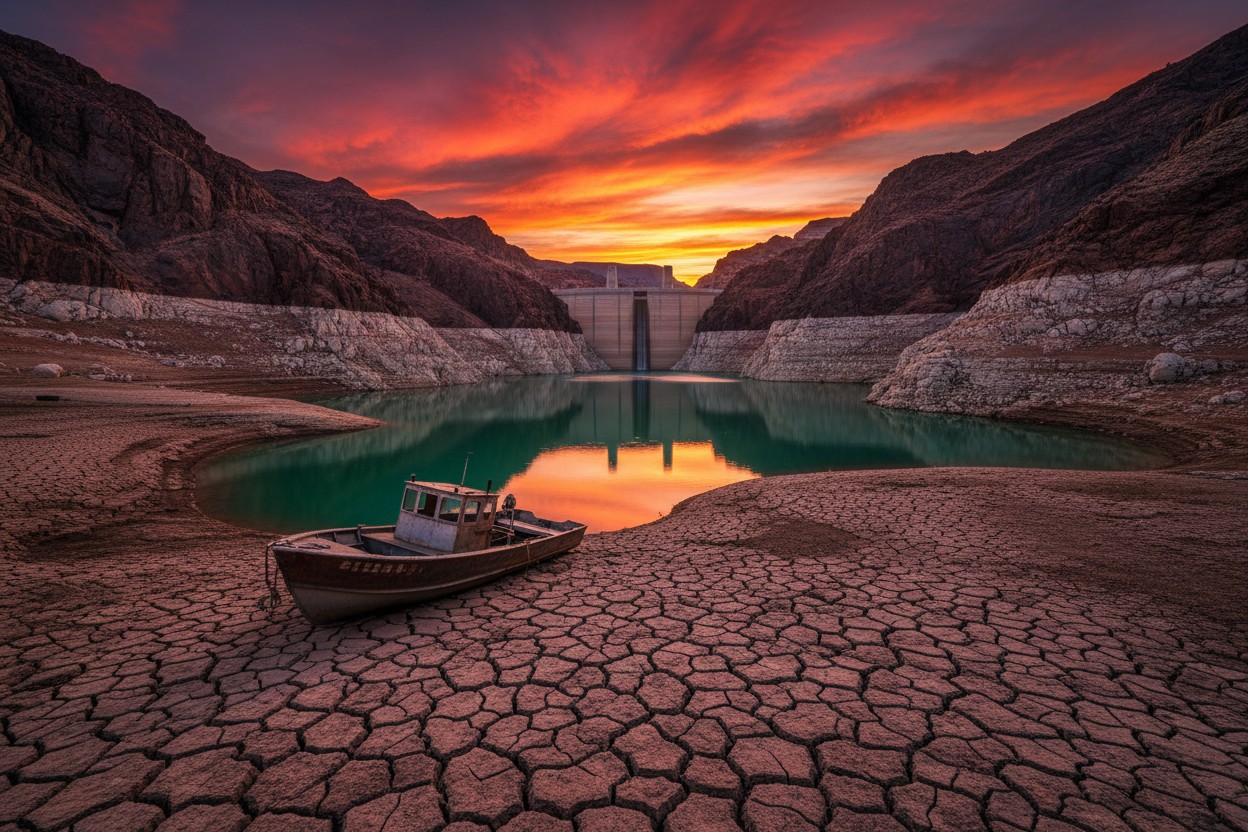
The American West is currently confronting a hydrological catastrophe of unprecedented scale. As of mid-August, the two largest reservoirs in the United States—Lake Powell and Lake Mead—have plummeted to historic low elevations, signaling a grim milestone for the Colorado River Basin. Data released by the U.S. Bureau of Reclamation (USBR) confirms that the lifeline for 40 million people across seven states and Mexico is stretched to its absolute limit, raising urgent questions about water security, power generation, and the viability of life in the arid desert.
On Sunday, August 16, Lake Powell’s surface elevation was recorded at 3,519.80 feet above sea level. Just days prior, on Friday, August 14, Lake Mead hit a harrowing 1,039.70 feet, officially surpassing its previous record low of 1,040.58 feet set in July 2022. These figures are not merely statistics; they are the physical manifestation of a "mega-drought" that has redefined the geography of the Southwestern United States.
A Legacy of Engineering and Hubris: The Colorado River System
To understand the current crisis, one must look at the monumental engineering projects that tamed the Colorado River. Lake Mead, formed by the iconic Hoover Dam, and Lake Powell, created by the Glen Canyon Dam, serve as the cornerstones of the region’s water infrastructure.
The selection of these sites was a result of historical debate. As documented by Chip Ward in Hope’s Horizon, the Glen Canyon site was initially considered for a major dam project but was ultimately bypassed in favor of the Boulder Canyon site because it was deemed too isolated, lacking the necessary infrastructure and proximity to electricity users. This decision birthed the Hoover Dam and Lake Mead. Over time, however, both sites became integral to the functioning of the West.
Today, these reservoirs are the primary buffers against the volatility of the Colorado River. They provide essential water supplies for irrigation, municipal use, and industrial cooling. Furthermore, the Glen Canyon Dam is a critical source of hydroelectric power, capable of energizing nearly half a million homes. Federal officials have repeatedly warned that as water levels at Lake Powell continue to recede, the dam’s ability to generate electricity is compromised. In 2022, reports surfaced suggesting that water levels were falling to depths once thought impossible, raising the specter of the dam ceasing energy production entirely—a scenario that could have rippled through the regional power grid.
The Chronology of a "Mega-Drought"
The current crisis did not emerge overnight; it is the culmination of decades of reduced precipitation and rising temperatures. In March 2021, the U.S. Drought Monitor sounded the alarm, noting that multiple states were mired in a severe drought that had all the hallmarks of a long-term "mega-drought."
The situation reached a breaking point in May 2026, when Utah Governor Spencer Cox declared a statewide emergency. "Our snowpack provides 95% of Utah’s water supply," Cox stated, underscoring the precarious reliance of the West on mountain snowmelt—a resource that has become increasingly unpredictable.
However, the narrative of the drought is complex. While many attribute the decline to climate change-induced "hot drought" conditions, some experts push back. Jonathan Waterman, in his book Running Dry, notes that historical tree-ring data suggests the region has faced even more severe droughts in the past than those recorded in the 21st century. Furthermore, a recent scientific analysis has challenged the "hot drought" explanation, arguing that it oversimplifies the crisis and ignores fundamental principles of thermodynamics, observed watershed hydrology, and century-old mathematical models of river flow.
The Seven-State Impasse
The management of the Colorado River is governed by a complex web of legal agreements and compacts between seven states: Arizona, California, Nevada, Colorado, Utah, Wyoming, and New Mexico. For years, these states have engaged in high-stakes negotiations to allocate water rights. Yet, despite the deteriorating conditions, a unified, long-term solution remains elusive.
The primary conflict arises from the conflicting interests of the "Upper Basin" states (Colorado, Utah, Wyoming, New Mexico) and the "Lower Basin" states (Arizona, California, Nevada). As water supplies dwindle, the competition for the remaining drops has intensified, turning the negotiation table into a theater of political and legal maneuvering. State and federal officials acknowledge that the lack of consensus is perhaps the greatest barrier to systemic reform.
Federal Intervention: A New Era of Restrictions
Faced with the failure of the states to reach a consensus, the federal government has been forced to step in as the ultimate arbiter. At the end of July, the federal administration unveiled a sweeping plan aimed at curbing water usage through 2036.
The directive mandates that California, Arizona, and Nevada—the three states most dependent on the river—must reduce their combined annual consumption by up to 3.7 billion cubic meters. To put this in perspective, that volume is equivalent to roughly 1.5 million Olympic-sized swimming pools. Notably, the plan places the burden of these cuts on the Lower Basin states, leaving Colorado, Utah, Wyoming, and New Mexico largely exempt from major consumption reductions.
This is not the first time the federal government has intervened. In 2022, the Department of the Interior triggered the first-ever "Tier 2" shortage designation for the river, forcing immediate water cuts in Arizona, Nevada, and Mexico. These repeated interventions underscore the federal government’s transition from a passive facilitator to an active regulator of water resources.
Implications and Legal Challenges
The lopsided nature of the new federal restrictions has set the stage for a period of intense legal friction. Officials in Arizona have already signaled their intent to resist, with the state setting aside millions of dollars in anticipation of litigation. The argument is that the burden of the crisis is being distributed inequitably, potentially threatening the agricultural and municipal stability of the Lower Basin states.
Beyond the legal battles, the environmental and economic implications are dire. Federal projections released in March warn that Lake Mead’s water levels could fall even further by November 2027, potentially dropping below the record lows observed in 2022. This prospect has emboldened advocacy groups to call for radical changes.
"Today’s Colorado River projections are a dire warning for the American West to eliminate rampant corporate water abuse before it’s too late," said Amanda Starbuck, research director for Food & Water Watch. Such sentiments highlight the growing public frustration with how water is prioritized, particularly between industrial agriculture and urban centers.
Conclusion: The Path Forward
The situation at Lake Powell and Lake Mead is a clarion call for a fundamental rethinking of water management in the American West. The era of assuming the Colorado River is a bottomless resource has ended. Whether through the enforcement of federal mandates, the potential for protracted legal battles, or the need for technological innovation in water conservation, the region is entering an era of austerity.
The Bureau of Reclamation has stated it will continue to monitor the conditions at Glen Canyon and Hoover Dams with heightened vigilance. However, engineering solutions alone may not be sufficient. As the climate shifts and historical water models fall out of sync with current realities, the seven states, federal agencies, and the public must navigate a narrow path between survival and collapse. The record lows of August 2026 are not merely a historical footnote; they are a preview of a new, drier reality that will test the resilience of the American West for generations to come.