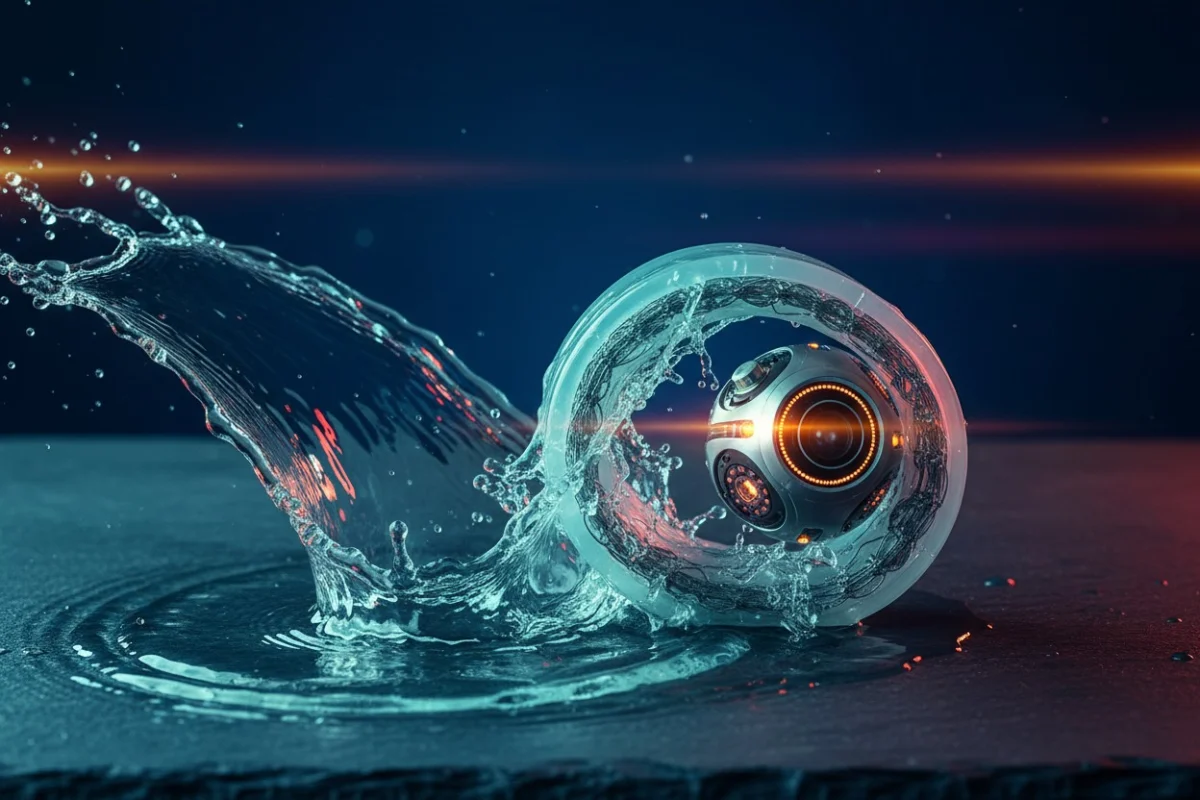
In an era defined by the rapid proliferation of the Internet of Things (IoT), the line between convenience and constant surveillance has blurred. From smart home sensors to wearable health trackers, our personal environments are increasingly populated by devices that "listen," "see," and "report." Now, a team of university researchers has introduced a breakthrough in transient electronics: a moisture-activated, stretchable battery that functions as a physical "kill switch," allowing users to permanently and irreversibly disable electronic sensors on demand.
The development, detailed in a recent peer-reviewed journal, marks a significant departure from traditional software-based security. Instead of relying on encryption—which can be bypassed—or privacy settings that can be toggled by third parties, this technology utilizes the fundamental laws of chemistry to end a device’s life cycle. By exposing the battery to water, the user triggers a rapid disintegration of its internal components, effectively cutting off the power supply and silencing the device for good.
The Chronology of Self-Destructing Electronics
The quest for transient or "ephemeral" electronics is not new, but the mechanisms used to achieve them have historically been difficult to control. Early attempts at creating self-destructing hardware often relied on reactive materials that required extreme heat or high-voltage electrical pulses to trigger degradation. These methods were often dangerous, impractical for consumer electronics, or required bulky external hardware that defeated the purpose of a portable device.
Over the past decade, material scientists have shifted their focus toward water-soluble polymers. The journey began with the development of biodegradable adhesives and coatings that could survive in standard humidity but dissolve upon immersion in water. Researchers built upon this foundation, experimenting with the structural features of polymers to ensure that they could maintain structural integrity during daily use—even under significant mechanical stretching—while remaining susceptible to targeted destruction.
The current breakthrough represents the culmination of this research. By engineering a battery that functions as a stretchable power source, the team has bridged the gap between flexible, wearable technology and the need for a fail-safe deactivation mechanism. Unlike previous iterations, this system requires only a drop of water or a brief submersion to initiate a permanent state of non-functionality, moving the concept of "self-destructing" tech from the realm of science fiction into the practical sphere of user-controlled privacy.
Mechanism and Material Science: How It Works
At the heart of this innovation is a sophisticated architecture composed of water-soluble polymers and specialized electrode structures. The battery is designed to be highly elastic, capable of stretching to significant lengths without losing its ability to power a connected device. This makes it an ideal candidate for wearable health sensors, smart labels, or flexible tracking tags.
The "kill switch" mechanism is remarkably straightforward. When the battery casing is exposed to moisture, the water-soluble polymers begin to swell and break down. This chemical reaction happens within minutes, causing the internal electrodes to lose connectivity. Once the circuit is physically broken through the disintegration of these components, the power source is permanently neutralized. There is no "reset" button; the hardware is effectively converted into inert matter.
This development leverages principles of mucoadhesion and polymer structural design, ensuring that the degradation process is predictable and reliable. By fine-tuning the chemical composition of the electrodes, engineers have ensured that the battery remains stable under normal ambient humidity but reacts decisively when a threshold of moisture is introduced. This creates a "trust-but-verify" model for hardware, where the user holds the final authority over whether a device remains operational.
Supporting Data and the Privacy Crisis
The urgency behind this development is rooted in the current, somewhat precarious, state of global surveillance. According to recent industry analyses, the growth of connected sensors has outpaced the development of consumer privacy protections. The rise of sophisticated Artificial Intelligence (AI) has exacerbated these fears; researchers have already demonstrated that AI can now interpret brain signals without the need for invasive implants, raising profound questions about the sanctity of mental privacy and the potential for unprecedented cognitive surveillance.
The backdrop for this technology includes a shift in how institutions manage data. The World Health Organization (WHO), for instance, has integrated global surveillance networks into its pandemic command structures. While intended for public health monitoring, these networks have sparked intense debate regarding centralized data collection and the risks of mission creep. Similarly, the use of drones and intelligence-gathering sensors by military forces across international borders has normalized the presence of "always-on" monitoring devices in civilian spaces.
Against this landscape, the moisture-activated battery offers a tangible remedy. If an individual suspects that a device—perhaps a smart tag or an environmental sensor—is being used for unauthorized tracking, they no longer need to rely on the manufacturer to stop the data stream. They can simply trigger the physical degradation of the battery, ensuring that the device is incapable of transmitting, storing, or processing data.
Expert Perspectives and Critical Commentary
The scientific community has reacted with cautious optimism. A lead author of the study noted in a public statement: "This approach provides a straightforward way to ensure that a device cannot be reactivated after its intended use. We are providing a tool for autonomy in an era of hyper-connectivity."
However, other experts have urged nuance. A commentary accompanying the study pointed out that while the technology is promising, its effectiveness relies entirely on the user’s ability to access the device and apply moisture. In environments where a device is hidden or inaccessible, the kill switch is useless. Furthermore, the technology requires precise environmental conditions; it must be protected from accidental moisture exposure, such as high humidity or rain, to prevent premature failure.
The broader security implications are also being debated. Security researchers have long warned that data-gathering devices, ranging from consumer health trackers to genetic testing programs, are far more pervasive than the public realizes. Some speakers at privacy conferences have gone as far as to warn that "super-intelligent" systems could eventually mandate that tech companies provide real-time location data on all citizens, potentially enabling a new, more efficient form of state control. While these scenarios are often dismissed as speculative, the demand for "hard-wired" disconnects suggests a growing anxiety that digital solutions are no longer sufficient to combat digital threats.
Implications for the Future of Privacy
The moisture-activated battery represents a pivot toward "privacy by design" at the hardware level. It shifts the burden of security from the cloud—where software updates can be pushed to override user settings—to the physical world, where the user has total, localized control.
Key Implications:
- Consumer Autonomy: For the first time, consumers can physically verify that a device is dead. This is a powerful tool for those concerned about corporate or governmental data harvesting.
- Environmental Responsibility: Because the materials used are water-soluble and designed to disintegrate, the battery also offers a pathway to reducing the growing problem of "e-waste." When a device reaches the end of its life, it can be disposed of in a way that minimizes environmental harm.
- Defense Against Covert Monitoring: In sensitive environments, such as during political negotiations or corporate board meetings, the ability to destroy sensors after use could prevent the lingering threat of "hot microphones" or remote data exfiltration.
- The "Last Line of Defense" Concept: Traditional security, such as home alarms or firewalls, can be turned against the user if the system itself is compromised. A physical kill switch provides a "last line of defense" that cannot be hacked, rerouted, or remotely updated.
Conclusion: A New Era for Transient Electronics
As the research team moves to scale this technology for real-world application, the focus will likely shift toward improving the durability of the protective coatings and refining the speed of degradation. The study, funded entirely by a government agency, underscores a growing interest in creating "privacy-enhancing" hardware that functions independently of software ecosystems.
While this moisture-activated battery is not a panacea for all surveillance threats, it is a significant step toward reclaiming the private sphere. By introducing a mechanism that allows for the physical termination of electronic surveillance, the researchers have offered a glimpse into a future where technology is not a permanent fixture in our lives, but a tool we can choose to discard, disable, and disconnect.
As society continues to integrate IoT into every facet of existence, the development of transient electronics may well prove to be the most vital defense against the erosion of privacy. The ability to "unplug" a device—not just by turning it off, but by chemically ending its existence—is perhaps the most honest way to ensure that our data stays our own.