
The landscape of American healthcare finance is facing a silent, multibillion-dollar hemorrhage. Medicaid and Medicare fraud, once viewed as localized instances of misconduct, have metastasized into a systemic challenge that threatens the stability of public health programs. From improper billing and undocumented services to sophisticated upcoding schemes and duplicate claims, the erosion of taxpayer funds is occurring at an unprecedented scale.
As regulatory scrutiny intensifies, health plans across the nation are finding that their traditional oversight mechanisms—often slow, reactive, and siloed—are woefully inadequate. With billions of dollars in active fraud exposure identified annually, the industry is reaching a critical inflection point: modernize payment integrity operations or face significant financial and regulatory repercussions.
The Anatomy of a Systemic Crisis: Main Facts
The shift from isolated "bad actors" to systemic financial leakage is driven by the sheer complexity of modern healthcare administration. Medicaid and Medicare, which serve as the backbone of coverage for millions of Americans, are increasingly targeted by complex fraud rings.
Recent investigations have uncovered multi-million dollar schemes, particularly in high-spend sectors like pharmacy benefits and hospice care. In California, for instance, a series of $100M+ fraud cases involving Medi-Cal providers has served as a wake-up call for the entire industry. When state spending is projected to grow at double the national average, even minor error rates—often sitting at 1-2%—translate into hundreds of millions of dollars in losses per state. This is no longer merely an operational nuisance; it is a board-level financial risk that impacts the viability of managed care organizations.
Chronology of the Regulatory Pivot
The regulatory response has evolved from sporadic audits to a sustained, high-intensity focus on accountability.

- Phase 1: The Reactive Era (Pre-2020s): For years, the "pay-and-chase" model dominated. Plans paid claims first and investigated anomalies months or even years later, often resulting in unrecoverable losses and high administrative costs.
- Phase 2: The Transparency Mandate (2020–2024): Following the pandemic-era expansion of Medicaid, oversight bodies—including the Centers for Medicare & Medicaid Services (CMS) and state-level Medicaid Fraud Control Units (MFCUs)—began demanding more robust evidence of fraud prevention, not just post-payment recovery.
- Phase 3: The Era of Velocity (2025–Present): Today, the industry has entered a phase where "recovery velocity" is the primary metric. Regulators are no longer satisfied with the identification of suspicious claims; they now require demonstrable proof of rapid intervention, high-speed recoupment, and a measurable return on investment (ROI) for all integrity operations.
Supporting Data: The Scale of the Leakage
The financial figures associated with healthcare fraud are staggering. According to the latest reports from the Office of Inspector General (OIG), the scale of the challenge includes:
- Confirmed Losses: Medicare and Medicaid fraud account for approximately $6–7 billion annually in confirmed losses and prevented payments.
- Active Exposure: Enforcement agencies, including the Department of Justice, have identified over $14.6 billion annually in active fraud exposure.
- The Growth Gap: Because the pace of investigation has significantly outstripped the capacity of many state agencies, the "recovery gap"—the difference between total improper payments and successful recoupment—is widening.
For health plans, these figures represent a clear mandate: they must shift from being passive participants in the claims cycle to becoming proactive gatekeepers of fiscal integrity.
Official Responses and Regulatory Pressure
The federal government is signaling that patience for "legacy" oversight systems has evaporated. CMS is increasingly leveraging its authority to pressure states, which in turn are applying rigorous oversight expectations onto managed care plans.
In jurisdictions experiencing rapid spending growth, state agencies are implementing more frequent and imposing interventions. These interventions are no longer just advisory; they include stringent reporting requirements that punish plans relying on retrospective audits. The message from the top is clear: if a plan cannot demonstrate real-time, defensible audit processes, it will be viewed as a liability.
Implications: The Shift to Embedded Payment Integrity
To manage these headwinds, health plans must transition to a model of "Embedded Payment Integrity." This requires moving away from the siloed, retrospective "pay-and-chase" model toward an integrated, end-to-end operational framework.
1. Proactive Fraud Detection and Risk Identification
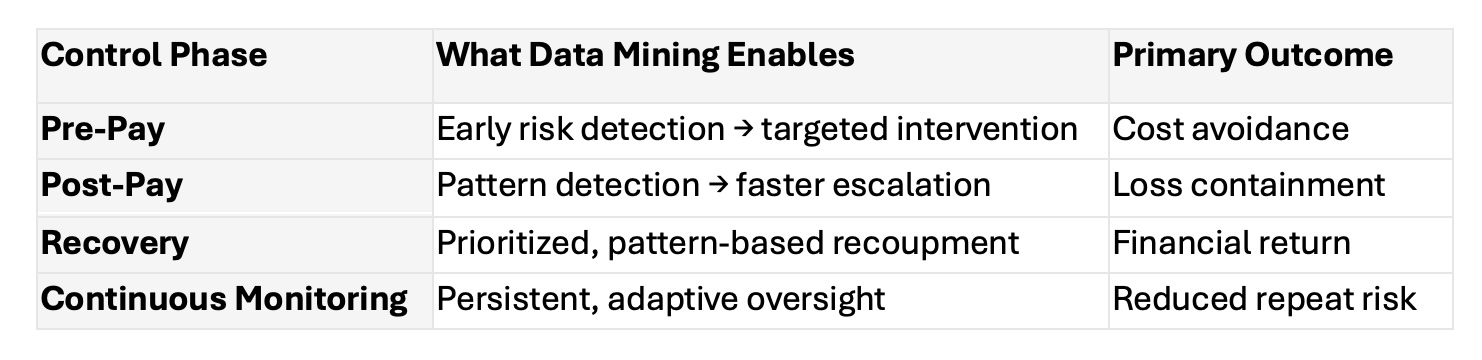
Modernizing begins with data. Plans must move beyond simple anomaly detection to sophisticated predictive modeling. By deploying advanced claims analytics and machine learning, organizations can identify high-risk providers before claims are even processed.
- Predictive Analytics: Utilizing data mining to identify patterns that correlate with fraudulent billing, such as sudden shifts in volume or irregular coding combinations.
- Provider Risk Scoring: Assigning dynamic risk scores to providers, allowing plans to focus their manual audit resources on the most likely offenders.
2. Real-Time Payment Controls
Effective integrity requires operational intervention. This means embedding controls directly into the claims workflow. When an anomaly is detected, the system should trigger an immediate "stop" or "review" flag, preventing the outflow of funds. This reduces the administrative burden of chasing down payments after they have already left the coffers.
3. Accelerated Recovery and Financial Resolution
Detection without resolution is meaningless. The new industry standard is "recovery velocity." Organizations are now automating the recoupment process, including:
- Automated Communication: Streamlining the documentation management between the payer and the provider.
- Dispute Support: Providing clear, data-driven justifications for denials that reduce the success rate of provider appeals.
- Reporting Dashboards: Utilizing real-time analytics to track the recovery lifecycle, ensuring that every case is resolved within a pre-defined window.
4. Scalable Program Integrity Operations
Sustainability requires a shift in organizational culture. Dedicated investigation teams must be supported by "feedback loops" where every detection helps calibrate the system to prevent future errors. By treating payment integrity as a core business function rather than a cost center, plans can protect their margins while ensuring long-term compliance.
The Strategic Imperative: Closing the Gap
The strategic gap between identification and intervention is where most health plans are currently losing the battle. A report—or even a flag in a system—does not constitute an effective integrity program if it does not lead to the immediate protection of assets.
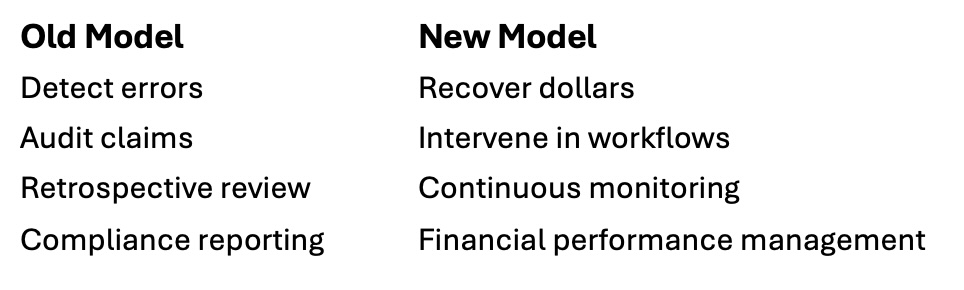
The next generation of payment integrity is defined by an intelligence layer that governs three control points:
- Pre-payment: Preventing the dollar from leaving the system.
- Post-payment escalation: Identifying and recovering errors that slip through the initial filters.
- Continuous Monitoring: Ensuring that the provider network remains compliant through iterative, data-backed oversight.
Conclusion: The Path Forward
The discovery of massive fraud schemes in programs like Medi-Cal is not a fluke; it is a symptom of a systemic vulnerability that affects health plans from coast to coast. As fraud risk continues to scale, the plans that survive and thrive will be those that view payment integrity as a competitive advantage.
By embracing an end-to-end, embedded operational model, health plans can move from being reactive victims of systemic abuse to becoming proactive stewards of healthcare resources. The differentiator in the coming years will not be how many instances of fraud a plan detects, but how quickly they can protect and recover the dollars that are the lifeblood of their network. In an era of increasing complexity, speed is the only defense that matters.
The financial and regulatory future of the managed care industry depends on this evolution. Plans must now choose whether to be defined by the gaps in their oversight or by the strength of their modern, data-driven defenses.