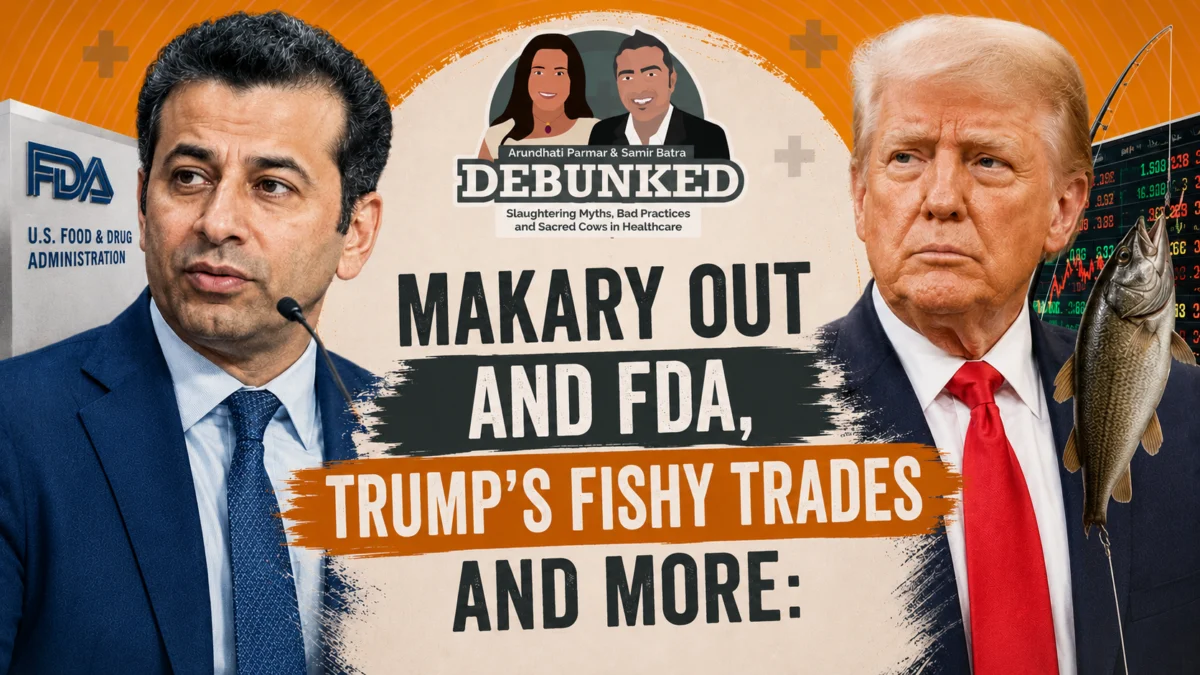
The landscape of American public health administration has been thrust into a state of heightened uncertainty following the resignation of Dr. Marty Makary, the 27th Commissioner of the Food and Drug Administration (FDA). After a brief and tumultuous 13-month tenure, Makary’s departure marks yet another significant shift in the Trump administration’s approach to federal health stewardship. His exit, characterized by policy friction with the White House, arrives at a critical juncture for the agency as it navigates complex challenges ranging from reproductive health access to the modernization of drug safety monitoring.
In the latest episode of the DeBunked podcast, MedCity News Editor-in-Chief Arundhati Parmar and Health Innovation Pitch Managing Partner Samir Batra dissected the legacy of Makary’s brief command. The discussion highlighted a broader trend of volatility within the current executive branch, where regulatory reform, ethical concerns regarding financial conduct, and the rapid evolution of pharmaceutical treatments are colliding.
The Tenure of Dr. Marty Makary: A Chronology of Conflict
Dr. Marty Makary’s appointment was initially viewed by many in the industry as a move toward a more pro-innovation, market-friendly FDA. As a physician and advocate for reform, his primary objective was to streamline agency operations and reduce the bureaucratic drag that often hampers the introduction of new therapies to the market.
Key Milestones and Policy Friction
- Early Ambitions (Year 1): Makary entered the office with a mandate to modernize the agency. He prioritized reducing the administrative burden on drug manufacturers while seeking to enhance the transparency of the FDA’s safety oversight mechanisms.
- The AEMS Initiative: One of his most tangible legacies is the development of the FDA Adverse Event Monitoring System (AEMS). By designing a more user-friendly interface for the public and a more cost-effective architecture for the agency, Makary aimed to modernize the outdated systems that track drug and vaccine side effects.
- The Breaking Point: The relationship between the FDA and the White House soured over specific policy disagreements. Sources close to the administration point to the approval process for flavored vaping products and the increasingly complex regulatory landscape surrounding abortion pill access as the primary drivers of his resignation.
- The Exit: After 13 months, the professional friction became untenable, leading to Makary’s departure. His tenure serves as a case study for the difficulty of balancing industry-friendly innovation with the politically charged directives of a polarized executive branch.
Modernizing Safety: The AEMS Framework
At the heart of Makary’s modernization efforts was the FDA Adverse Event Monitoring System (AEMS). For years, the FDA’s legacy databases were criticized for being cumbersome, expensive to maintain, and difficult for the average citizen to navigate.
Makary’s push for AEMS was rooted in the belief that "transparency is the best medicine." By streamlining how adverse events are reported, categorized, and searched, the agency theoretically enables faster identification of safety signals. This transition is not merely technical; it is a fundamental shift in how the FDA engages with the public. However, critics argue that such streamlining must not come at the expense of rigorous, longitudinal scrutiny—a balance that remains the defining challenge for the next commissioner.
The Ethical Shadow: Stock Trades and Governance
Perhaps the most contentious segment of the recent DeBunked episode centered on the intersection of public policy and private financial gain. The hosts scrutinized recent reports of stock trades made by individuals connected to the administration that appear to coincide with major health policy announcements.
The Legislative Gap
While members of Congress are subject to the Stop Trading on Congressional Knowledge (STOCK) Act of 2012, which mandates disclosure of financial transactions to prevent insider trading, the Executive Branch operates under a different, and arguably less transparent, regulatory framework. The President and Vice President are notably exempt from the core provisions of the STOCK Act.
Samir Batra, in a candid assessment, characterized the current optics as "shady." Even if these transactions adhere to the letter of the law, the perception of a conflict of interest creates a crisis of public trust. When policy decisions—such as the fast-tracking of certain drug approvals or the shifting of regulatory priorities—appear to enrich those in power, the credibility of the FDA as an objective, scientific arbiter is fundamentally eroded.
The Rise of GLP-1 Microdosing: A Market Response
While political turmoil dominates the headlines, the pharmaceutical market is undergoing a quiet revolution of its own. The emergence of GLP-1 receptor agonists—originally developed for diabetes and now synonymous with the weight-loss boom—has created a crisis of affordability.
The Noom Precedent
In response to the exorbitant costs of traditional GLP-1 therapies, market players are shifting their strategies. Companies like Noom have begun championing "microdosing" programs. The rationale is simple: provide the benefits of GLP-1s at lower, more sustainable, and more affordable dosages. This move represents a pivot toward consumer-centric healthcare where the industry is forced to innovate in the face of economic barriers rather than solely through the development of new, high-cost chemical entities.
Judicial Validation: The Medicare Pricing Win
The healthcare industry received a significant regulatory clarification last month when the U.S. Supreme Court declined to hear an appeal from pharmaceutical manufacturers challenging the federal government’s authority to negotiate Medicare drug prices.
This decision is a watershed moment for American healthcare. For decades, the pharmaceutical industry argued that such negotiations interfered with market forces and hampered research and development. The Court’s refusal to intervene reinforces the government’s power to act as a significant buyer, potentially curbing the rising costs that have plagued Medicare for years. This ruling, combined with the pressure to microdose, suggests that the "business as usual" model of pharmaceutical pricing is under sustained assault from both the judiciary and the market.
Implications: Where Does the FDA Go From Here?
The departure of Dr. Makary, coupled with the ongoing debates over ethical standards and drug pricing, paints a picture of an agency in transition.
1. The Need for Stability
The frequent turnover in the FDA Commissioner role (27 commissioners in total) suggests a structural problem. The agency requires a leader who can navigate political pressure without compromising the scientific integrity that is the hallmark of the FDA’s global reputation.
2. The Transparency Imperative
The AEMS initiative must continue, regardless of leadership changes. The public’s demand for accessible safety data is only growing. Future administrations would do well to prioritize the democratization of this data to rebuild public trust.
3. Closing the Ethical Loophole
The debate surrounding the STOCK Act is likely to gain momentum. As the public becomes more aware of the discrepancies between congressional and executive financial disclosure requirements, there will be increasing pressure to harmonize these laws. A failure to do so risks long-term damage to the perceived legitimacy of federal health institutions.
4. The Future of Drug Innovation
As GLP-1 microdosing and Medicare price negotiations demonstrate, the future of the pharmaceutical industry is no longer just about the next "blockbuster" drug. It is about the optimization of existing therapies and the navigation of a stricter price-conscious environment.
Conclusion
The DeBunked podcast co-hosts captured a sentiment that is prevalent across the healthcare sector: we are in an era of "blunt, obvious" challenges. Dr. Makary’s departure is a symptom of a broader issue—the friction between the demand for rapid, market-driven innovation and the necessity of rigorous, transparent, and ethical oversight.
As the Trump administration seeks a successor for the FDA, the priority should not merely be finding a candidate who aligns with policy goals, but one who can restore the agency’s role as a trusted, objective, and transparent protector of public health. Until such stability is achieved, the FDA will likely remain in the crosshairs of both political firestorms and the intense scrutiny of a public that is increasingly sensitive to the intersection of power, profit, and patient safety.