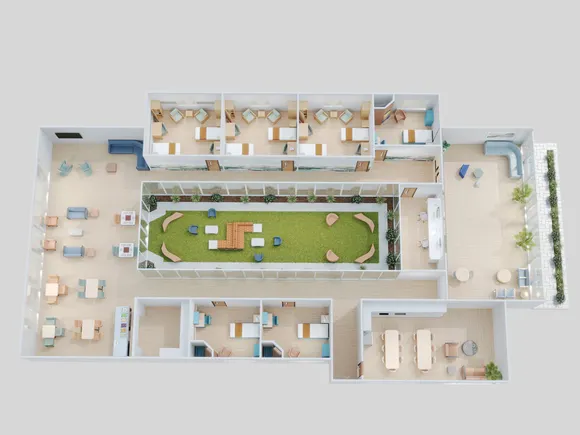
The modern healthcare landscape is defined by a paradoxical pressure: the urgent need to expand and modernize facilities while simultaneously maintaining the "zero-downtime" mandate of clinical operations. As patient volumes rise and medical technology evolves at breakneck speeds, healthcare executives are finding that the traditional construction model—characterized by long site-based timelines, labor volatility, and environmental unpredictability—is increasingly incompatible with the realities of modern medicine.
For hospitals, a construction project is no longer just a capital expenditure; it is a significant operational risk. When a project slips behind schedule, it does not merely delay a grand opening; it disrupts patient care, defers revenue, and strains capital budgets. In response, a paradigm shift is underway, with industry leaders turning to permanent modular healthcare construction to decouple facility expansion from the inherent risks of traditional field-based building.
The New Reality: Construction as an Operational Risk
For decades, the standard for building hospitals was a linear, site-centric process. However, the confluence of nationwide labor shortages, supply chain volatility, and the stringent demands of active clinical environments has rendered this model fragile.
The Cost of Delay
When construction timelines drift, the ripple effects are felt throughout the entire healthcare ecosystem. Delayed occupancy means postponed patient services, which directly impacts the bottom line. Beyond lost revenue, hospitals are often forced to extend temporary leasing arrangements for equipment or clinical space, further eroding the project’s ROI.
Furthermore, capital planning relies on predictable cash flows and milestones. When these become volatile, organizations face increased uncertainty, making it difficult to allocate resources toward other mission-critical initiatives. In the current economic climate, schedule reliability has emerged as a key performance indicator (KPI) for facility expansion, rivaling clinical outcomes in its importance to institutional health.
Evolution of the Method: The Shift to Offsite Fabrication
To navigate these challenges, organizations are increasingly partnering with firms like CareAffirm, which utilizes purpose-built, permanent modular solutions to bridge the gap between rapid deployment and clinical-grade durability.
The Mechanics of Parallel Construction
Unlike the "build-in-place" model, permanent modular construction relies on the principle of parallel construction. In this workflow, site preparation and foundation pouring occur simultaneously with the fabrication of the building components in a controlled, offsite manufacturing facility.
By shifting the majority of the construction process into a climate-controlled environment, builders eliminate the variables that plague traditional sites:
- Weather-Related Delays: Rain, snow, and extreme temperatures can halt traditional construction for days or weeks. Modular components are fabricated indoors, ensuring consistent progress regardless of the forecast.
- Labor Stability: By centralizing work in a manufacturing setting, modular providers avoid the unpredictability of local labor markets, maintaining a dedicated, skilled workforce that is specialized in modular assembly.
- Inspection and Quality Control: Offsite environments allow for rigorous, factory-level inspections. This ensures that every wall, mechanical system, and electrical component meets—or exceeds—the same building codes and performance standards as site-built facilities.
Minimizing the Clinical Footprint: The ICRA Imperative
Perhaps the most significant advantage of modular construction for hospitals is its minimal impact on active clinical environments. Traditional construction is notoriously intrusive, generating noise, dust, and debris that pose risks to patients—particularly those with compromised immune systems.
Addressing the ICRA Burden
Healthcare facilities operate under strict Infection Control Risk Assessment (ICRA) requirements. In a traditional build, managing ICRA requires extensive, costly mitigation strategies—such as airtight hoarding, negative air pressure systems, and complex logistics to move materials through occupied spaces.
Modular construction fundamentally changes this dynamic. Because the structure is largely completed offsite, the onsite installation phase is significantly condensed. Instead of months of disruption, hospitals experience a short, surgical installation window. This leads to:
- Reduced Noise and Vibration: Keeping the hospital environment calm for patient recovery.
- Minimal Dust and Debris: Lowering the risk of hospital-acquired infections (HAIs) associated with construction dust.
- Operational Continuity: Staff can continue to provide care in adjacent units without the constant interruption of heavy machinery or invasive site work.
Data and Strategic Implications
The Economic Argument for Speed
In the healthcare sector, "time-to-care" is a metric of success. Every day a facility remains under construction is a day that a patient cannot be treated and a day of potential revenue that remains unrealized.
Supporting data suggests that modular projects can accelerate occupancy by 30% to 50% compared to traditional methods. For a hospital system, this means:
- Earlier Revenue Generation: Bringing new diagnostic or inpatient capacity online months ahead of schedule.
- Reduced Capital Exposure: Decreasing the duration of interest-accruing construction loans.
- Capital Flexibility: Reallocating savings from shortened timelines into medical equipment, personnel, or further facility upgrades.
The Durability Question
A common misconception regarding modular construction is that "faster" implies "temporary." It is critical to distinguish between permanent modular construction and temporary trailers. Permanent modular healthcare solutions are designed to the same (or higher) structural and performance standards as traditional buildings. They are integrated into the facility’s core infrastructure and are built to last for decades, ensuring that organizations do not have to sacrifice quality for the sake of efficiency.
The Role of CareAffirm in Modernizing Expansion
As healthcare demands grow, organizations are no longer asking if they should modernize, but how they can do so without breaking their operational rhythm. CareAffirm stands at the forefront of this movement, providing room-based solutions that leverage modularity to solve specific, high-stakes clinical challenges.
By integrating offsite fabrication with the needs of the healthcare environment, CareAffirm helps administrators turn facility expansion from a source of anxiety into a strategic advantage. Whether it is adding new ICU beds, upgrading specialized diagnostic suites, or expanding outpatient clinics, the focus remains on predictability.
Official Perspective: Risk Management as Strategy
Industry experts emphasize that modern healthcare construction has become, at its heart, an exercise in risk management. Executives are increasingly evaluating their projects not just by the cost per square foot, but by the "cost of uncertainty."
"When we look at the trajectory of healthcare, we see that the organizations that will thrive are those that can pivot quickly," notes a spokesperson from the field. "Modular construction provides that agility. It allows a hospital system to respond to a sudden surge in demand or a change in patient demographics without being bogged down by the two-to-three-year timelines of traditional development."
Conclusion: The Path Forward
The future of healthcare facility development lies in the marriage of advanced manufacturing and clinical excellence. As the healthcare industry grapples with an aging population, rising acuity levels, and the need for high-tech, high-efficiency environments, the tools used to build these spaces must keep pace.
Permanent modular construction offers a path that respects the sanctity of the patient experience while meeting the relentless demands of institutional growth. By reducing the onsite burden, ensuring higher quality through factory-controlled conditions, and accelerating the delivery of critical services, modularity is no longer just an alternative—it is becoming the gold standard for hospital expansion.
For the healthcare provider, every day saved in the construction timeline is more than just a line item on a budget sheet; it is an opportunity to deliver life-saving care sooner. As the industry looks toward the next decade of challenges, the integration of permanent modular room solutions will prove to be a defining factor in which organizations lead and which struggle to keep up.
In the final analysis, modular construction is not just about building walls; it is about building the capacity to heal, the agility to adapt, and the reliability that patients and clinicians deserve. Through the adoption of these innovative methods, healthcare leaders can ensure their facilities are as dynamic and capable as the medical teams working within them.