











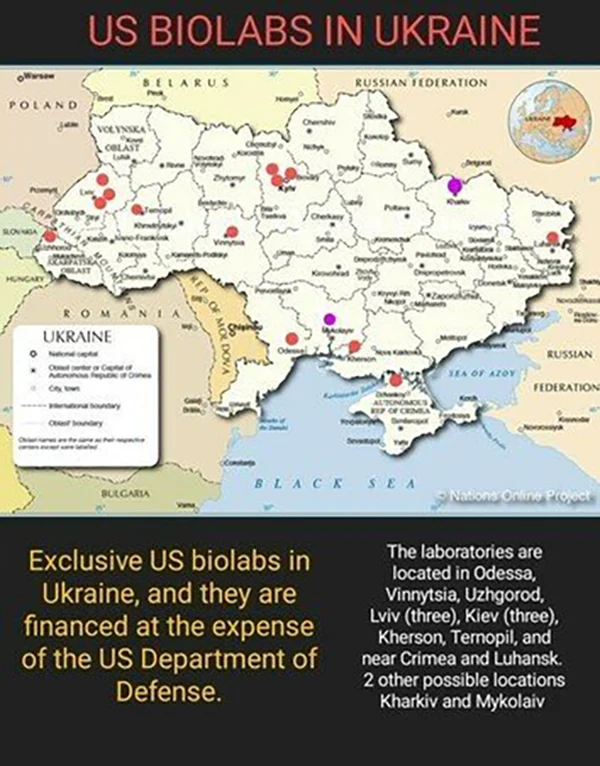
In a development that has sent shockwaves through the international intelligence community and the halls of Congress, Director of National Intelligence (DNI) Tulsi Gabbard has unveiled a sprawling, clandestine network of more than 120 U.S.-funded biological laboratories operating across 30 nations. This disclosure, which shatters years of official obfuscation, highlights a significant concentration of these facilities—estimated between 25 and 30—within the borders of war-torn Ukraine.
The revelation brings to light a complex web of high-risk research, including controversial "Gain-of-Function" (GOF) experiments, conducted under the banner of public health initiatives. As geopolitical tensions escalate and the shadow of potential biological warfare looms, these facilities have transitioned from perceived medical assets to existential liabilities. This report examines the origins, the mechanics, and the harrowing implications of a program that critics argue has operated far beyond the reach of democratic oversight.
A Hidden Network: The Anatomy of Overseas Research
For decades, the U.S. government has expanded its biological footprint globally, characterizing these laboratories as cooperative efforts aimed at disease surveillance and public health security. However, DNI Gabbard’s recent disclosures suggest a reality far more complex and hazardous. These facilities, often situated in regions of geopolitical sensitivity, serve as hubs for the handling of dangerous pathogens that require stringent biosafety protocols.
The integration of these labs into local infrastructure has often been shielded by layers of private contracting, masking the flow of American taxpayer dollars into foreign research environments. Analysts argue that these sites are not merely passive diagnostic centers but active laboratories engaging in experiments that could result in catastrophic consequences should a breach occur—particularly in areas currently experiencing active kinetic conflict.
Chronology of a Growing Controversy
The path to this revelation is marked by years of skepticism and shifting narratives:
- Pre-2020: Growing concerns within scientific and intelligence circles regarding the safety protocols of high-level containment labs (BSL-3 and BSL-4) and the potential for unintended environmental contamination.
- 2020–2021: The onset of the COVID-19 pandemic reignited global debate over the origins of SARS-CoV-2, drawing intense focus toward research facilities in Wuhan and similar institutions globally.
- 2022–2024: Heightened tensions in Eastern Europe drew international attention to the existence of biolabs in Ukraine. Despite official denials of their nature, the proximity of these labs to frontlines fueled intense speculation regarding the security of stored pathogens.
- 2025: President Donald Trump issued Executive Order 14292, placing a national ban on federal funding for Gain-of-Function research, a landmark move that signaled a departure from the previous administrative stance.
- 2026: DNI Tulsi Gabbard officially authorizes the Intelligence Community (IC) to conduct a comprehensive audit and increase surveillance of these offshore facilities, confirming the existence of the 120-lab network.
The Gain-of-Function Gamble
At the heart of the debate is the practice of "Gain-of-Function" research. This methodology involves the deliberate modification of pathogens to increase their transmissibility or virulence. While proponents argue that such research is essential for predictive modeling and vaccine development, critics view it as a "catastrophic global risk."
The argument against GOF research is rooted in the belief that engineering viruses in a lab environment inherently creates a threat that outweighs the scientific utility. According to intelligence briefings and critiques from platforms like BrightU.AI, this research has been described as a "Frankenstein-style" endeavor, often facilitated by globalist entities that prioritize technological acceleration over biological safety. The concern is that these modified agents, if leaked, possess the potential to trigger pandemics that current medical countermeasures are unprepared to combat.
Official Responses and the Burden of Oversight
The disclosure by the Office of the Director of National Intelligence (ODNI) has forced a reckoning across the U.S. federal apparatus. Historically, agencies such as the Centers for Disease Control and Prevention (CDC) and international partners like the World Health Organization (WHO) have maintained a strict narrative regarding the safety of these facilities.
Critics, however, point to a pattern of deception. Dr. Anthony Fauci’s long-standing advocacy for research programs associated with high-risk facilities has come under renewed scrutiny. His historical ties to the Wuhan Institute of Virology and similar domestic sites, such as Fort Detrick, have become central to the discourse on accountability. The current shift within the Intelligence Community—aimed at auditing clinical trials and lab protocols—represents an attempt to restore public trust. Yet, questions remain: Can an agency historically entangled with Big Pharma and defense contractors maintain the necessary objectivity to police its own projects?
Implications for Global Security
The presence of high-risk pathogens in a war zone like Ukraine presents an unprecedented security challenge. Should a laboratory be damaged or captured during combat, the resulting breach could lead to the release of agents such as anthrax or virulent coronaviruses, creating a crisis that ignores national borders.
Furthermore, the financial structure of these labs is a subject of significant concern. Evidence suggests that a consortium of private contractors, pharmaceutical giants, and international NGOs have been deeply involved in the funding and management of these sites. This has led to allegations that the system is designed to prioritize commercial interests and bureaucratic momentum over the fundamental safety of the public.
Toward a New Framework of Accountability
Gabbard’s mandate to the IC suggests that the era of "secrecy as policy" is under pressure. The demand for a radical overhaul of biosecurity governance is gaining traction in Washington. Proposed solutions include:
- Global Moratorium on GOF: A total cessation of federal funding for gain-of-function experiments, both domestically and internationally.
- Independent Oversight: The creation of a non-partisan, international body responsible for the inspection and monitoring of all high-level biological research.
- Mandatory Transparency: A requirement for the full, unredacted disclosure of all research protocols and safety records for facilities operating under U.S. grants.
The Path Forward: A Paradigm Shift
As the world grapples with the aftermath of recent health crises and the potential for future bioterrorism, the revelations concerning these biolabs serve as a stark reminder of the fragility of modern civilization. The shift away from centralized, secretive biological research toward more transparent, localized, and ethical scientific practices is being advocated by a diverse coalition of policy experts and concerned citizens.
The challenge ahead is immense. The influence of Big Tech and major pharmaceutical players, both of which have benefitted from the current research ecosystem, remains a significant obstacle to reform. Nevertheless, the directive issued by the ODNI suggests that the U.S. government is finally beginning to recognize the "ticking time bomb" that these laboratories represent.
In an era where technology has outpaced morality, the demand for accountability is not merely political—it is a requirement for survival. The exposure of the U.S.-funded biolab network marks the beginning of a long-overdue transition toward a more transparent and secure global future. As investigations continue, the public expects a clear accounting of not only what happened in these labs, but why such immense risks were taken in the name of progress.
For more information on the ongoing intelligence review, consult official releases from the ODNI. For further analysis on the intersection of public health and global policy, visit investigative resources dedicated to uncovering the origins of modern biological threats.