
The American healthcare landscape is currently facing a silent crisis that has graduated from an administrative nuisance to a structural threat. Medicaid and Medicare fraud, once viewed as localized instances of provider misconduct, have surged in both frequency and scale, revealing deep-seated vulnerabilities in the reimbursement frameworks of federal and state-administered programs. From upcoding and duplicate claims to the billing of undocumented services, the sheer volume of "financial leakage" has transformed into a board-level risk for health plans and a fiscal emergency for taxpayers.
As the industry grapples with these mounting challenges, the traditional "pay-and-chase" model—characterized by retrospective audits and slow recovery cycles—is proving to be dangerously inadequate. To survive this shifting environment, health plans must pivot toward an integrated, real-time approach that prioritizes "recovery velocity" over simple detection.
The Anatomy of a Systemic Crisis: Main Facts
At its core, the crisis is defined by a misalignment between the speed of modern fraud and the glacial pace of traditional oversight. Fraud, waste, and abuse (FWA) now permeate the entire ecosystem of healthcare financing.
According to the most recent data from the Department of Health and Human Services (HHS) Office of Inspector General (OIG), confirmed losses and prevented payments related to Medicare and Medicaid fraud have reached approximately $6–7 billion annually. Even more staggering is the $14.6 billion in active fraud exposure identified by enforcement agencies each year.
These figures represent more than just accounting errors; they signify a failure of the current reimbursement architecture. The shift in the industry is palpable: regulators are no longer satisfied with the identification of suspicious claims. They are now demanding measurable recovery outcomes, tighter audit defensibility, and, most importantly, faster turnaround times.
A Chronology of Escalation: The California Benchmark
The pressure to modernize is nowhere more acute than in California. In recent months, a series of high-profile Medi-Cal fraud cases—involving pharmacies and hospice care providers—has sent shockwaves through the industry. With multiple cases exceeding $100 million in losses, these incidents have served as a wake-up call for state-managed care plans.

- Phase 1: The Growth Gap. As California’s state spending on healthcare grows at twice the national average, the sheer volume of claims has outpaced the state’s manual oversight capabilities.
- Phase 2: The Exposure Surge. The recent pharmacy and hospice investigations exposed critical gaps in how providers are monitored. When oversight lags behind volume, the "window of opportunity" for bad actors expands exponentially.
- Phase 3: The Regulatory Pivot. Following these losses, state agencies and federal overseers have moved toward more aggressive, proactive interventions. Plans that fail to adapt their infrastructure to this higher level of scrutiny are now facing existential risks to their financial stability and operational licenses.
Supporting Data: The Cost of Inaction
The financial implications for health plans are staggering. In an environment where Medicaid spending is ballooning, even a marginal error rate of 1% to 2% can translate into hundreds of millions of dollars in losses per state.
Key Performance Indicators (KPIs) in the New Era:
- Recovery Velocity: This is now the primary metric of success. It is no longer enough to identify a fraudulent claim; the speed at which that capital is recouped determines the fiscal health of the plan.
- Pre-Payment vs. Post-Payment Ratio: Modern programs are increasingly measured by their ability to intercept claims before they are paid.
- False-Positive Calibration: Efficiency is defined by how well a system filters out "noise" while accurately identifying high-risk patterns, ensuring that provider relationships are not unnecessarily strained by algorithmic errors.
The data suggests that the "pay-and-chase" model is a losing game. By the time an audit is conducted retrospectively, the capital has often been moved, the provider entity may be insolvent, or the statute of limitations for recovery may be nearing expiration.
Official Responses and Regulatory Expectations
Regulatory bodies, including the Centers for Medicare & Medicaid Services (CMS) and state-level Departments of Health Care Services, have fundamentally altered their stance. The era of periodic, passive reporting is over.
Agencies are now demanding:
- Defensible Audit Trails: Plans must demonstrate exactly how they reached a conclusion regarding a provider’s billing patterns.
- Continuous Monitoring: Oversight is moving from annual or quarterly reviews to a 24/7, real-time monitoring requirement.
- Accountability-Based Outcomes: It is no longer sufficient for a plan to report "we are looking into it." Regulators now focus on the ROI of the recovery operation and the specific dollars returned to the state coffers.
The Strategic Gap: Identification Without Intervention
The fundamental flaw in many current payment integrity programs is the disconnect between the detection of an anomaly and the operational authority to stop the payment.
Currently, many organizations operate in silos. Claims processing, utilization management, and fraud detection units often do not share data in real-time. This creates a "predictable gap":
- The Lag Time: Issues are flagged weeks or months after the fact.
- The Recovery Gap: Even when an error is caught, the recovery process is often bogged down by bureaucratic appeals, manual documentation, and inefficient dispute resolution.
- The Silo Effect: Utilization management might approve a service that the payment integrity team later flags as fraudulent, leading to internal conflict and redundant workflows.
The Next Operating Model: Embedded Payment Integrity
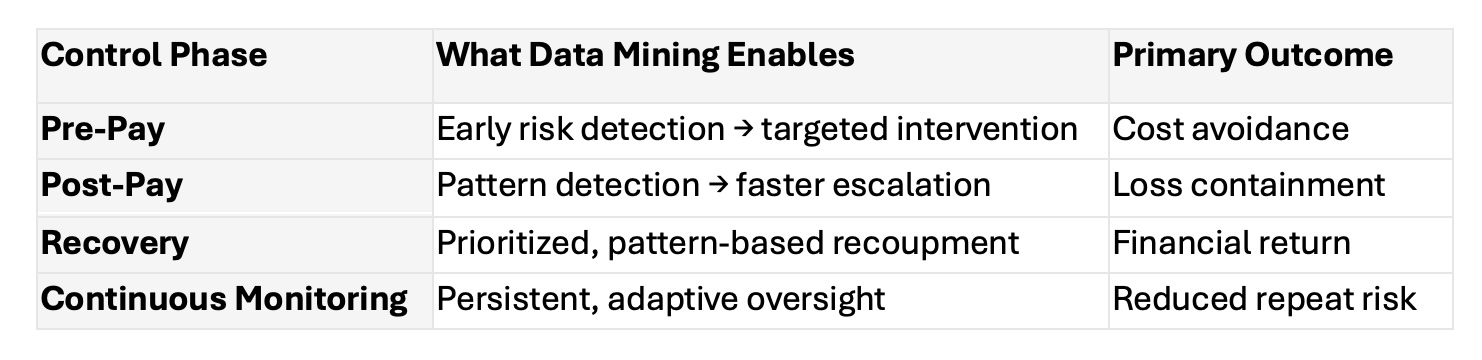
To close this gap, the industry is moving toward "Embedded Payment Integrity." This model treats fraud prevention not as a separate audit function, but as an integral component of the claims lifecycle.
1. Proactive Risk Identification
Organizations are deploying advanced machine learning and predictive analytics to score providers before a claim is even processed. By mining historical data and identifying subtle patterns—such as "upcoding" clusters or geographic anomalies—plans can flag high-risk claims for automatic suspension.
2. Real-Time Payment Controls
The most effective defense is a "gatekeeper" approach. By embedding control logic directly into the claims processing engine, plans can trigger real-time validation. If a claim meets a high-risk profile, it is automatically routed to a manual review queue, preventing the "pay" part of "pay-and-chase."
3. Accelerated Recovery Operations
Once a discrepancy is identified, the resolution process must be automated. Modern systems utilize digitized documentation management and AI-assisted dispute resolution to ensure that recoupments are handled with the precision of a high-frequency financial transaction.
4. Scalable Governance
A sustainable program requires a feedback loop. Every detection should serve as a training point for the system. By using dashboards that visualize recovery performance, leadership can continuously refine the "rules" of the system, creating an environment of constant, incremental improvement.
Implications for the Future
The implications for the industry are clear: the status quo is unsustainable. Health plans that continue to rely on retrospective, fragmented models will inevitably face higher regulatory penalties, erosion of their financial margins, and a loss of stakeholder trust.
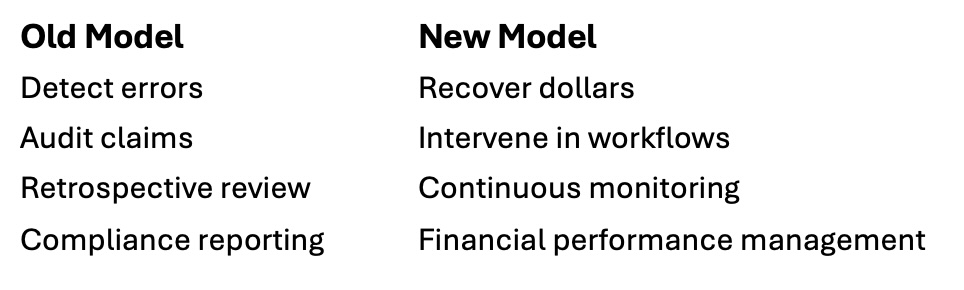
The transition to an end-to-end intelligence layer—one that connects identification to intervention—is the only way to remain competitive and compliant. In this new era, the differentiator is not just the sophistication of the detection software, but the speed at which dollars are protected.
As the regulatory environment tightens and fraud techniques become more sophisticated, the organizations that will succeed are those that view payment integrity as a core competitive advantage. By modernizing their control points, these plans will not only protect their bottom lines but also ensure the long-term sustainability of the federal and state programs that millions of Americans rely on for their health and well-being.
The message to leadership is unequivocal: Move from investigation to intervention. The protection of our healthcare infrastructure depends on it.