In the modern lexicon of physical culture, one question serves as the universal litmus test for upper-body strength: "How much can you bench?" It is a query that echoes across gym floors from commercial fitness chains to elite powerlifting warehouses. For decades, the bench press has stood as the undisputed monarch of upper-body compound movements, serving as the primary benchmark for quantifying strength.
Yet, despite its status as a foundational exercise for the chest, shoulders, and triceps, the bench press is frequently misunderstood. It is arguably the most common source of preventable shoulder injuries in the fitness world. The culprit, however, is rarely the movement itself; it is the application. When executed with precision, it is a cornerstone of a lifetime of training. When performed with ego and poor biomechanics, it becomes a fast track to physical therapy.
The Anatomy of the Bench Press: Why It Matters
The bench press is a sophisticated compound movement that engages the pectoralis major, the anterior deltoids, and the triceps brachii. Because it allows for the loading of significant weight, it is highly effective at triggering hypertrophy and strength gains.
However, the shoulder joint is one of the most mobile—and therefore most unstable—joints in the human body. During a bench press, the rotator cuff muscles must work overtime to stabilize the humerus as it moves through a horizontal plane under heavy load. If the setup is flawed or the technique is haphazard, that load shifts from the intended muscle groups onto the delicate soft tissues of the shoulder capsule, leading to impingement, tendinitis, or more severe tears.
The First Rule: Dismantling Ego-Lifting
The most critical rule of the bench press is simple: leave your ego at the door. In the hierarchy of gym culture, the desire to impress strangers often overrides the necessity of proper form. This "ego-lifting" is the primary driver of injury.
The goal of a training session is not to move the maximum amount of weight once to satisfy the gaze of onlookers; it is to provide a sufficient stimulus for muscle growth while preserving the integrity of your joints. A successful workout is one that leaves you capable of training again with even greater intensity the following week. If your form breaks down to move a weight, that weight is, by definition, too heavy.
The Role of "Training Wheels"
For beginners, the free-weight bench press can be daunting. There is no shame in utilizing the Smith machine as a starting point. While purists may scoff, the Smith machine provides a fixed path, allowing a novice to focus on developing the motor patterns, scapular retraction, and bar control required before attempting to stabilize a loaded Olympic bar. Think of it as a pedagogical tool—a way to build the "neuromuscular map" of the movement without the immediate risk of the bar drifting or the lifter becoming trapped.
Establishing the Perfect Setup
Proper setup is the difference between a high-performing lift and a recipe for injury. Even before the bar leaves the rack, the following principles must be observed:
- Scapular Retraction: Pull your shoulder blades together and "down" into your back pockets. This creates a stable shelf for your upper back, protecting the shoulders and providing a solid base for the press.
- The Arch: A slight, natural arch in the thoracic spine is acceptable and encouraged to optimize the angle of the chest muscles.
- Leg Drive: The bench press is a full-body movement. Your feet should be planted firmly on the floor. Driving through your heels creates tension that transfers through the core and stabilizes the entire kinetic chain.
- Grip Width: A grip slightly wider than shoulder-width is generally standard, but it must be tailored to your anatomy. Your forearms should be perpendicular to the floor at the bottom of the movement.
The Mechanics of Control: Don’t Chase, Master
A persistent myth in strength training is that speed and violence equal results. In reality, muscle responds to tension, not momentum. Slamming a bar off your chest and relying on the "bounce" to complete the lift does nothing to stimulate the targeted muscle fibers.
"Control, don’t chase," is the mantra every lifter should adopt. This means a slow, controlled eccentric (lowering) phase, a brief, deliberate pause at the chest, and an explosive—yet controlled—concentric (upward) phase. No one has ever won a bodybuilding title because they bounced 315 pounds off their rib cage on a Tuesday. Conversely, countless lifters have ended their training careers prematurely by ignoring the importance of controlled tempo.
The Art of the Spot: Safety and Communication
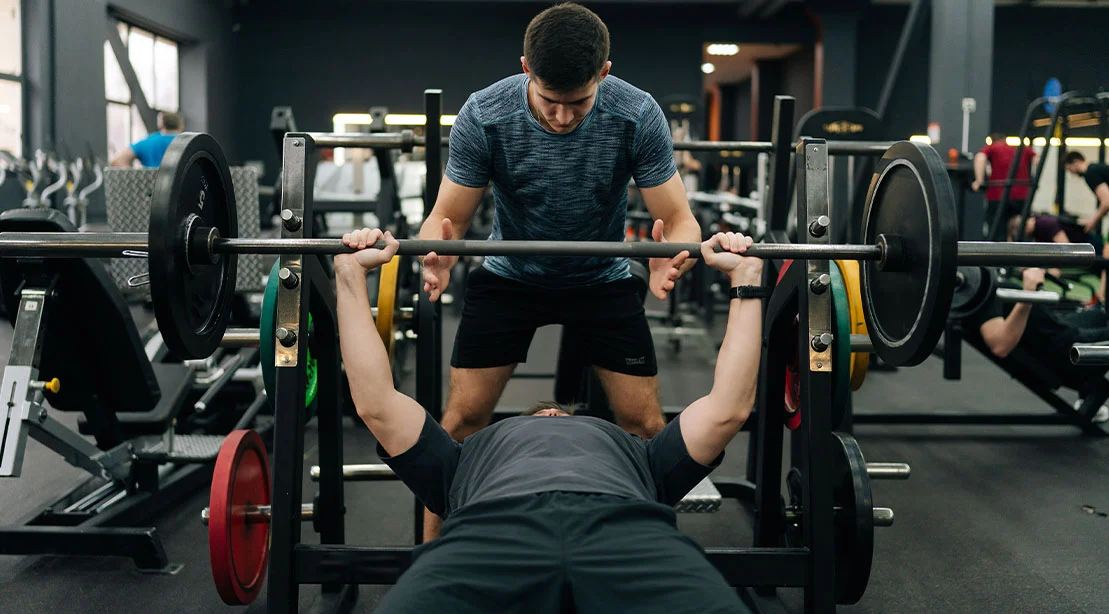
Every serious lifter will eventually reach a point where they need a spotter. A competent spotter is not there to perform an "upright row" while you pretend to bench; they are there to provide an insurance policy.
A proper spotter stands with hands near the bar, tracking the movement, ready to assist only if the bar stalls or deviates from the intended path. Before the set begins, a professional dialogue is mandatory:
- "How many reps are you aiming for?"
- "Do you want assistance if you reach failure?"
- "Do you need a lift-off to clear the rack?"
These questions eliminate uncertainty. If you are training alone, the rules change. Do not attempt personal records (PRs) without a spotter. Utilize a power rack with safety pins set at the appropriate height, or bench with a weight you are 100% confident you can handle for the prescribed rep range.
Progressive Overload: The Long Game
The most common mistake beginners make is falling victim to "program hopping." Social media is rife with flashy, complicated routines that promise overnight results. However, the human body responds to one fundamental law: progressive overload.
You do not need a new routine every week; you need a better version of your current one. Improve your technique. Add a micro-load of 2.5 pounds when possible. Perform one extra repetition than you did last week. These incremental, boring, consistent improvements are the bedrock of elite strength.
Furthermore, a bench press program is only as good as its supporting structure. If you ignore your upper back, your shoulders will eventually pay the price. Strong rear deltoids and rhomboids act as the "brakes" for the bench press, stabilizing the joint during the descent. Incorporating rows, face pulls, and rotator cuff work ensures that your shoulders remain healthy enough to support your bench press progress for years to come.
Implications for Long-Term Athleticism
The bench press has earned its place in the pantheon of strength exercises because, quite simply, it works. For generations, it has been the primary vehicle for building power, stability, and muscle. But the perspective must shift from the short-term to the long-term.
The strongest person in the gym is not necessarily the one who can bench the most weight on a given Monday. The strongest person is the one who is still pressing pain-free twenty years later. By mastering the movement, respecting the inherent risks, keeping the ego in check, and prioritizing consistent, progressive overload, the bench press transitions from a dangerous experiment into a lifelong tool for physical development.
Master the form. Respect the weight. Stay consistent. If you commit to these principles, the bench press will not only build your chest and triceps; it will serve as the foundation of your athletic longevity.