









In an era where health podcasts, biohacking influencers, and wellness gurus dominate our social media feeds, the quest for immortality—or at least the desire to outlive our peers—has become a cultural obsession. We are constantly told that to age gracefully, we must track our glucose, monitor our sleep stages, ice-plunge our way to metabolic health, and supplement with a cabinet full of expensive compounds.

The message is seductive: "I want to do everything I can to preserve my health for as long as possible." It implies that longevity is a puzzle to be solved through extreme optimization. However, a growing body of evidence and data from professional health coaching suggests a different, more liberating reality. For most people, the pursuit of "optimal" health is not only unrealistic—it is unnecessary.

The Myth of Optimization
The modern "longevity movement" is often spearheaded by high-profile figures like Dr. Peter Attia, Dr. Andrew Huberman, and biohacker Bryan Johnson. While their dedication to science is commendable, the "optimal" protocols they champion are frequently translated into daily life as a series of complex, costly, and time-consuming mandates.

At Precision Nutrition, where we have coached hundreds of thousands of individuals, we have found that the gap between "optimal" and "effective" is vast. The data consistently shows that modest, consistent efforts toward foundational habits yield far better results than intense, short-lived "optimization" protocols. When we chase perfection, we often fall into the trap of diminishing returns, where the final 10 percent of effort provides only 1 percent of the result, all while sacrificing our quality of life.

The Pillars of Foundational Health
If cutting-edge, fringe strategies are not the key to a long life, what is? The answer lies in the "basics"—the unglamorous, often-ignored fundamentals of human biology.

1. The Exercise Sweet Spot
Exercise is arguably the single most effective "drug" for longevity. Studies, including long-term research on Harvard alumni, confirm that physical activity reduces all-cause mortality regardless of weight or genetic predisposition.

The "Extreme Exercise Hypothesis" suggests that while moderate-to-high activity levels are life-extending, there is a U-shaped curve. Excessive, ultra-high-volume training can actually lead to myocardial fibrosis or atrial fibrillation. The "sweet spot" for most people is roughly 150 to 300 minutes of moderate aerobic activity per week, paired with three sessions of resistance training. Resistance training is particularly critical as we age, as it preserves muscle mass and bone density, directly reducing the risk of falls—a leading cause of death among the elderly.

2. Nutritional Realism
Nutrition does not require complex meal plans or expensive superfood powders. The data suggests that eating a diet consisting of 70 to 80 percent whole or minimally processed foods is the gold standard.

The "five-a-day" rule for fruits and vegetables remains one of the most robust findings in nutritional science. Research involving 1.8 million people shows that mortality risk plateaus at five servings of produce daily. Beyond that, the benefits do not increase significantly. Furthermore, protein intake is vital; as we age, we require roughly 1.2 grams of protein per kilogram of body weight to prevent sarcopenia. Chasing extreme macronutrient ratios often ignores the simple fact that consistent, colorful, whole-food consumption is the most reliable path to metabolic health.

3. The Power of Sleep and Stress Management
Sleep is the foundation of physiological repair. Research indicates that those who consistently get seven to nine hours of sleep live significantly longer than those who don’t. A single hour of sleep deprivation is linked to an 11 percent increase in cardiovascular risk.

Stress management is similarly vital. However, the goal is not to eliminate stress—which is a necessary, adaptive part of life—but to develop the capacity to recover from it. Whether through deep breathing, journaling, or simply stepping outside, the goal is to keep your "recovery jug" as full as your "stress bucket" is drained.

Chronology of Modern Longevity Trends
- The Early 2000s: Focus was primarily on "diet and exercise" basics.
- 2010–2018: The rise of wearable technology (Fitbit, Apple Watch) brought data-tracking into the mainstream.
- 2019–Present: The "Biohacking Era." Influencers began pushing supplements like NAD+, intermittent fasting protocols, and constant biomarker tracking, moving the goalposts from "staying healthy" to "maximizing biological performance."
- The Current Correction: Experts are now pivoting back to "Deep Health"—a holistic approach that recognizes that social, emotional, and existential health are just as critical as physical biomarkers.
Supporting Data: Why Consistency Wins
Internal data from our year-long coaching programs reveals that clients who practiced basic habits with only 10 to 49 percent consistency still achieved significant, measurable health outcomes. This defies the "all-or-nothing" mentality that plagues the wellness industry.

Consider the following comparisons:

- Social Isolation vs. Smoking: The mortality risk of social isolation is equivalent to smoking 15 cigarettes a day. This makes cultivating a circle of three to five close friends a more effective "health intervention" than many expensive supplements.
- Preventative Care: While people obsess over cold plunges, they often miss basic preventative screenings, dental care, and vaccination schedules. These "boring" medical steps are statistically far more likely to save your life than exotic, unproven wellness hacks.
The Cost of Optimization: Implications
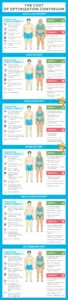
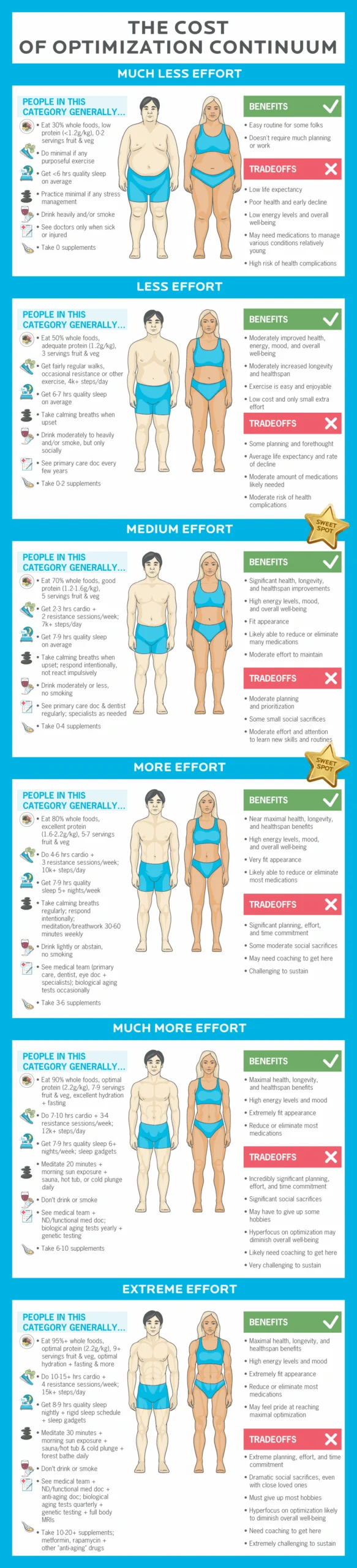
When we compare a "Healthy" individual to an "Optimizer," the resource gap is staggering. An optimizer may spend 3 to 4 times the time and money on their health regimen. This includes recurring costs for continuous glucose monitors, advanced blood panels, specialized supplements, and time-intensive recovery therapies.

This creates two significant implications:

- The Opportunity Cost: Every hour spent in a hyperbaric oxygen chamber or tracking macro-nutrients is an hour not spent with family, pursuing a career, or engaging in hobbies. If these activities are the ones that provide the "meaning and purpose" which studies identify as the #1 predictor of longevity, then optimization is actually self-defeating.
- The Risk of Orthorexia: Excessive focus on diet and fitness can spiral into disordered eating or exercise addiction. When a health plan becomes a source of stress, it ceases to be a health plan and becomes a liability.
Conclusion: The Path Forward
If you want to live a long, healthy life, the prescription is surprisingly simple:

- Clarify your goals: Distinguish between wanting to "live long" and wanting to "live well."
- Master the basics: Prioritize sleep, consistent movement, protein, whole foods, and social connection.
- Audit your effort: If you are already consistent with the basics, you are likely already in the top percentile of health. Any further effort should be weighed against the potential impact on your overall quality of life.
The latest trends will always promise a shortcut to vitality, but biology remains constant. Longevity is not found in the fringe, the expensive, or the extreme. It is found in the quiet, consistent application of the fundamentals. Stop chasing the "optimal" and start embracing the "essential." Your life, and your sanity, will thank you.