











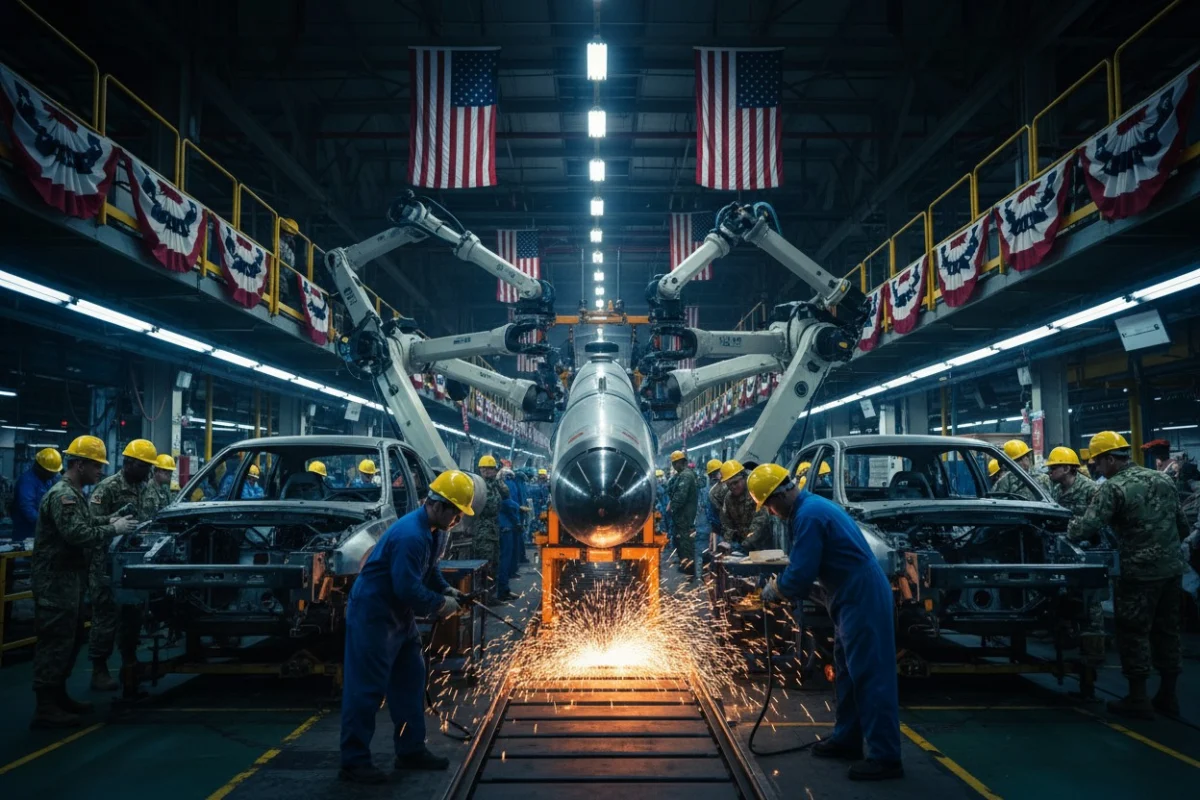
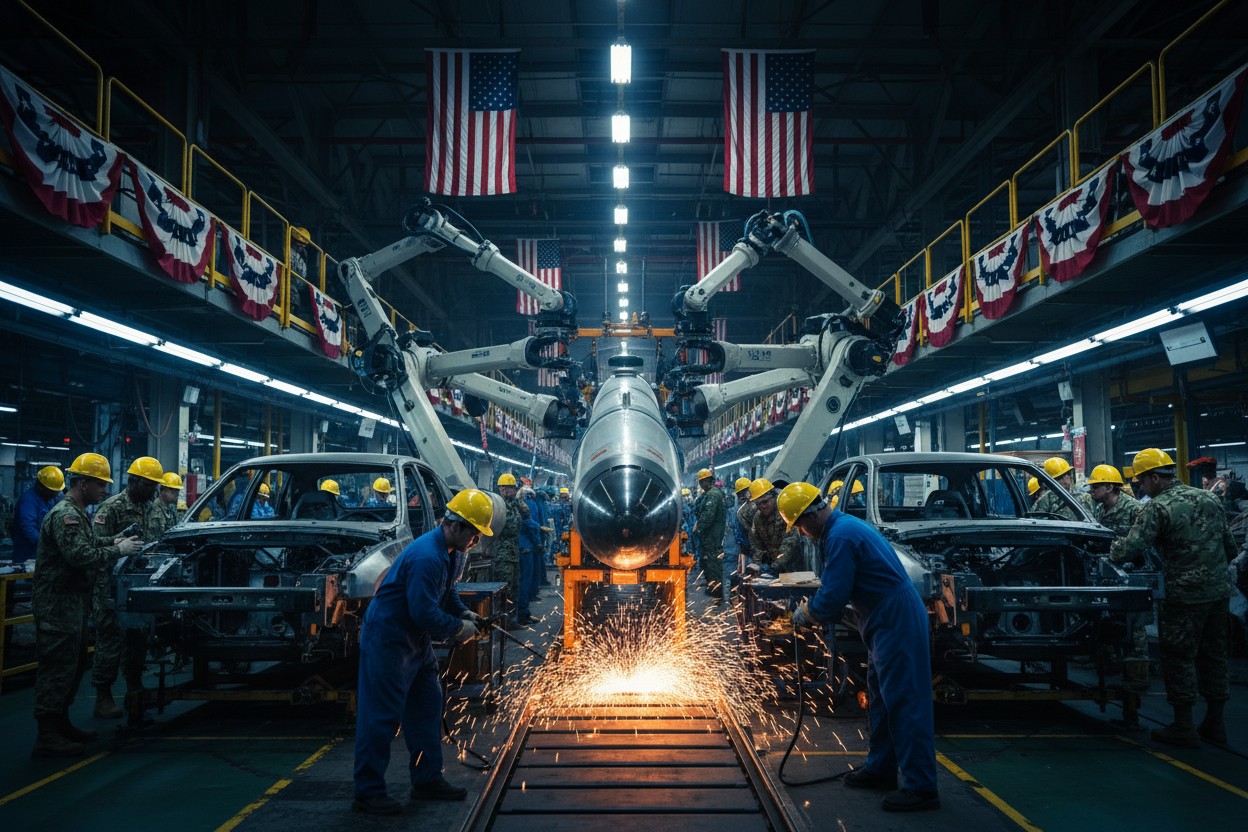
WASHINGTON – In a move reminiscent of the industrial mobilization that defined the United States during the Second World War, the Trump administration has signaled a tectonic shift in national security strategy. President Donald Trump announced on Monday that major American automakers, including General Motors and Ford, are in active discussions to transition civilian assembly lines toward the production of sophisticated weaponry, specifically Patriot air-defense systems and Tomahawk cruise missiles.
This initiative, framed by the White House as a critical component of a "big strong economic push," seeks to rapidly expand the nation’s military output. The goal is to replenish domestic arsenals that have been significantly depleted by prolonged conflicts and intensive military engagements, including recent operations in the Middle East.
The Strategic Shift: A "Wartime Footing" for Industry
Speaking to reporters at the White House, President Trump confirmed that the administration is leveraging the expertise of the automotive giants to address a pressing national security shortfall. "They’re dealing with General Motors. They’re dealing with Ford," the President stated. "I know General Motors is all excited about building weapons now."
The shift represents the latest application of the Defense Production Act (DPA), a Korean War-era statute that grants the executive branch the authority to mandate that private manufacturers prioritize the production of goods essential for national defense. While the DPA was famously utilized by the Trump administration in 2020 to compel General Motors to manufacture ventilators during the height of the COVID-19 pandemic, the current pivot toward missile production marks an unprecedented escalation in its use during peacetime.
Defense Secretary Pete Hegseth has characterized this strategy as placing the U.S. industrial base on a "wartime footing." The Pentagon’s outreach, first reported by the Wall Street Journal in April, has reportedly included discussions with other industrial titans, such as GE Aerospace and Oshkosh, regarding the retooling of civilian factories for the manufacturing of munitions.
Chronology: From Pandemic Response to Military Mobilization
The evolution of this industrial strategy can be traced through several key phases over the last half-decade:
- March 2020: The Trump administration invokes the Defense Production Act for the first time in the modern era, forcing automotive manufacturers to pivot from vehicle production to the assembly of medical ventilators to combat the COVID-19 health crisis.
- 2023–2025: Persistent geopolitical tensions and the sustained supply of military hardware to Ukraine, coupled with intensive missile usage during the U.S.-Israeli conflict with Iran, lead to a sharp decline in domestic munitions inventories.
- April 2026: Reports emerge indicating that the Pentagon has formally approached General Motors, Ford, and other manufacturers to explore the feasibility of retooling existing civilian facilities for munitions production.
- June 2026: President Trump confirms that discussions are underway to convert factory capacity for the manufacturing of Patriot interceptors and Tomahawk cruise missiles, signaling a permanent shift toward long-term defense production.
Supporting Data: Stockpiles and Supply Chain Vulnerabilities
The impetus for this mobilization is rooted in stark data regarding the current state of U.S. military readiness. According to officials familiar with the Pentagon’s assessment, the rapid expenditure of Tomahawk cruise missiles, Patriot interceptors, and THAAD (Terminal High Altitude Area Defense) systems has strained the U.S. supply chain to a degree that threatens the timely fulfillment of commitments to NATO allies.
However, the path to expanded production is fraught with material bottlenecks. The automotive sector, which is being asked to serve as the backbone of this new "Arsenal of Democracy," is simultaneously grappling with a crisis in raw materials. Ford Motor Company recently faced production halts at its Chicago plant due to a acute shortage of rare-earth magnets. These magnets are not only vital for the operation of electric vehicle motors but are also critical components in the guidance and navigation systems of advanced defense munitions.
The scarcity of these materials is a direct byproduct of escalating trade tensions between Washington and Beijing. China, which holds a dominant position in the global processing of rare-earth elements, has implemented export restrictions as a retaliatory measure against U.S. tariff hikes. This has created a paradoxical situation where the administration’s push for "fair play" trade policies has tightened the supply chains of the very companies now being tasked with bolstering national security.
Official Responses and Budgetary Commitments
The administration appears undeterred by these challenges, framing the conversion as a necessary investment in national sovereignty. During his briefing, President Trump downplayed fears of an immediate weapons crisis, noting that the U.S. maintains "quite a few" missiles in reserve, but emphasized that the current administration’s objective is to maintain a significantly larger buffer for future contingencies.
To support this objective, the White House has requested a record-shattering $1.5 trillion military budget for the 2027 fiscal year. Secretary Hegseth has repeatedly argued that this level of spending is essential to restore military readiness. Analysts suggest that the lion’s share of this funding will be directed toward the expansion of production lines, the upgrading of existing facilities, and the creation of strategic stockpiles designed to deter potential adversaries.
While General Motors and Ford have remained largely silent regarding specific contract details, industry experts suggest that the companies are likely viewing these overtures through a lens of economic opportunity. By retooling for military contracts, these firms could secure long-term government revenue streams that are insulated from the cyclical fluctuations of the consumer automotive market.
Broader Implications: Trade, Policy, and Ethics
The intersection of industrial policy, trade protectionism, and militarization has sparked a fierce debate among policymakers and analysts.
The Economic Perspective
Proponents of the Trump administration’s approach, including advocates like Lou Dobbs, argue that this strategy fulfills a long-held promise: to use trade and industrial policy to strengthen the American economy and create domestic jobs. By forcing a return to manufacturing, the administration aims to end the era of "hollowed-out" industrial towns. Small and midsize manufacturers have already reported a surge in orders as supply chains are "near-shored" back to the United States.
The Material Reality
Conversely, a report from the U.S. Geological Survey indicates that despite these efforts, the United States became increasingly dependent on foreign mineral imports in 2025. This reliance on external sources for the materials required to build both electric cars and cruise missiles represents a critical vulnerability in the administration’s long-term plan.
The Moral and Ecological Debate
Beyond the economics, the rapid expansion of military production has drawn criticism from those concerned with the global impact of U.S. policy. Authors such as Gar Smith have warned that an obsession with the "glamours of militarism" often blinds nations to other, perhaps more existential, perils such as ecological collapse. Critics argue that the conversion of civilian-oriented industries into producers of engines of war represents a moral shift that may have lasting consequences on the American social fabric.
Conclusion: The Path Forward
As the White House moves forward with its plan to retool the American heartland, the success of the endeavor will hinge on three primary factors: the ability to secure a reliable, domestic supply chain for rare-earth minerals; the willingness of private corporations to align their long-term growth with Pentagon requirements; and the political sustainability of the $1.5 trillion defense budget.
The "Arsenal of Democracy" approach served the United States well in the 1940s, but the modern global economy is far more interconnected and reliant on complex, fragile supply chains. For President Trump, this policy is the ultimate test of his "America First" doctrine—a high-stakes bet that he can reorganize the engine of the American economy to serve the needs of a new, more volatile geopolitical era. Whether this leads to a manufacturing renaissance or a dangerous overextension of the nation’s industrial capacity remains to be seen.