











Reviewed by Brian St. Pierre, MS, RD
"Is this drug going to steal my job?"
When GLP-1 receptor agonists—the class of medications that includes semaglutide (Ozempic/Wegovy) and tirzepatide (Mounjaro/Zepbound)—first permeated the fitness industry in 2017, this anxiety was palpable among health and fitness professionals. At the time, the drugs were largely viewed as a theoretical disruption. Prescriptions were scarce, and the prospect of a pharmacological solution for weight management felt like a distant challenge to the traditional "calories in, calories out" coaching model.
Fast forward to 2026. The landscape has shifted irrevocably. Over 10% of U.S. adults are now utilizing GLP-1 medications. For the modern coach, the question is no longer about survival, but about evolution. The consensus among elite practitioners has shifted: GLP-1s are not a replacement for coaching, but a powerful, albeit complex, tool that requires a sophisticated, nuanced approach.
The Evolution of the Coaching Paradigm
The initial defensive posture of the fitness industry has largely melted away, replaced by a more pragmatic understanding. Coaches are increasingly viewing these medications as an additive complement to their work rather than a threat. However, the integration of pharmacotherapy into a client’s health journey brings new responsibilities.
Kate Solovieva, a Super Coach and Director of Community at Precision Nutrition, offers a framing that serves as the new industry standard: "As a coach, you’re not in the GLP-1 world; you’re in the GLP-1 support world."
This distinction is vital. Coaches who waste energy decrying the use of medication or attempting to force every client into a "natural" mold are missing the mark. Instead, the market opportunity—and the ethical imperative—lies in identifying the subgroup of GLP-1 users who are actively seeking support to maximize their health outcomes.
Chronology of a Cultural Shift
- 2017: FDA approval of semaglutide for type 2 diabetes begins a quiet revolution. Coaches largely ignore the trend, viewing it as a niche medical intervention.
- 2021–2023: Accelerated adoption follows clinical trials demonstrating significant weight loss efficacy. The "Ozempic" name becomes a cultural touchstone.
- 2024–2025: The "muscle mass panic" sets in. Fitness professionals begin to sound the alarm on sarcopenia and the risks of rapid weight loss without resistance training.
- 2026: GLP-1 usage reaches a critical mass of 1 in 10 adults. The coaching industry formalizes protocols for "GLP-1 support," focusing on protein intake, muscle preservation, and long-term habit formation.
The Taxonomy of the GLP-1 Client
Coaching readiness is fluid, not fixed. A client’s needs will evolve as they move through their medical journey. Based on extensive experience with over 175,000 clients, we have identified seven distinct archetypes, each requiring a specific coaching move.
1. The Honeymooner (Low Readiness)
This client is currently experiencing rapid weight loss with minimal side effects and zero lifestyle changes. They are satisfied and see no reason to "do the work" of tracking or training.
- Coaching Move: Respect their space. Avoid the "righting reflex"—the urge to correct them. Celebrate their success and keep the door open for when the honeymoon inevitably ends.
2. The Ambivalent Candidate (Low-to-Moderate Readiness)
Stuck between the medical provider’s recommendation and their own fears regarding side effects or "taking the easy way out."
- Coaching Move: Use the "4 Crazy Questions" to explore the consequences of both acting and not acting. Do not prescribe; provide data to help them clarify their own values.
3. The Ready-to-Quitter (Moderate Readiness)
They are seeing results but suffering from severe nausea, fatigue, or gastrointestinal distress. They are on the verge of stopping the medication entirely.

- Coaching Move: Normalize the side effects. Suggest small, frequent meals and help them prepare for a conversation with their doctor regarding dosage adjustments.
4. The Muscle-Loss Risk (Moderate Readiness)
The scale is moving, but they are losing lean body mass at an alarming rate due to inactivity and low protein intake.
- Coaching Move: Use objective data like a DEXA scan or strength-testing baselines to show them what is happening under the surface. Pivot their focus to protein at every meal and scaled resistance training.
5. The Under-Fueler (Moderate-to-High Readiness)
The medication has suppressed their appetite to a dangerous degree. They are often eating less than 1,000 calories a day and suffering from fatigue or hair loss.
- Coaching Move: This is a red flag for potential disordered eating. Implement a structured eating schedule regardless of hunger cues. If resistance persists, prioritize a referral to a dietitian or medical professional.
6. The Graduate (High Readiness)
They have reached their goal weight and are preparing to taper off the medication.
- Coaching Move: Temper expectations. The "finish line" is actually the start of an endurance race. Focus on cementing habits that allow them to maintain results without pharmacological assistance.
7. The Priced-Out (High Readiness)
They have been forced off the medication due to insurance changes or cost. They are often frustrated and feeling a loss of control.
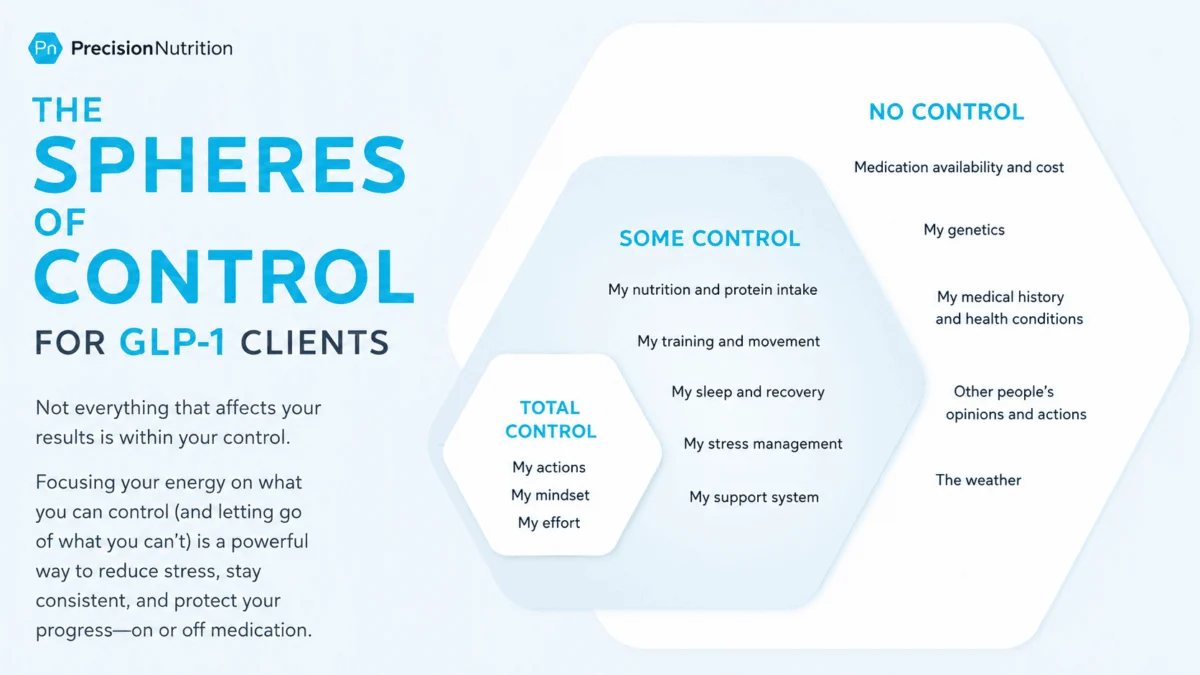
- Coaching Move: Emphasize the "Spheres of Control." Validate their anger at the systemic failure, then redirect their energy toward the foundational habits they can control: protein, sleep, stress, and consistent movement.
Supporting Data and Risks
The biological reality of GLP-1s cannot be ignored. Research indicates that without protective strategies, up to 40% of weight loss in GLP-1 users can come from lean mass. This is the primary driver for the "Muscle-Loss Risk" category. Conversely, those who integrate resistance training and high-protein intake while on the medication are four times more likely to maintain a 10% weight loss upon cessation.
Furthermore, side effects are a common barrier to compliance. Data shows that approximately 50% of users report nausea, 33% report diarrhea, and 20% report vomiting. These are not signs of personal failure; they are predictable physiological responses that require strategic nutritional navigation.
The Ethical Responsibility of the Coach
Coaches must operate strictly within their scope of practice. You are not a doctor; you cannot adjust dosages or prescribe medication. However, you are the architect of the client’s lifestyle environment.
When a client presents with red flags—such as severe vomiting, signs of pancreatitis, or an absolute refusal to consume adequate nutrition—it is not just a coaching decision to refer out; it is an ethical necessity. Always maintain a vetted list of medical professionals to whom you can refer your clients.
Implications for the Future of Coaching
The long-term success of a client, whether they stay on GLP-1s for life or decide to wean off, depends entirely on the "ruts" they carve into their daily routine. Think of the Oregon Trail: the ruts were made by the constant, repetitive passage of wheels. Similarly, a coach’s job is to ensure the client repeats healthy behaviors—resistance training, protein-centric nutrition, and stress management—enough times that these habits become the path of least resistance.
As Toni Bauer, PN’s Director of Coaching and Education Operations, emphasizes: "Ideally, your client will have embraced the identity of a new person. That’s the client who maintains."
The goal is not to keep a client on a medication forever, nor is it to force them off. The goal is to build an identity and a set of neural pathways that function regardless of the chemical intervention. By focusing on the "support world" rather than the "GLP-1 world," coaches can provide the stability and expertise that these clients desperately need, ensuring that the progress made during the medication phase is not just a temporary victory, but a permanent transformation.