








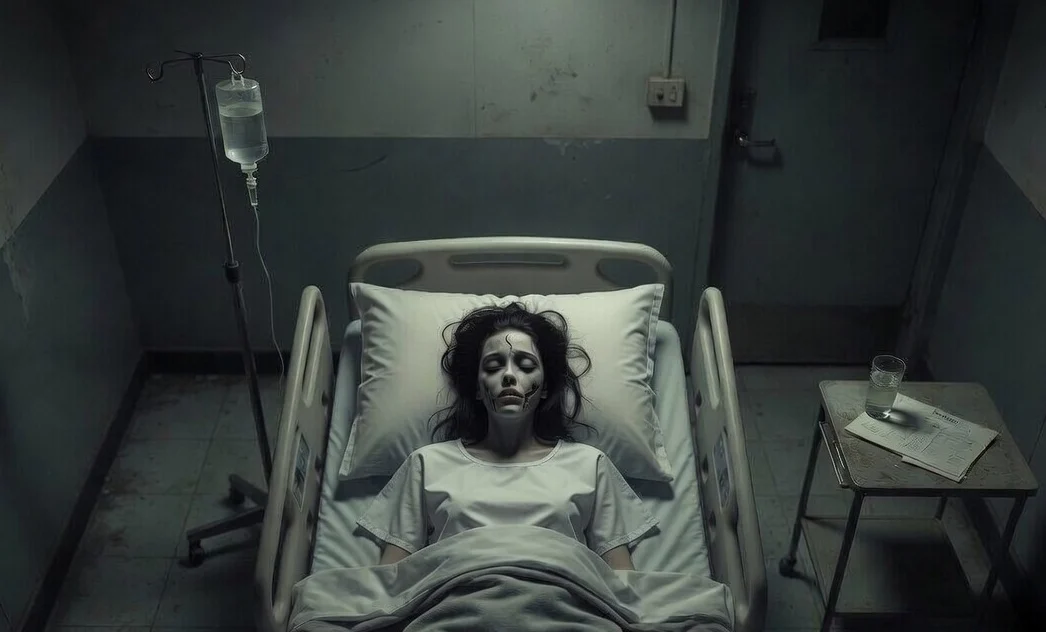
The image is as haunting as it is clinical: a young woman named Natalie, barely out of high school, lying in a rickety hospital bed. She is not suffering from a physical virus or a sudden injury, yet her body is a war zone. She is hallucinating, her limbs are convulsing, and she is screaming in a state of total psychological collapse. Nurses descend upon her, pinning her wrists to the mattress to administer intravenous injections of midazolam and haloperidol. As the tranquilizers take hold, the screaming stops, and she drifts into a chemically induced stupor.
For the medical professionals in the room, this was a clear-cut case of psychosis or perhaps a burgeoning personality disorder. For Natalie, however, this was the physical manifestation of a "rape of the soul"—the result of a calculated, years-long campaign of psychological abuse by two peers.
Natalie Rose’s story, recently detailed in her reflections for the Complex PTSD Foundation and Mad in America, serves as a harrowing case study in the intersection of narcissistic abuse and medical gaslighting. Her journey highlights a systemic failure in modern psychiatry: the tendency to pathologize the symptoms of trauma rather than addressing the root cause of the distress.
Main Facts: The Anatomy of a Psychological Assault
The catalyst for Natalie’s descent was not a biological predisposition to mental illness, but a social "witch hunt." During her final year of high school, a friendship betrayal evolved into a targeted campaign of psychological warfare. The perpetrators—twin sisters—deliberately selected, studied, and "groomed" Natalie for abuse. Their motivation was rooted in a paradoxical combination of proximity and jealousy over Natalie’s academic successes.
Psychological abuse, often categorized as narcissistic emotional abuse, operates through a series of covert tactics designed to dismantle a victim’s sense of reality. In Natalie’s case, the abusers utilized:
- Gaslighting: Manipulating the victim into doubting their own perceptions and memories.
- Intermittent Reinforcement: Using "hot and cold" behavior—alternating between affection and cruelty—to create a Stockholm Syndrome-style trauma bond.
- Isolation: Systematically cutting the victim off from support networks, including friends and family, to ensure total control.
- Grooming: A process of desensitizing the victim to increasingly severe levels of disrespect and boundary-crossing.
By the time Natalie reached college, the abuse had permeated her entire existence. She describes "walking on eggshells," her thoughts and words becoming a mirror of her abusers’ demands in a desperate, failed attempt to avoid further punishment.
Chronology: From Social Torment to Clinical Imprisonment
The Escalation (High School to Early College)
The abuse began as a subtle erosion of Natalie’s confidence. Previously a high-achieving, joyful student, she was conditioned to believe that her success was a provocation. The twins’ "mean girl" tactics evolved into a sophisticated psychological siege. Natalie began experiencing "uncontrollable bodily reactions," including shaking, insomnia, and gastrointestinal distress—the nervous system’s "fight, flight, freeze, or fawn" response to a persistent threat.
The Medical Crisis
As the psychological pressure became unbearable, Natalie’s body began to fail. She was transported to the hospital multiple times by paramedics for symptoms that appeared neurological or psychiatric: hallucinations, word retrieval issues, memory loss, and autoimmune flares.
The medical system’s response was immediate and, according to Natalie, devastating. Rather than investigating the environmental stressors or the history of bullying, clinicians focused on the "disturbing" behavior itself. Natalie was cycled through emergency rooms and psychiatric wards, receiving a revolving door of diagnostic labels, including:
- Schizophrenia
- Psychosis
- Borderline Personality Disorder (BPD)
- Tourette’s Syndrome
- Autism
The Era of Over-Medication
To manage these labels, doctors prescribed heavy regimens of antipsychotics and benzodiazepines. However, these medications often induced their own side effects—paranoia and further hallucinations—which clinicians then interpreted as evidence of a worsening mental illness. Natalie describes this period as being "revictimized by the experts," where her vulnerability was met with mockery and her trauma was treated as a museum of pathology.
The Turning Point: The Cabin in the Woods
Two years ago, Natalie began a radical shift in her recovery. She moved to a cabin in the woods, distancing herself from both her abusers and the psychiatric system. This isolation allowed her to quiet the "external noise" and begin listening to her own voice. Through writing and somatic therapy, she began to deconstruct the "victim-blaming" narratives imposed on her by ill-informed medical providers.
Supporting Data: The Prevalence of Medical Gaslighting in Trauma Cases
Natalie’s experience is far from an isolated incident. Research into Complex Post-Traumatic Stress Disorder (C-PTSD) suggests that victims of prolonged emotional abuse are frequently misdiagnosed with personality disorders, particularly Borderline Personality Disorder.

- The Gender Bias in Diagnosis: Studies have shown that women are disproportionately diagnosed with BPD when presenting with symptoms of trauma. According to the National Education Alliance for Borderline Personality Disorder, up to 75% of those diagnosed with BPD are women, many of whom have extensive histories of interpersonal trauma.
- The Impact of Narcissistic Abuse: While not yet a formal clinical diagnosis in the DSM-5, "Narcissistic Abuse Syndrome" is a term used by mental health professionals to describe the specific cluster of symptoms—including dissociation and cognitive dissonance—observed in victims of high-conflict personalities.
- The Cost of Misdiagnosis: Misdiagnosing trauma as a biological mental illness often leads to the prescription of medications that do not address the underlying nervous system dysregulation. A 2020 study in the Journal of Traumatic Stress highlighted that patients with C-PTSD often show poor responses to traditional antipsychotic treatments, which can exacerbate feelings of alienation and hopelessness.
Official Responses and the Psychiatric Debate
The psychiatric community remains divided on how to handle cases like Natalie’s.
The Traditional Allopathic View:
Standard psychiatric practice, guided by the DSM-5, focuses on symptom management. From this perspective, a patient presenting with hallucinations and convulsions must be stabilized with medication to prevent self-harm or further cognitive decline. Proponents argue that labels like BPD or Schizophrenia provide a necessary framework for insurance coverage and standardized treatment protocols.
The Critical Psychiatry Perspective:
Organizations like Mad in America and the CPTSD Foundation argue that the current system is "profoundly broken." They contend that the medical model often ignores the "social determinants of mental health." Natalie’s critique of her therapists—including one who allegedly made inappropriate advances and suggested she was "in love" with her abusers—highlights a lack of trauma-informed training among practitioners.
In recent years, there has been a growing movement toward Somatic Modalities. These therapies (such as Somatic Experiencing or EMDR) focus on how the body "keeps the score" of trauma. Natalie credits her current recovery to providers who are "in the system but not of the system"—professionals who validate her experience of abuse rather than forcing synthetic substances as a primary solution.
Implications: Reclaiming the Soul from the System
Natalie Rose’s journey from a "tranquilized girl in a hospital bed" to a self-described "warrior" has significant implications for how society views both bullying and mental health.
1. The Necessity of Trauma-Informed Care
Natalie’s story underscores the danger of clinicians who fail to recognize the signs of Stockholm Syndrome and trauma bonding. When a victim appears "obsessed" with their abuser, it is often a survival mechanism (fawning) rather than a romantic or "disturbed" fixation. Therapy must evolve to recognize these nuances to avoid re-traumatizing survivors.
2. The Validity of the Survivor’s Voice
A central theme of Natalie’s recovery is the rejection of clinical labels. By viewing her bodily reactions as "healthy responses to an unhealthy situation," she was able to shed the shame associated with being "mentally ill." This shift from "What is wrong with you?" to "What happened to you?" is the cornerstone of modern trauma advocacy.
3. The Power of Somatic Recovery
Natalie’s progress in her "cabin in the woods" suggests that for some survivors, the path to healing lies outside the clinical environment. By focusing on her nervous system and physical safety, she has reached a point where she no longer experiences physical reactions to the memory of her abuse.
Conclusion: An Indestructible Soul
Today, a decade after the initial trauma, Natalie Rose continues to navigate the remnants of her experience. She battles the lingering effects of medication withdrawal and the grief of lost years. Yet, her outlook is one of defiant optimism.
She maintains a sign above her doorknob with adjectives that describe the "truth" of her soul: spunky, fearless, authentic, creative, and unstoppable. Her story is a testament to the resilience of the human spirit in the face of both interpersonal cruelty and institutional failure.
"The people, groups, and systems of the world can crush my mind, body, and psyche into little pieces," Natalie writes. "But what the world cannot destroy, no matter how hard it tries, is my soul. My soul is indestructible."
For the thousands of survivors who see themselves in Natalie’s struggle, her message is clear: the "crazy" labels imposed by the world are often just the echoes of a body trying to survive the unthinkable. Recovery is not just about silencing the symptoms; it is about retrieving the soul from those who tried to steal it.