











For millennia, our ancestors navigated the complexities of health and survival by relying on their internal compass: a visceral, sensory understanding of how they felt. They knew when they were exhausted, when they were fueled, and when they were primed for physical exertion. Today, however, that internal dialogue is increasingly being drowned out by the digital hum of wearables.
From heart rate variability (HRV) and step counts to sleep staging and caloric expenditure, we are currently living in the age of the "Quantified Self." While these devices promise a bridge between subjective feeling and objective reality, they also introduce a modern dilemma: Are we becoming more in tune with our bodies, or are we simply outsourcing our self-awareness to an algorithm?
The Data Paradox: When Precision Becomes Noise
The appeal of fitness trackers is undeniable. In the best-case scenario, these devices act as a reality check. We are notoriously poor at quantifying our own behaviors. A colleague once insisted he was maintaining a strict caloric deficit, only to discover through meticulous logging that he was consuming an additional 500 calories daily—hidden entirely in his affinity for barbecue sauce.
Yet, there is a limit to this utility. Samantha Kleinberg, a computer scientist specializing in decision-making, notes that even small amounts of extraneous information can degrade our ability to make sound choices. This is the "paradox of tracking": too little information leaves us flying blind, but too much information leads to analysis paralysis. When the path forward is obscured by a sea of metrics, we lose the ability to act intuitively.
Chronology of the Quantified Movement
The transition from "listening to the body" to "consulting the dashboard" did not happen overnight.
- The Analog Era: Until the late 20th century, physical feedback was purely internal—Rate of Perceived Exertion (RPE) was the gold standard for athletes.
- The Early Calibration Era (1980s–2000s): Athletes like Ben Johnson famously demonstrated "outlier performance," possessing an almost supernatural ability to track their own 100-meter sprint times within a tenth of a second of a stopwatch. This was the pinnacle of human-sensory calibration.
- The Wearable Explosion (2010–Present): With the rise of affordable sensors, accelerometers, and optical heart-rate monitors, the general public gained access to clinical-grade data. Suddenly, "feeling tired" was no longer sufficient; users demanded to see a "low recovery score" to justify a rest day.
Supporting Data: The Accuracy Gap
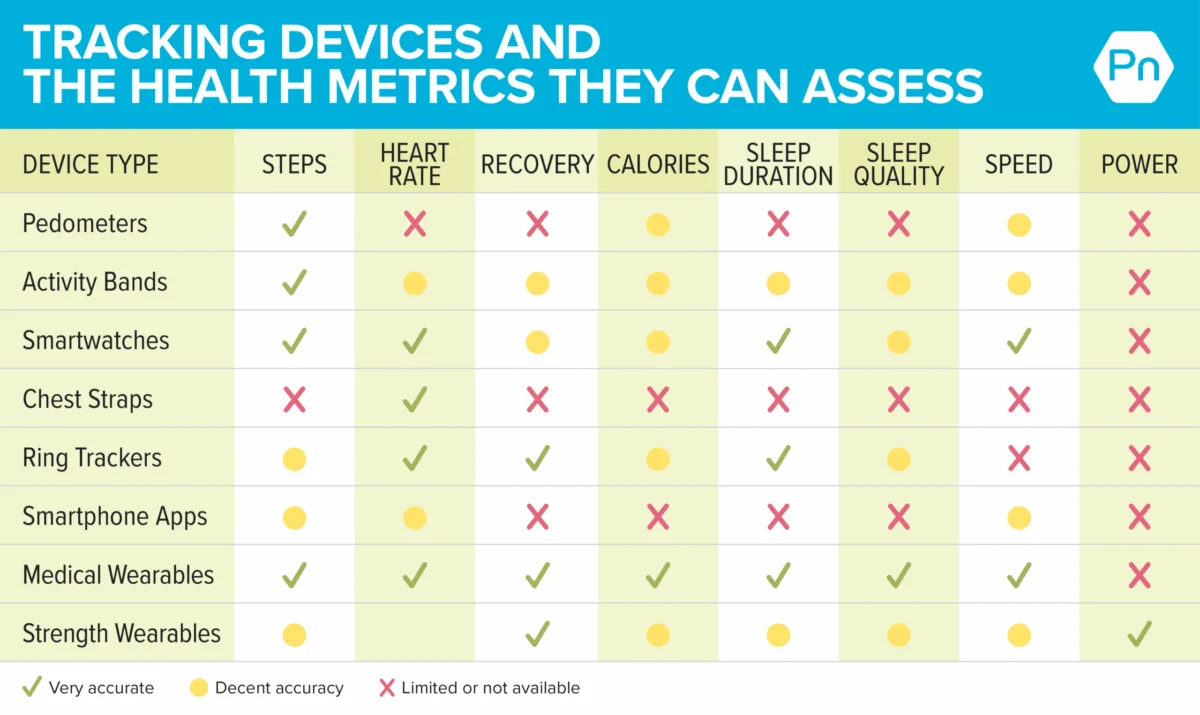
It is a common misconception that all data is created equal. While heart rate and step counting have reached high levels of reliability, other metrics—such as "calories burned" and "movement velocity"—remain prone to significant margins of error.

When evaluating the utility of these devices, users must consider the "Sweet Spot" of information. As displayed in industry research, the relationship between data availability and decision-making performance follows an inverted U-shaped curve.
- The Low End: Insufficient data leads to guessing and potential injury.
- The Peak: The "Sweet Spot" where data informs intuition.
- The High End: Data overload leads to anxiety, burnout, and a complete disconnection from physical signals.
Signs You Are Using Tech Correctly (or Incorrectly)
To determine whether your relationship with your fitness tracker is healthy, examine how it impacts your daily behavior.
1. The Validation Effect
For many, data serves as a necessary reassurance. Consider the case of "Zak," a high-performing athlete who struggled to trust "easy" training days. His coach prescribed Zone 2 cardio, but Zak felt like he wasn’t doing enough. By tracking his resting heart rate, he saw tangible proof that his body was recovering and adapting. The data acted as a mirror, validating his training method and reducing his performance anxiety.
- The Bad Omen: If you find yourself stressed by data you cannot control—such as a poor sleep score after a night caring for a newborn—you are using the tracker as a source of judgment rather than a tool for improvement.
2. Motivation and Behavioral Prompts
Behavioral psychology suggests that action requires three components: motivation, ability, and a prompt. Trackers are excellent at providing the "prompt." A classic example involves users who believe a nightcap helps them sleep. Once they see their sleep quality plummet on a tracker, the visual evidence acts as a behavioral intervention. "Once you see it, you can’t un-see it."
- The Bad Omen: If the pursuit of records—such as destroying local cycling leaderboard times—becomes more important than the joy of the ride, the tracker has shifted from a tool to a taskmaster, leading to potential burnout.
3. Self-Awareness vs. Dependency
Ideally, trackers should teach us how to read our own bodies. By checking in with yourself before looking at the data, you begin to calibrate your internal sensors.
- The Bad Omen: The "Great App Blackout" of 2019 serves as a cautionary tale. When major tracking platforms went offline, millions of users felt a sense of panic. They no longer knew how much to eat or how hard to train because they had completely surrendered their intuition to an interface. This is the definition of "nomophobia"—the fear of being without one’s digital lifeline.
Implications: The Future of Intuitive Training
Does this mean we should abandon our smartwatches? Absolutely not. Instead, we must shift our philosophy. The future of health and performance lies in the calibration of the human sense with the digital sensor.

Developing Mental Shortcuts
Rather than relying on an accelerometer to tell you how hard you worked, use the "Million Dollar Question": If I had to do this for a million dollars, how many more reps could I perform? By forcing yourself to estimate your capacity before consulting the data, you sharpen your RPE (Rate of Perceived Exertion). Over time, your internal sense becomes as precise as the tracker on your wrist.
Reclaiming the Senses
Human beings possess a biological suite of sensors that technology cannot replicate:
- Proprioception: The awareness of where your limbs are in space.
- Interoception: The internal sense of heart rate, hunger, and fatigue.
- Vestibular Sense: The sense of balance and spatial orientation.
These systems are part of a sophisticated, neural pattern-recognition engine. When you use technology to validate these internal signals, you aren’t just becoming a "quantified" human; you are becoming a more attuned one.
Conclusion: The Goal is Mastery, Not Metrics
Ultimately, the most successful athletes and health enthusiasts are those who use data to build a resilient practice—one based on mindfulness, mastery, and meaning. When the scale plateaus or the race times regress, extrinsic motivation will fade. If your entire identity is tied to the numbers on a screen, you will likely quit. If, however, your identity is tied to the felt experience of movement and the enjoyment of the process, you will be able to weather the plateaus.
Fitness trackers are a powerful tool for the toolbox, but they should never become the architect of your health. Use them to calibrate, use them to learn, and—when the time is right—have the confidence to leave the screen behind and listen to the only device that truly matters: your own body.
For those interested in mastering the art of coaching and helping others build sustainable, data-informed lifestyle habits, the Precision Nutrition Level 1 Certification provides the foundational knowledge to navigate these complexities.