









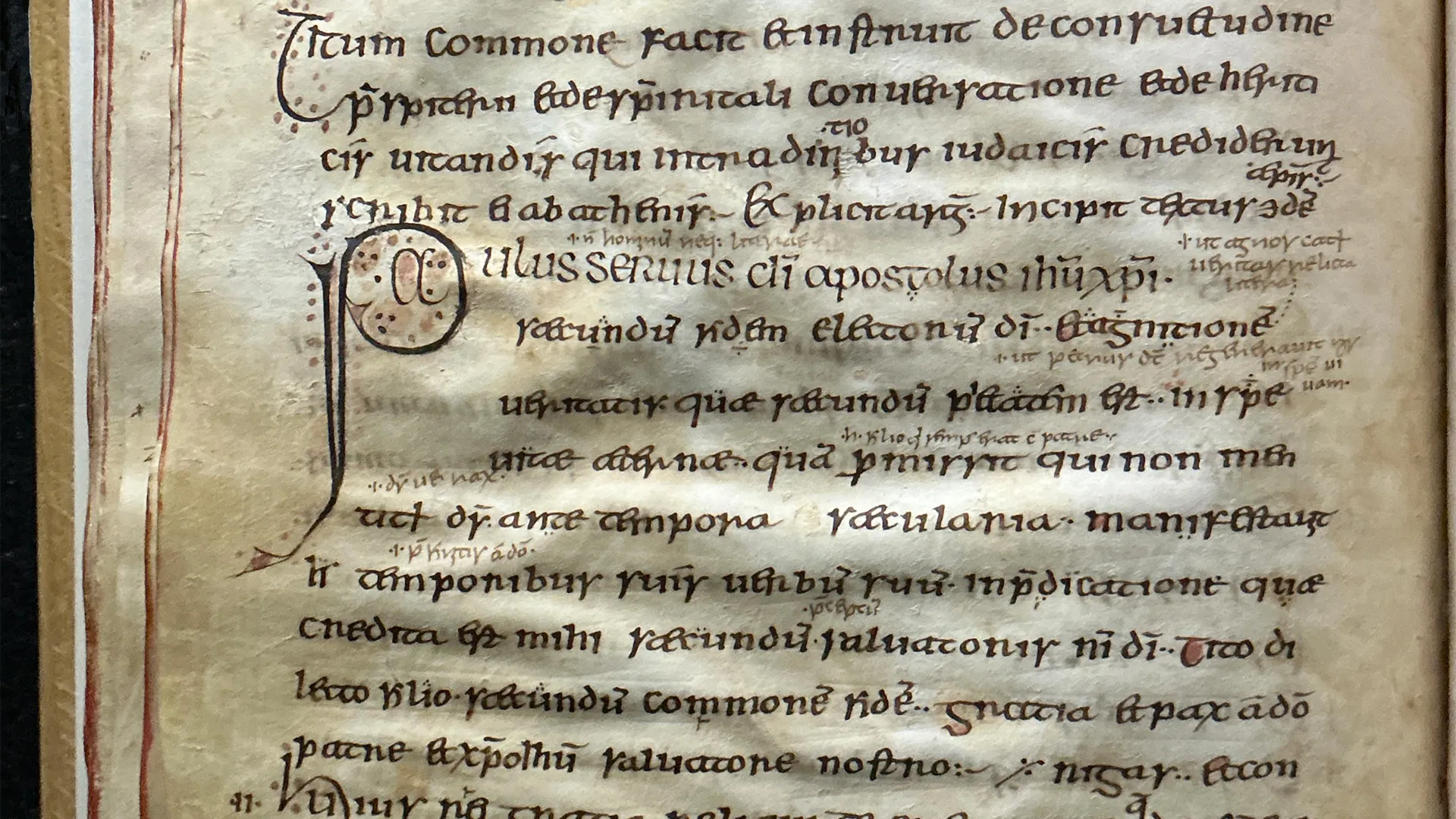
For centuries, the York Gospels have been revered as a masterpiece of Anglo-Saxon artistry—a silent, illuminated witness to the religious and cultural fervor of the early Middle Ages. Yet, beneath the intricate calligraphy and gold-leaf illustrations, these pages have been hiding a darker, biological history. An international team of researchers, led by University College Dublin (UCD), has unlocked a startling secret preserved within the parchment of these and other ancient manuscripts: the genetic signature of the sheeppox virus (SPPV).
This groundbreaking study, published in Science Advances, does more than just identify a dormant pathogen; it provides a definitive genetic timeline for a disease that has plagued livestock for millennia. By treating historical documents as "biological archives," scientists have successfully reconstructed over 3,500 years of viral evolution, revealing that the sheeppox virus has remained remarkably stable throughout human history.
The Parchment Paradigm: Manuscripts as Disease Reservoirs
Before the advent of the printing press and the mass production of paper, information was captured on vellum and parchment—materials derived from the processed skins of sheep, goats, and cattle. While historians have long studied these materials for their linguistic and aesthetic value, they have rarely considered them as repositories of environmental and biological data.
"The recording of ancient DNA of pathogens has completely changed our understanding of infectious disease in the past," explains Louis L’Héte, a PhD candidate at UCD and the study’s lead author. "Here, we show that parchment can also preserve animal pathogen DNA. It is possible that archives and libraries around the world also contain the genetic traces of disease outbreaks in animals in the past."
The study’s methodology involved analyzing several historically significant works, including the 1,000-year-old York Gospels and the Corpus Glossary—one of the earliest English dictionaries, housed at Corpus Christi College, Cambridge. The findings were uniform across various sites: the DNA of the sheeppox virus was present on the pages, indicating that the animals utilized to produce the parchment were infected with the disease at the time of their death.
Perhaps most intriguingly, the researchers detected viral DNA on parchment derived from goatskin and calfskin. Since sheeppox is highly specific to sheep, this anomaly suggests one of two scenarios: either the virus exhibited a wider host range in the medieval period, or, more likely, cross-contamination occurred during the intensive, communal process of parchment production in medieval tanneries.
A Chronology of Contagion: From Bronze Age Steppes to Medieval Europe
To contextualize the findings from the manuscripts, the research team expanded their scope, looking back further into the mists of prehistory. By examining ancient sheep teeth recovered from pastoralist settlements across the Eurasian steppe, the scientists were able to bridge the gap between the medieval period and the Bronze Age.
Teeth are the "gold standard" for paleogenetic research, as the hard enamel acts as a protective vault, shielding delicate genetic material from environmental degradation for thousands of years. The analysis of these teeth confirmed the presence of the sheeppox virus dating back at least 3,700 years.
The Evolutionary Timeline:
- 11,500 – 3,700 Years Ago: Genomic comparison suggests that the major branches of the capripoxvirus family—comprising sheeppox, goatpox, and lumpy skin disease—diverged during this epoch. This timeframe aligns perfectly with the rise of human agricultural societies, the domestication of livestock, and the mass migration of sheep from the Eurasian steppe into Europe.
- 3,700 Years Ago: The earliest evidence of the virus is found in Bronze Age sheep teeth, establishing a baseline for the pathogen’s impact on early pastoralists.
- The Medieval Period (approx. 1,000 years ago): Viral DNA embedded in illuminated manuscripts demonstrates that sheeppox was a persistent and destructive presence throughout the Middle Ages, affecting sheep flocks across Britain and continental Europe.
The correlation between human migration and viral spread is significant. As humans moved their herds across vast distances to seek new pastures, they inadvertently created the perfect conditions for the virus to flourish, mutate, and establish itself as a permanent fixture in the agricultural landscape.
The Resilience of a Pathogen: Stability Over Millennia
Perhaps the most surprising takeaway from the study is the genetic inertia of the sheeppox virus. While many viruses—such as influenza—are defined by their rapid mutation rates, the sheeppox genome appears to have remained largely unchanged for several millennia.
"We find that unlike the smallpox virus, the sheeppox virus genome was very stable over the last few millennia," says L’Héte.
This stability provides a unique advantage for modern researchers. Because the virus has not drastically altered its core genetic structure, the ancient samples provide a direct map of the pathogen’s biology. By understanding how the virus stabilized and became a highly effective sheep pathogen in the past, scientists hope to gain insights into how it might be combated today.
Implications for Modern Agriculture and Global Health
Sheeppox remains a catastrophic threat to modern livestock farming. It is a highly contagious disease characterized by rapid transmission, high mortality rates among lambs, and devastating economic consequences. Outbreaks reduce yields in wool, meat, and milk, often crippling small-scale farmers and causing significant disruption to international trade.
The contemporary relevance of this study is underscored by current events. "People around the world are still fighting against this pathogen," L’Héte notes, pointing to recent outbreaks in Greece that have caused widespread economic distress.
By analyzing the "deep time" evolution of the virus, researchers are now better positioned to develop vaccines and mitigation strategies. If the virus’s genetic makeup has remained stable, the targets for therapeutic intervention may be equally enduring. Understanding the "genetic lock" that allowed this virus to thrive for 3,700 years could be the key to finally breaking its hold on modern agriculture.
Collaborative Science: Uniting the Disciplines
This massive undertaking, which involved over 30 institutions, serves as a testament to the power of interdisciplinary research. The project brought together specialists from fields as diverse as genetics, virology, medieval history, protein chemistry, and conservation.
Dr. Kevin G. Daly, Associate Professor at UCD’s School of Agriculture and Food Science and the study’s supervising author, emphasizes that the discovery would have been impossible without such cooperation.
"This kind of exciting, surprising discovery is only possible when researchers from a range of disciplines come together to share their expertise and data—a generosity and trust that collaborative science depends on," says Dr. Daly. "Parchment making has been considered a vanishing craft, but we are beginning to understand just how much of the past it has retained."
Conclusion: Archives of the Future
The success of the UCD-led team opens a new frontier in historical science. Libraries and archives, once seen merely as places to read about the past, are now revealed to be massive, untapped bio-banks. Every sheepskin manuscript, every leather-bound ledger, and every parchment document produced before the industrial era is a potential time capsule, waiting to yield its secrets about the evolution of disease.
As the team looks to the future, they suggest that this methodology could be applied to other pathogens. From bubonic plague to livestock-borne viruses that have shaped human civilization, the genetic history of our world is literally written into the books we have preserved.
The research was made possible through the funding and support of Taighde Éireann-Research Ireland and the European Research Council. As the scientific community digests these findings, one thing is clear: the history of human progress is inextricably linked to the pathogens that have walked—and suffered—alongside us. By looking at the pages of history, we are finally beginning to understand the full, often microscopic, reality of the world we inhabit.