As the sleep technology landscape experiences a seismic shift, the introduction of the Sleepal AI Lamp in May 2026 marks a pivotal departure from the status quo. For over a decade, the consumer market has been flooded with wearable devices that promise "sleep insights" based on proprietary, often opaque algorithms. Yet, the industry has faced a recurring critique: the lack of rigorous, clinical-grade validation.
The launch of the Sleepal AI Lamp represents a tactical pivot in this narrative. The focus is no longer on the theoretical capabilities of radar-based monitoring, but rather on the empirical challenge of clinical validation. By releasing an extensive dataset alongside its product launch, Sleepal is forcing a conversation about how we define the boundary between wellness tracking and medical-grade diagnostics.
Main Facts: A New Benchmark for Contactless Monitoring
The Sleepal AI Lamp is a contactless, radar-based monitoring system that utilizes 60 GHz millimeter-wave technology to track physiological data without requiring the user to wear sensors, bands, or watches. Unlike standard wearables that rely on accelerometry or photoplethysmography (PPG), the Sleepal system captures submillimeter chest wall displacements—the subtle rhythmic movements associated with cardiac and respiratory activity.
The most striking feature of this launch is not the hardware itself, but the data supporting it. Sleepal enters the market with a foundation built upon a 1,022-night validation study, supplemented by over 2,000 total nights of simultaneous polysomnography (PSG) and radar data collected across multiple hospital sleep laboratories. This dataset, now available as a preprint on arXiv (2604.16442), serves as a high-water mark for a sector that has historically operated with little to no public accountability.
Chronology: From Concept to Clinical Benchmarking
The development of the Sleepal AI Lamp was led by Dian Fan, a former executive at a Fortune 500 smart home company. Recognizing the limitations of consumer-grade sleep trackers, Fan’s team opted for a development path that bypassed the typical "black box" approach common in Silicon Valley.
- Early Development: The team focused on overcoming the signal-to-noise ratio challenges inherent in radar-based monitoring, utilizing modern digital beamforming and machine learning to isolate respiratory and cardiac signals from ambient environmental noise.
- The Validation Phase: In partnership with undisclosed hospital sleep labs, the team conducted a longitudinal study involving participants with a wide range of sleep profiles, including those with mild-to-moderate obstructive sleep apnea (OSA), periodic limb movement disorder (PLMD), and fragmented sleep architectures.
- May 2026: The official crowdfunding launch, coupled with the public disclosure of their validation methodology on arXiv, signaling a shift toward transparency in the consumer health sector.
Supporting Data: Rigor in a Sea of "Wellness" Products
The core differentiator of the Sleepal system is its performance across a heterogeneous population. Many existing algorithms are trained on "healthy sleepers," leading to a significant drop in accuracy when the user presents with a sleep disorder.

The Sleepal dataset reports:
- Sleep/Wake Discrimination: A 92.77% correct assignment rate.
- Sleep Staging: A 77.2% accuracy in identifying the four standard sleep stages.
- Disordered Populations: Even among patients with severe obstructive sleep apnea (AHI > 30), the system maintained a 74.3% accuracy rate.
These figures were derived in clinical settings, ensuring that the performance metrics reflect the "real-world" complexity of sleep environments rather than the idealized conditions of a controlled laboratory.
Environmental Sensing: The Missing Link in Sleep Hygiene
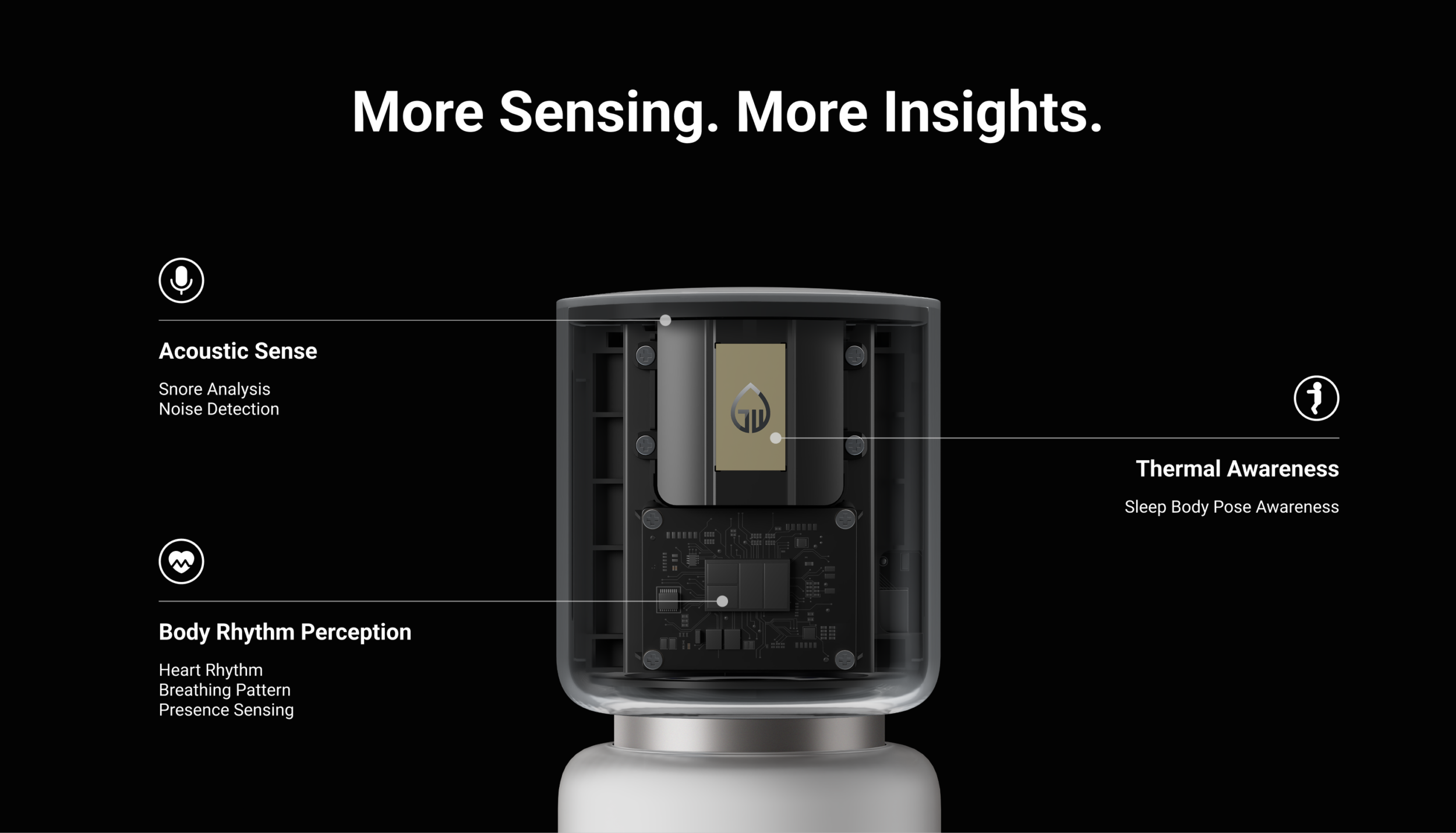
While physiological data has dominated the conversation, Sleepal introduces a secondary, highly significant layer: environmental monitoring. By tracking ambient temperature, humidity, light levels, and acoustics, the device offers a holistic view of the sleeping environment.
Bridging the Gap in Behavioral Interventions
Sleep clinicians have long advised patients on the importance of "sleep hygiene"—maintaining optimal temperatures (15–20°C), reducing light, and managing noise. However, monitoring adherence to these recommendations has traditionally relied on subjective patient self-reporting, which is notoriously unreliable.
The Sleepal AI Lamp provides an objective bridge. For instance, a patient complaining of mid-night awakenings might discover a correlation between their sleep fragmentation and a 3-4°C rise in bedroom temperature caused by poor ventilation. This transforms abstract "hygiene" advice into actionable, data-driven behavioral interventions.
Passive Posture Monitoring
Utilizing a thermal array—distinct from optical cameras—the device tracks sleep posture (supine, lateral, or prone). This is particularly relevant for the 25% to 30% of the population whose sleep quality is position-dependent. Previously, verifying adherence to positional therapy required bulky wearables or labor-intensive video analysis. Sleepal provides this information passively, offering clinicians a new tool for monitoring therapeutic compliance.

Official Stance: The Wellness vs. Medical Divide
Despite the high level of technical accuracy, the company is careful to categorize the Sleepal AI Lamp as a consumer wellness product. It is not FDA-cleared for diagnosis or disease detection. This distinction is critical, yet it creates a complex paradox for the medical community.
If a device reaches an accuracy level comparable to Type III home sleep apnea testing (HSAT) devices, at what point does it become "clinically relevant"? We have seen this tension before; the irregular rhythm notification features on smartwatches were never intended to be diagnostic, yet they have led to the clinical detection of atrial fibrillation in countless users.
Implications for Sleep Medicine Practice
The arrival of Sleepal forces a reckoning within sleep medicine. For physicians, the challenge is no longer about whether to recommend a specific brand, but how to interpret the data that patients are increasingly bringing into the office.
1. The New Standard of Disclosure
The validation approach employed by Sleepal—large sample sizes, diverse patient populations, and open-access preprints—should be viewed as the new minimum requirement for manufacturers. Sleep medicine professionals now have a clear, objective standard to use when evaluating future entrants to the market. When a company claims their device is "clinically validated," the clinician’s response should be: "Where is the data, and may we see the preprint?"
2. Clinical Counseling and Limitations
Physicians must continue to manage patient expectations. Contactless devices can offer insights into patterns and environmental factors, but they cannot replace the gold-standard polysomnography required for diagnosing primary sleep disorders. For patients who find wearables uncomfortable, claustrophobic, or irritating to the skin, contactless systems provide a necessary alternative that maintains a level of accuracy sufficient for lifestyle adjustments.
3. The Future of the Field
The American Academy of Sleep Medicine (AASM) has maintained a cautious stance on consumer trackers, and this remains a prudent position. However, the trajectory of the technology is undeniable. As contactless sensors improve, the line between "wellness" and "clinical data" will continue to blur.

The role of the sleep professional is not to ignore these advancements, but to define their place within the care continuum. We are moving toward a future where environmental data and longitudinal, non-invasive physiological tracking will play a substantial role in patient management.
Conclusion: A Turning Point?
Whether the Sleepal AI Lamp becomes the new standard or simply another well-marketed iteration of existing tech will ultimately be decided by independent peer review and long-term user outcomes. However, the precedent set by the transparency of their 1,022-night dataset is a significant, positive development.
For the sleep medicine community, the message is clear: the technology is no longer the bottleneck. The bottleneck is the methodology used to validate it. By providing the research community with the data required to evaluate their claims, Sleepal has moved the goalposts for every other player in the industry. For now, the most important takeaway for clinicians is that the era of "trust us" marketing is coming to a close, replaced by an era where data must be seen to be believed.