










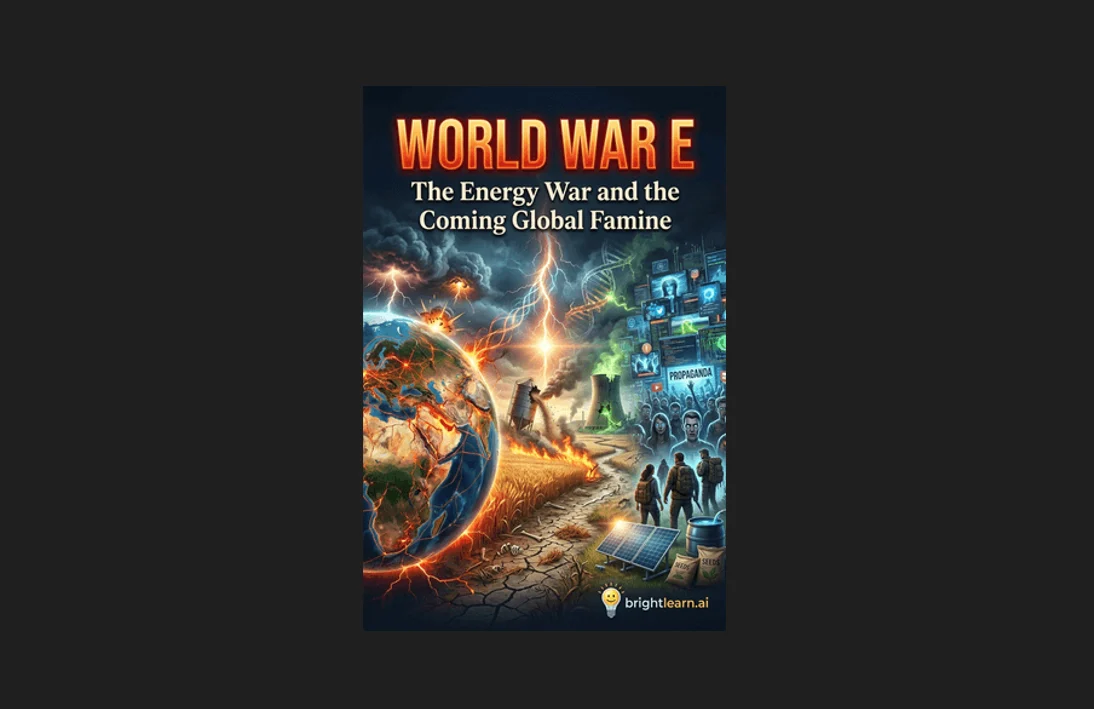
In the modern era, energy is the invisible architecture upon which all of human life rests. It is the silent current that powers the hospital ventilator, the combustion that moves the tractor across the field, and the heat that preserves the cold chain of our food supply. Yet, according to Matt Bracken’s latest manuscript, World War E: The Energy War and the Coming Global Famine, this fundamental lifeblood of civilization is currently the target of a coordinated, global campaign of sabotage and systemic dismantling.
Bracken’s work serves as an urgent indictment of a geopolitical landscape that many perceive as a series of unrelated, unfortunate accidents. Instead, he presents a meticulously documented case that the "green transition" and global supply chain failures are not the result of market forces or climate change, but rather the calculated levers of an engineered collapse.
The Anatomy of an Energy Siege
To understand the scope of World War E, one must first acknowledge the fragility of the global energy grid. Bracken posits that the modern world is a "just-in-time" society, dependent on a fragile web of pipelines, tankers, and refineries. When this web is tugged at specific, high-tension points, the entire fabric of civilization begins to unravel.
The narrative moves beyond abstract theory, pointing to tangible acts of sabotage that have reshaped the global energy landscape since 2022. The destruction of the Nord Stream pipelines, for instance, is framed not as an isolated act of regional conflict, but as a surgical strike intended to sever Europe’s industrial heart from reliable, low-cost energy.
A Chronology of Strategic Destabilization
- September 2022: The sabotage of the Nord Stream pipelines, which removed a critical artery for natural gas distribution to European industrial hubs.
- The Houthi Blockade: Escalating tensions in the Red Sea and the Bab al-Mandeb strait have effectively weaponized a global maritime choke point, driving up shipping costs and interrupting oil flows.
- Targeted Infrastructure Attacks: The systematic targeting of Russian energy refineries by drone warfare, often facilitated by intelligence networks, has been instrumental in squeezing global fuel supply, leading to the inflationary spikes felt by the average consumer at the pump.
- The Balticconnector Incident: The disruption of subsea cables and pipelines in the Baltic region serves as further evidence of an ongoing campaign to induce energy insecurity across the continent.
The Nexus of Energy and Famine
Perhaps the most harrowing component of Bracken’s analysis is the connection between energy policy and the biological survival of the human population. The link is direct and indisputable: fertilizer production is chemically dependent on natural gas. By restricting the availability and raising the price of energy, the architects of this system have effectively engineered a global bottleneck in food production.
The Mathematics of Decline
Bracken draws upon the research of economist Professor Steve Keen, who suggests that the coming years will witness a staggering shortfall in food availability. The figures cited are grave, with projections indicating that the current global agricultural infrastructure will struggle to support billions of people.
This is not a matter of soil depletion or weather patterns; it is a matter of industrial input. When nitrogen-based fertilizers—which sustain the high-yield crops necessary for a global population of eight billion—become unaffordable or unavailable, the "Green Revolution" goes into reverse.
Furthermore, Bracken explores the weaponization of biological threats, such as the introduction of screwworm and other livestock diseases, which serve to accelerate the degradation of protein supplies. As fuel becomes scarce, the "just-in-time" delivery system for perishables collapses, turning a systemic energy shortage into a localized famine.
Psychological Warfare: The Normalization of Crisis
A significant portion of World War E is dedicated to the psychological state of the populace. Invoking the framework of Yuri Bezmenov—the late KGB defector who famously outlined the stages of ideological subversion (demoralization, destabilization, crisis, and normalization)—Bracken argues that the public is being subjected to a relentless program of "learned helplessness."
The constant oscillation between states of crisis—from pandemic lockdowns to sudden, unexplained price spikes and energy shortages—is designed to strip the individual of their agency. By consistently moving the goalposts, the authorities induce a state of exhaustion where the public eventually ceases to plan, stops resisting, and accepts the "new normal" as an inevitable feature of modern life.
The media, according to Bracken, acts as the primary enforcement arm of this strategy. By framing systemic failures as "supply chain issues" or "climate change," the establishment gaslights the public, effectively masking the deliberate nature of the scarcity. The author contends that independent, alternative media has become the last bastion for critical thinking, serving as the only effective counterweight to a narrative designed to manufacture compliance.
Decentralization as the Ultimate Antidote
Amidst the bleak outlook, World War E is fundamentally a call to action. It rejects the fatalism that often accompanies such investigations and provides a manual for resilience. Bracken argues that the primary vulnerability of the current system is its centralization. By relying on municipal water, centralized energy grids, and global supply chains, the average citizen has surrendered their survival to forces that do not have their best interests at heart.
Survival Strategies for a Post-Centralization World
- Energy Autonomy: Investing in local, decentralized power generation, such as small-scale solar or wind, to mitigate reliance on the vulnerable national grid.
- Water Independence: Learning to harvest rainwater and the development of private, deep-well systems to bypass the potential failure of municipal water treatment facilities.
- Community Networks: Rebuilding the local social fabric. Bracken emphasizes that when institutional systems fail, the strength of one’s community—neighbors, local farmers, and skill-sharing networks—becomes the most valuable asset for survival.
- Food Security: Moving toward permaculture and home-based food production. The act of saving seeds and growing one’s own sustenance is framed as a radical act of independence from a system designed to starve the non-compliant.
Implications for the Future
The implications of World War E are profound. If Bracken’s assessment is correct, we are living through a transition period characterized by the intentional dismantling of the industrial age. The "Energy War" is not a temporary fluctuation; it is a permanent restructuring of how civilization functions.
The political establishment, for its part, continues to push for "Green New Deals" and net-zero policies, which critics argue are merely the branding for this managed decline. By demanding that societies transition away from high-density, reliable energy sources toward intermittent, lower-density alternatives, governments are effectively locking in a future of scarcity.
For the reader, the conclusion is clear: the era of relying on the system to provide for basic needs is drawing to a close. The "smoking gun" that Bracken identifies is not just the sabotage of a pipeline or the manipulation of a market; it is the realization that the modern comfort of the average citizen was always contingent upon a stability that has been quietly withdrawn.
World War E serves as a clarion call for the prepared. It is not designed to provide comfort, but rather to provide the necessary tools for those who refuse to be mere casualties of a global, engineered collapse. In an age of information warfare and systemic gaslighting, the most radical thing an individual can do is to become self-sufficient. As the book concludes, the ultimate weapon against the architecture of the "con game" is the restoration of the individual’s ability to survive without the permission of the state.
Whether one views this as a dystopian conspiracy or a realistic assessment of geopolitical maneuverings, the evidence presented by Bracken necessitates a closer look at the world around us. The next time the grocery bill rises or the energy grid flickers, the informed reader will look past the headlines and toward the broader, darker strategy that is being played out on the global stage.