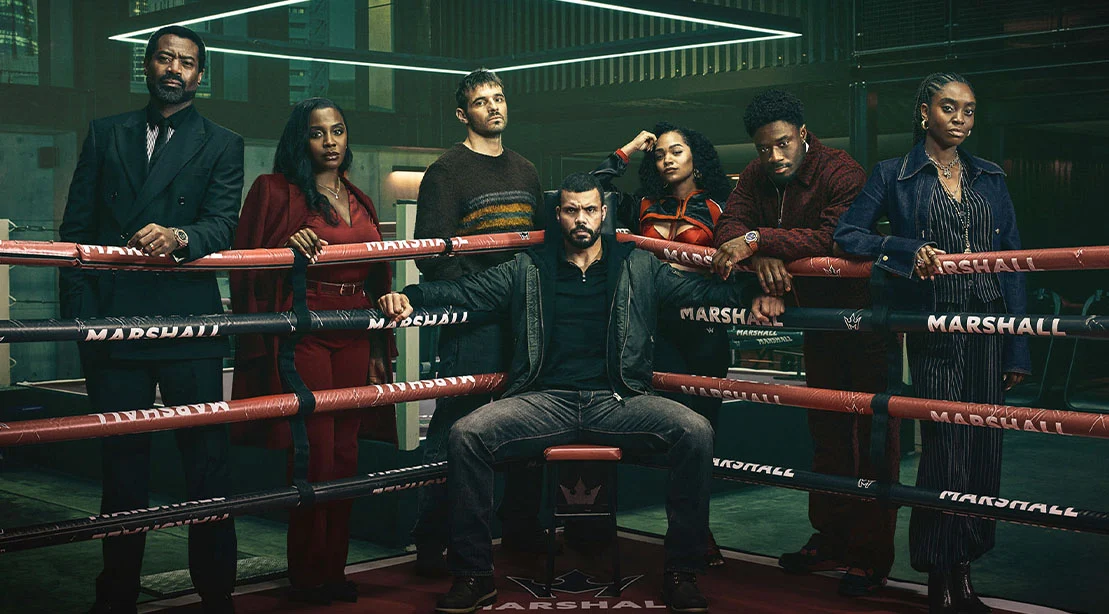
When the cameras roll on Fightland, the new high-stakes drama from Starz, the audience is immediately thrust into the visceral, sweat-soaked reality of professional boxing. The series, which masterfully blurs the lines between the squared circle and the shadows of organized crime, demands more than just acting ability; it demands the physical presence of a man prepared for war. At the center of this storm is Howard Charles, who portrays Maduka “Duke” Kilroy, a former champion seeking vengeance against the criminal syndicate he believes orchestrated his brother’s demise.
While television history is littered with boxing dramas that rely on clever editing and deceptive camera angles to sell a knockout punch, Fightland sets a new bar for authenticity. In this series, the punches don’t just look like they connect—they often do. To understand the sheer dedication required to embody a heavyweight contender, Muscle & Fitness went behind the ropes to speak with Charles, his on-screen antagonist, and the visionary stunt coordinator who turned the set into a proving ground.
The Mandate of Mass: Preparing for the Heavyweight Division
For Howard Charles, a London-born actor known for his roles in Top Boy and Shadow and Bone, the journey to becoming Duke Kilroy was a masterclass in professional discipline. When he was first cast, Charles was in peak physical condition, though his physique was calibrated for agility rather than the raw, hulking mass of a heavyweight.
“Fortunately, I was already in pretty good shape,” Charles reflects. “I only had two weeks to prepare before we started shooting, so I always say: you can’t ‘get’ ready when you need to ‘be’ ready. So, be ready!”
Despite his fitness, the production team identified a critical hurdle: to play a convincing world-class heavyweight, Charles needed to add significant, functional mass. At the time of his casting, the actor was hovering in the cruiserweight range—roughly 175 to 200 pounds. To step into the role of a heavyweight champion, he was tasked with gaining 15 pounds of lean muscle in record time.
The challenge was not simply to bulk up, but to do so without sacrificing the mobility required to perform complex boxing choreography. “You can put on 7 kilos (15 pounds) in one night if you really want to,” Charles notes with a laugh. “But that wouldn’t help you carry out the task at hand, would it?”
The actor’s approach was surgical. He shifted his training focus from endurance-based conditioning to heavy-load strength training. By prioritizing fewer repetitions with heavier weights, he successfully pivoted his metabolism. Having spent seven weeks in a strict calorie deficit prior to the role, the reversal was a shock to his system, but one he embraced with professional rigor. Within two weeks, the scale began to tip in his favor. By the time he walked to the center of the ring for the show’s opening title fight, he had successfully crossed the 200-pound threshold, carrying his new frame with the ruggedness of a fighter who had spent a lifetime in the gym.
A Chronology of Commitment: From Casting to the Ring
The development of Fightland was an exhaustive process that prioritized boxing fidelity above all else. The production utilized the legendary Peacock Gym in London’s Canning Town—a site steeped in pugilistic history, having hosted titans like Lennox Lewis, the Klitschko brothers, and Floyd Mayweather.
Phase 1: The Tactical Shift
Immediately following his casting, Charles began working with England Boxing coach Marcus Flemming. The goal was to dismantle the "actor’s movement" and replace it with the grounded, rhythmic mechanics of a pro. This included mastering the "Philly Shell," a defensive stance popularized by Mayweather, which requires a precise coordination of the lead arm guarding the abdomen and the rear hand shielding the chin.
Phase 2: The Physical Transformation
Mid-way through the initial filming blocks, the directive for mass-building became the priority. This coincided with the filming of the show’s climactic opening scene. Charles balanced a high-protein, surplus-calorie diet with intense technical boxing drills, ensuring that his new weight was not "vanity muscle," but functional, explosive power.
Phase 3: The Reality of Contact
As production moved into the later episodes, the focus shifted from learning the mechanics to performing the choreography under duress. It was during this stage that the "real-punch" protocol was established. Both Charles and his opponent, Marcus Flemming, recognized that in the heavyweight division, the pace of a fight is slower, the stakes higher, and the impact more pronounced. To capture this, they abandoned the "Hollywood style" of missed punches in favor of controlled, but legitimate, contact.
The Technical Backbone: Expert Insights
The authenticity of Fightland rests on the shoulders of stunt coordinator Crispin Layfield, whose resume includes blockbusters like James Bond: Tomorrow Never Dies and the critically acclaimed Band of Brothers. For Layfield, the visual language of the show had to be undeniable.
"From my point of view, it was so important that we had to have all of the boxing done correctly," Layfield explains. "It had to be authentic."
Layfield credits the show’s intensity to the synergy between the stunt department and Marcus Flemming’s technical boxing expertise. "When Howard turned up to do his training with Marcus, you could tell straight away that he was able to box," says Layfield. "He could move, and he had this incredible memory for learning the fights. That’s a rare combination in an actor."
Flemming, who also stepped in front of the camera as the antagonist "H Bomb," echoed this sentiment. He noted that the most difficult part of the process was not teaching an athlete to fight, but teaching an actor to move like one. "When you’re casting boxers, it’s quite easy because they are boxers and it comes naturally," Flemming says. "But the challenge is getting the actor to actually move like a boxer. Howard didn’t just learn the moves; he learned the intent."
The Impact of Authenticity: When the Punches Landed
Perhaps the most startling revelation from the set was the decision to forgo protective distance for the sake of realism. On multiple occasions, Charles and Flemming determined that the camera angles were failing to convey the raw, kinetic energy of their exchange. To solve this, they opted to throw genuine, albeit measured, punches.
"There were occasions where the angles didn’t appear to represent the action fully," Charles recalls. "So, in order to make sure the strikes looked like they were connecting, we threw genuine haymakers at each other for good measure."
This immersion created an atmosphere that pushed the cast to their limits. At one point, the intensity reached a fever pitch where the two men were actively egging each other on to increase the force of their strikes. The result is a series of fight scenes that feel less like a choreographed dance and more like a genuine, life-altering clash in the ring.
Implications for the Genre
The success of Fightland—and the dedication shown by its lead—signals a shift in the way combat sports are portrayed on television. By blending the high-stakes, gritty world of organized crime with a near-documentary level of attention to the "Sweet Science," the creators have raised the bar for what audiences expect from the genre.
For Howard Charles, the role was more than just a job; it was an education. As a self-confessed boxing fan, he credits the team—from the legendary trainers to the vision of executive producer Curtis "50 Cent" Jackson—for creating an environment where he could thrive.
"It’s been an absolute honor to serve the character and the story," Charles concludes. When asked about the possibility of returning to the ring for future seasons, his answer is immediate: "I’m more than ready to punch my way through whatever comes next."
Fightland is scheduled to premiere on Friday, July 31, 2026, on Starz in the United States and Canada, with a follow-up release in the United Kingdom via Sky Atlantic in August. For those looking to follow the transformation of Howard Charles, the actor continues to document his fitness journey and behind-the-scenes glimpses of the show on his official Instagram account.
With its uncompromising commitment to reality, Fightland promises to be not just a drama, but a tribute to the resilience and sacrifice required to survive both inside and outside the ropes.