The United States Armed Forces comprise nearly two million active-duty service members. Their commitment is the bedrock of national security, yet the "cloth of the nation" they wear represents only one side of a complex, often grueling equation. Behind every soldier, sailor, airman, and marine is a support structure—a spouse, a partner, or a parent—who manages the domestic front, ensures the stability of the family, and navigates the unique stresses of military life. While the service member is often in the spotlight, the "selfless service" of the military spouse remains a quiet, vital force that is frequently overlooked.
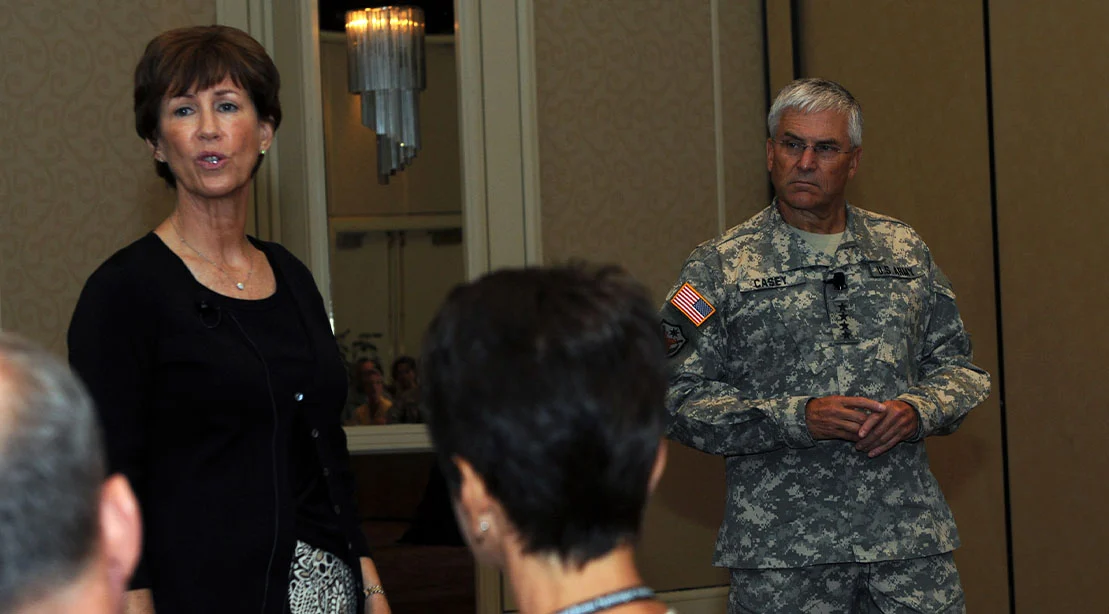
Sheila Casey, wife of retired four-star General and 36th Army Chief of Staff George Casey Jr., knows this reality better than most. Yet, she is not merely a military spouse; she is a trailblazer who redefined the role, proving that personal ambition and selfless service are not mutually exclusive. By prioritizing her own health and professional autonomy, Casey has become a beacon for military families, advocating for the radical idea that to serve others effectively, one must first be physically and mentally fortified.
The Chronology of a Resilient Life
Sheila Casey’s journey is a testament to endurance. Born into an era when women’s sports were in their infancy, she found early discipline and community in the pool, competing as a swimmer for 12 years. This foundation in athleticism would serve as the cornerstone of her philosophy: if you do not take care of yourself, you lose the capacity to sustain the people and causes you love.
A Life in Motion
Marriage to a career officer meant a life of perpetual transition. Over a span of 41 years, Casey moved 25 times. These relocations were not simple changes of address; they were systemic overhauls of her life. She was responsible for the logistics of moving, the establishment of new households, and the immediate integration into unfamiliar communities—all while her husband’s duty dictated his availability.
The complexity of this lifestyle intensified when her son joined the military, eventually deploying to a war zone. This transition from "military wife" to "military mother of a combatant" provided a harrowing education. "I thought I understood what it would be like to send a child to a war zone," Casey admits. "I quickly realized once that happened, I didn’t have a clue until I actually experienced it myself."
Professional Autonomy in a Rigid Environment
Recognizing that her identity could not be tethered solely to her husband’s rank, Casey made a conscious decision early in her marriage to forge a professional path. This was not a rejection of the military lifestyle, but a survival strategy for her own mental health. Her husband, General George Casey Jr., was a staunch supporter of this autonomy, acknowledging that a spouse must find happiness outside of their partner’s career.
Her resume reads like a roadmap of high-level public service:
- The Hill: Served as Chief Operating Officer for 20 years.
- The White House: Served as Special Assistant to President Biden and Director of Joining Forces, an initiative dedicated to supporting military and veteran families.
- Civilian Recognition: Twice awarded the Defense Distinguished Civilian Service Medal.
Supporting Data: The Reality of the Military Spouse
The narrative of the "supporting spouse" is supported by cold, hard data. According to a 2017 study by the Department of Defense, 92 percent of military spouses are women. This demographic reality underscores the cultural expectation of the "caregiver" role.
However, the strain of this role—characterized by frequent relocation, long periods of separation, and the inherent anxiety of combat deployment—has historically led to high rates of underemployment and mental health fatigue among spouses.
Casey’s work today with organizations like American Corporate Partners (ACP) and Hiring Our Heroes directly addresses these systemic issues. By providing one-to-one mentorship, she helps veterans and spouses navigate the difficult transition from active duty to the civilian labor market. She emphasizes that military spouses do not need "permission" to build a career; they need the tools and the confidence to claim their space in the professional world.
Official Perspectives: The Philosophy of "Self-First"
In interviews and public engagements, Casey consistently challenges the "martyrdom" culture that permeates military families. There is a pervasive guilt associated with taking time for oneself when a spouse is deployed or a family is in crisis. Casey views this as a dangerous fallacy.
"I think that women, who are generally the caregivers, tend to think, ‘I’ll take care of myself later,’ but in the long run, it doesn’t help," she explains. Her own adherence to fitness—a habit carried over from her swimming days—has shielded her from the common chronic health issues associated with high-stress living.
The Physicality of Duty
For Casey, physical fitness is not about aesthetics; it is about longevity. She maintains that even 30 minutes of daily activity is a necessary investment in the family’s future. When she speaks to groups of military spouses, her message is clear: You are an athlete of life. You cannot navigate the figurative mountains of military relocation and emotional strain if your internal engine is failing.
This philosophy of physical endurance recently manifested in a literal challenge: climbing Machu Picchu. Joined by her husband and family members, she trekked to 13,500 feet, camping in 30-degree weather. While she jokingly declared it the "last mountain" she would climb, the feat served as a powerful metaphor for her life. Whether moving homes, supporting a child in combat, or summiting a peak, the strategy remains the same: preparation, persistence, and the refusal to let the weight of the burden break your spirit.
Implications: A New Model for Modern Service
The implications of Sheila Casey’s life and work are profound for the next generation of military families. Her career suggests that the "military spouse" identity is evolving. It is no longer defined merely by what one does for their partner, but by what one achieves for themselves.
Empowering the Next Generation
Casey’s influence has ripple effects. By serving in the White House and through national non-profits, she has helped codify the support systems that were once left to chance. Her advocacy for "Joining Forces" has ensured that the needs of military caregivers—survivors, families, and partners—are a matter of national policy rather than just personal concern.
For the young spouse sitting in a base housing unit, struggling to find a job, or worrying about a deployed loved one, Casey offers this advice: "Everything else falls into line after that." By prioritizing one’s own health and career, the spouse becomes more resilient, more capable, and ultimately, a more effective partner.
Final Reflections
The narrative of the American military is often told through the lens of battlefield glory. But as Sheila Casey demonstrates, the true resilience of the United States lies in the households that endure. By maintaining her own identity and health, Casey has proven that the "greater good" is not served by self-sacrifice to the point of exhaustion, but by the sustainable, healthy, and empowered service of every member of the military family.
As she continues her work with ACP and Hiring Our Heroes, her legacy will not just be found in her husband’s distinguished military record or her own prestigious government titles, but in the thousands of military spouses who, upon hearing her story, realize that their own lives, careers, and personal health are worthy of the same effort they dedicate to their families. In the end, Sheila Casey has shown that being "fit to serve" is a standard that applies to the entire family, not just the one wearing the uniform.