Updated September 29, 2026
For many, the yoga studio serves as a sanctuary—a quiet harbor from the relentless noise of the modern world. However, as the popularity of group yoga continues to climb, the shared experience of the studio has become a complex social ecosystem. Danielle Brunson, a seasoned trauma-informed yoga and meditation instructor, suggests that while the practice is deeply personal, the environment is communal. Balancing individual needs with the collective flow is an art form, one that often leads to accidental “etiquette traps.”
Brunson, who admits to having been the “guilty party” in her own student days, emphasizes that these lapses are rarely malicious. Whether it is an ill-timed arrival or an unsolicited adjustment, these moments are human. The challenge lies in fostering an environment where students can move from judgment to empathy, turning their awareness away from the perceived disruptions of others and back onto their own practice.
The Chronology of a Class: From Arrival to Release
The social landscape of a yoga class often follows a predictable arc, beginning the moment a student crosses the threshold of the studio.
The Pre-Class Ritual
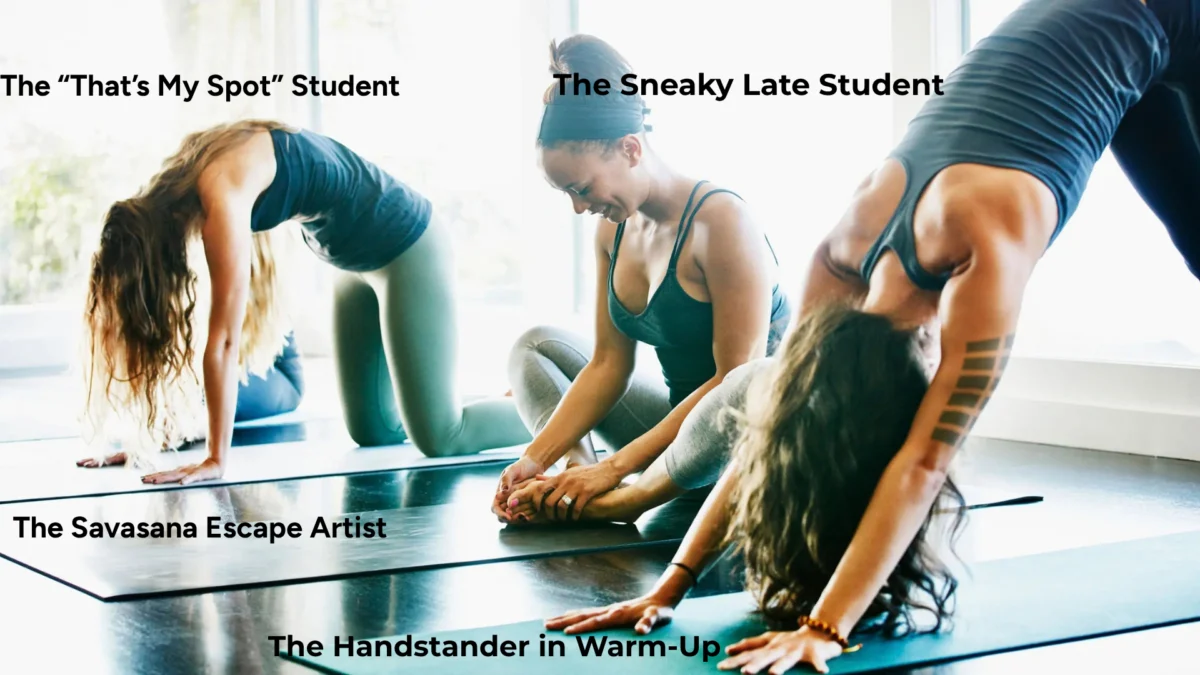
The first ten minutes are critical. This is the window where the “Sneaky Late Student” and the “Oversharer” typically make their appearances. While teachers generally accommodate late arrivals, the disruption caused by clinking water bottles and heavy sighs can break the meditative state of the room. Simultaneously, the “Oversharer” often treats the moments before class as a therapy session, potentially overwhelming the teacher who is attempting to hold space for dozens of students.
The Flow and the Friction
As the class progresses, the rhythm is often interrupted by those who resist the pace. Whether it is the “Competitive Breather” whose Ujjayi breath reaches decibel levels that distract neighbors, or the “Mat Creep” who encroaches on others’ personal square footage, the physical flow of the room is constantly being negotiated. The middle of the class is also where the “Block Negotiator” and the “Pose Corrector” reveal their tendencies, often rejecting the instructor’s guidance in favor of their own agenda or, in the case of the corrector, attempting to co-opt the instructor’s role.
The Finality of Savasana
The most sensitive period in any yoga class is Savasana (Corpse Pose). This is the culmination of the physical practice, a time for integration and stillness. It is also the moment most prone to disruption by the “Savasana Escape Artist.” Leaving early is often a logistical necessity, but the timing—right as the room descends into silence—can shatter the atmosphere for the entire collective.
Supporting Data: Why Etiquette Matters
While yoga is an internal discipline, its modern iteration is a social one. According to industry surveys, over 70% of frequent studio practitioners report that the behavior of fellow students significantly impacts their ability to maintain focus.
The psychological implications of a disruptive environment are significant. Trauma-informed instructors like Brunson note that for students seeking a sense of safety, the predictability of a class is essential. When a peer performs an unprompted handstand during a seated meditation, it doesn’t just annoy the teacher—it disrupts the sensory container of the room. This "audible commotion" often causes a ripple effect: students open their eyes, heart rates spike, and the meditative state is lost.
Furthermore, the "Mat Creep" phenomenon speaks to the need for spatial awareness. In a crowded studio, physical boundaries act as a form of non-verbal communication. When those boundaries are ignored, it can lead to a subconscious tension among practitioners, as the brain shifts from internal introspection to external monitoring of personal safety and space.
Official Perspectives: The Teacher’s Role
For the instructor, managing these situations requires a delicate balance of authority and compassion. Brunson suggests that teachers must practice aparigraha—non-attachment—when students ignore cues, such as the use of blocks or the timing of transitions.
“As a teacher, I have to let go of the need to control the outcome,” Brunson explains. “If a student chooses to struggle through a triangle pose without a block despite my suggestion, that is their journey. My role is to provide the guidance; the student’s role is to decide how to inhabit their own practice.”
However, teachers also act as the guardians of the collective experience. When a student begins a, “That’s my spot” confrontation, the teacher becomes a mediator. In these scenarios, the consensus among studio management is that consistent attendance does not grant ownership of floor space. Arriving early remains the only reliable method for securing a preferred spot, a rule that preserves equity in the studio environment.
The Philosophy of Practice: Implications for the Self
The underlying issue behind most etiquette gaffes is an excess of "external awareness." When a student feels the need to perform a handstand during meditation or correct a neighbor’s posture, they are effectively demonstrating a disconnect from their own mat.
Confronting the Silence
The "Person Who Can’t Wait"—the student who constantly adds extra movement between poses—is often avoiding the discomfort of stillness. From a philosophical standpoint, these moments of pause are where the true work happens. When a student refuses to sit in the quiet, they are effectively running from a moment of potential self-inquiry.
The Practice of Satya (Truth)
Brunson advocates for the application of satya, or truthfulness, when analyzing one’s own behavior in class. If we are honest with ourselves, most of us have been the person who arrived late, left early, or sighed too loudly. By acknowledging our own capacity for disruption, we develop the empathy necessary to forgive others.
Moving Toward Collective Consciousness
The implications of practicing better etiquette extend beyond the studio. When we learn to respect the boundaries, silence, and flow of a shared space, we are training our nervous systems to be more mindful of our impact on the world outside. The studio is a microcosm of society; the way we handle our mat space, our timing, and our interactions with others is a reflection of our broader social intelligence.
Conclusion: A Call for Grace
As the wellness industry continues to grow, the etiquette of the yoga studio must evolve to reflect a culture of mutual respect. It is not about policing behavior or creating an environment of stifling perfection; it is about cultivating a space where everyone—from the regular in the back corner to the newcomer in the front—can feel at home.
Ultimately, the goal of yoga is union. If we can approach our practice with a bit more consideration for our neighbors, we move closer to that ideal. The next time you find yourself frustrated by a clanging water bottle or a wandering mat, remember: you are not just practicing yoga in a room; you are practicing yoga with a room. Turn your gaze inward, offer a little empathy to your neighbor, and return to your breath. After all, we are all just doing our best to find our balance.