Introduction: A Weekend of Meteorological Upheaval
Over the past weekend, the United States found itself squeezed between two distinct, high-impact weather systems that paralyzed regions on both sides of the continent. From the battered shores of New Jersey and Massachusetts to the Pacific coastlines of Mexico and Hawaii, millions of residents faced a relentless barrage of wind, flooding, and infrastructure failure.
As the recovery phase begins, communities are grappling with the scope of the damage. While the East Coast struggled with the remnants of a powerful nor’easter that turned quiet seaside towns into disaster zones, the West Coast and the Pacific faced the raw, concentrated power of tropical cyclones. The dual nature of these events has reignited national conversations regarding disaster preparedness, the fragility of coastal infrastructure, and the growing influence of global climate patterns on extreme weather intensity.
The East Coast: A Nor’easter’s Relentless Assault
The Anatomy of the Storm
The nor’easter that struck the Eastern Seaboard was characterized by its longevity and the sheer intensity of its wind gusts. Stretching from New Jersey up through New York, Long Island, and into Southern New England, the storm system stalled, allowing it to act as a sustained hammer against coastal infrastructure.
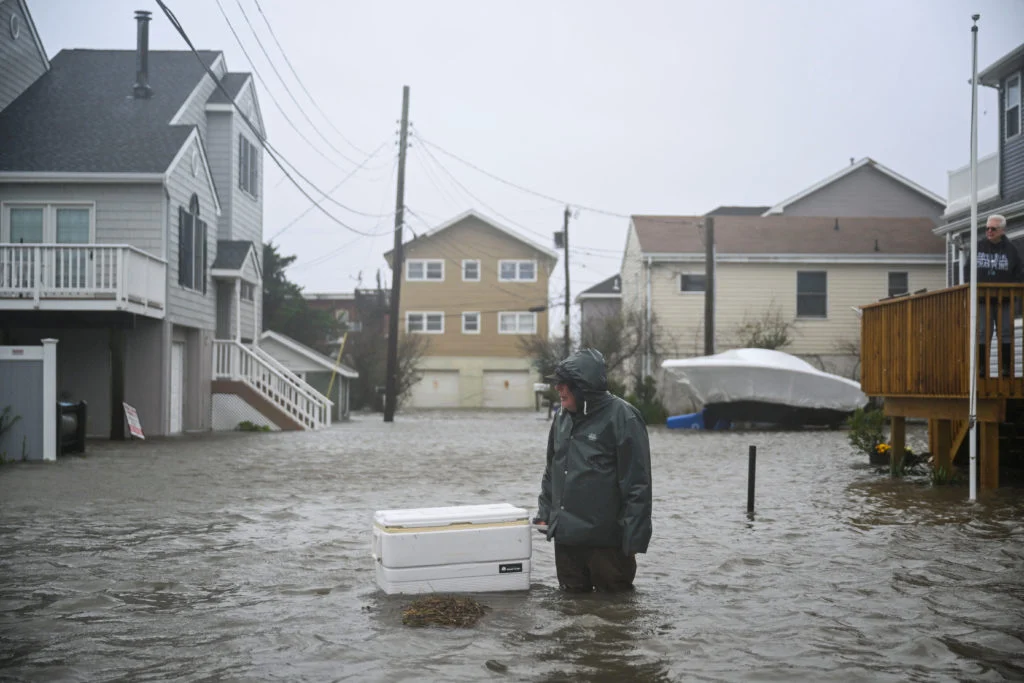
Coastal communities that served as popular summer destinations were unrecognizable by Sunday. Meteorologists recorded waves reaching up to 14 feet, which breached sea walls and overwhelmed drainage systems. In New Jersey, the tidal surges were particularly devastating; low-lying neighborhoods experienced flooding of historic proportions, with residents describing streets that had been transformed into navigable waterways.
Human Toll and Infrastructure Failures
The storm’s human impact was tragic. In New York City, a Housing Authority worker lost his life on Saturday after being struck by a falling tree—a stark reminder of the lethal potential of high-wind events in urban environments.
Across the impacted states, the electrical grid proved unable to withstand the pressure. At the height of the storm, more than 100,000 customers across the Northeast and mid-Atlantic regions were left in the dark. Utility companies struggled to restore power as high winds made it hazardous for repair crews to ascend bucket trucks or clear debris from tangled power lines.
In Wareham, Massachusetts, residents like Sue Mastria recount the harrowing early morning hours of the storm. "I was asleep at 3:00 a.m. All of a sudden, I heard a boom," she recalled. The sound was a massive tree collapsing onto her vehicle, effectively totaling it. Her experience was echoed by thousands of others whose properties were damaged by the relentless gusts.
Unexpected Discoveries
Amidst the destruction, the storm revealed a piece of history. On the South Shore of Nantucket, the churning surf and erosion caused by the nor’easter exposed the skeletal remains of a sailing vessel, believed to have wrecked in 1884. While the discovery fascinated historians, it served as a grim testament to the power of the Atlantic to reclaim the land—and the secrets buried within it.
Chronology of the Event
- Friday Evening: The nor’easter begins its slow churn, centered near Cape May, New Jersey. Initial reports of flooding begin to surface.
- Saturday Morning: The storm intensifies. New York City experiences severe wind gusts, forcing the cancellation of major events, including a New York Yankees game.
- Saturday Afternoon: The Housing Authority worker is killed in New York City. Power outages begin to spike across Long Island and Southern New England.
- Sunday Morning: The storm weakens slightly but maintains its position near the coast, causing continued tidal flooding.
- Sunday Evening: Recovery efforts commence as the storm system begins to dissipate. Simultaneously, reports from the Pacific indicate that Hurricane Polo and Hurricane Nolo are creating a secondary global crisis.
The Pacific Front: Cyclones and Flash Floods
While the East Coast battled the nor’easter, the Pacific Ocean was experiencing its own turmoil. In Mexico, Hurricane Polo—a Category 3 storm—brought life-threatening conditions to the coast. The storm necessitated immediate evacuations, the closure of vital ports, and the widespread cancellation of school sessions.
Residents of Cabo San Lucas reported not just the immediate danger of the storm, but a growing anxiety about the "new normal." One resident, speaking through an interpreter, noted, "Climate change is a part of this. Hurricanes and cyclones are stronger, not only in Mexico, but around the world."
Simultaneously, the Hawaiian Islands faced Hurricane Nolo. The Big Island narrowly avoided a direct landfall, yet the storm’s proximity for 36 hours resulted in heavy rain and flash flooding. National Guard troops were deployed to assist in rescues, demonstrating the level of urgency required to protect citizens from rapidly rising water levels.
Implications: The Growing Climate Debate
The simultaneous nature of these weather events has intensified the debate surrounding climate resilience. Coastal cities, built on the assumption of historical weather patterns, are finding that the "once-in-a-century" storm is becoming a recurring phenomenon.
Economic and Social Disruption
The economic fallout from these storms is substantial. Beyond the immediate costs of property damage and utility restoration, there is the "hidden" cost of tourism disruption and commercial downtime. In New York City, tourists like Adolfo Mendoza found their plans upended, illustrating how modern travel and service-based economies are increasingly vulnerable to weather volatility.
The Need for Hardened Infrastructure
The recurring power outages highlight a critical weakness in the U.S. electrical grid. As storms become more frequent and more intense, the reliance on above-ground power lines is being questioned. Many experts are now advocating for the undergrounding of utilities, though the high cost and logistical complexity of such projects remain significant barriers.
Official Responses and Recovery
Local and state authorities have mobilized emergency response teams to manage the cleanup. In the immediate aftermath, the focus remains on clearing blocked roads, restoring power, and assessing the structural integrity of flooded homes.
Federal agencies are coordinating with local municipalities to provide support, particularly in regions where the damage has exceeded the capacity of local budgets. However, the sheer scale of the impacted areas—spanning from the mid-Atlantic to the islands of Hawaii—stretches emergency resources thin.
Looking Ahead
The events of the past weekend serve as a clear indicator of the challenges ahead. As the atmosphere warms, the energy available to drive both nor’easters and tropical cyclones increases. The resilience of the East Coast, combined with the struggles of the Pacific coast, suggests that disaster preparedness is no longer a peripheral concern but a central pillar of national security and urban planning.
As residents in Massachusetts begin to clear debris and those in Hawaii continue to dry out their homes, the message remains clear: the environment is changing, and the infrastructure that supports modern life must change with it. Whether through better flood mitigation, a more resilient energy grid, or improved early warning systems, the path forward requires a shift from reactive recovery to proactive adaptation.
For now, the cleanup continues. The waves have receded, the winds have died down, and the sun has returned, but for those who lost homes, businesses, or loved ones, the impact of this weekend will be felt for years to come.