











Across the sprawling expanse of the Atlantic Coast, the boundary between land and sea is blurring. For generations, the shoreline was a place of stability, a foundation for family legacies and economic prosperity. Today, that boundary has become a front line in a quiet but catastrophic war against nature. As sea levels rise, storms intensify, and relentless erosion claims the earth beneath the foundations of American homes, coastal communities are being forced to confront an uncomfortable reality: the coast is no longer a permanent feature, but a fluid, shifting threat.
The Physical Crisis: When the Ocean Claims the Neighborhood
In the Outer Banks of North Carolina, the geography is not just changing—it is disappearing. In the small community of Buxton, residents like Lat Williams have become involuntary witnesses to the rapid reclamation of the land by the Atlantic. Just a year ago, the neighborhood looked vastly different; today, the space where Williams’s home once stood is nothing more than open, churning water.
The statistics are harrowing. In the past year alone, twenty-one houses on the Outer Banks have been claimed by the ocean. In a single, terrifying 45-minute span, five homes collapsed into the surf, their structures splintering under the weight of surging tides and aggressive erosion. For homeowners, the experience is visceral. Williams recalls the devastating sight of a neighbor’s home colliding with his own deck as the ground simply vanished.
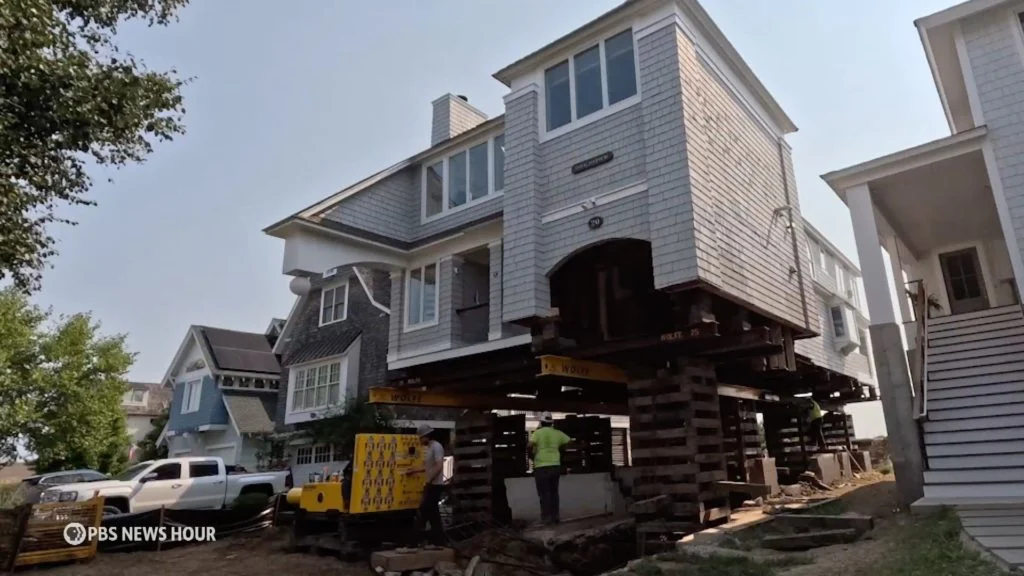
The crisis is not confined to the Outer Banks. Similar scenes are playing out in Connecticut and across the Eastern Seaboard, where homeowners are faced with the prohibitive costs of survival. For Williams, the solution was drastic: he spent over $250,000—a significant portion of his retirement savings—to physically lift his three-bedroom home and move it two blocks inland, roughly 600 feet from the water’s edge. It was an act of desperation born of a refusal to abandon a lifetime of memories, yet it highlights the growing divide between those who can afford to "retreat" and those who cannot.
Chronology of a Disappearing Coast
The current crisis did not emerge overnight; it is the culmination of decades of environmental shifts and human development patterns.
- The 1960s–1970s: A period of significant coastal development. During this time, homes were constructed hundreds of feet from the high-tide line, a distance that seemed, at the time, to be a safe buffer against the ocean.
- The 2012 Inflection Point: Superstorm Sandy tore through the East Coast, causing nearly $70 billion in damage and serving as a brutal wake-up call for communities from New Jersey to Connecticut. For many residents, like Tim Rath, the event marked the moment the "safe" distance became a myth.
- 2023–2024: A period of unprecedented acceleration. Erosion rates in some areas of the Outer Banks have reached 10 to 15 feet per year. This velocity means that in the span of a single mortgage, a home can go from being a beachfront paradise to a total loss, often leaving owners with nothing but debris for the local government to manage.
Supporting Data: The Science of Erosion
The erosion occurring on the Atlantic Coast is not merely a product of seasonal weather; it is part of a systemic climate shift. Dr. Reide Corbett, a coastal scientist at East Carolina University, emphasizes that while barrier islands are naturally dynamic, the current rate of loss is "uniquely bad."
The science is clear: as the planet warms, polar ice sheets melt, and the ocean expands. This global sea-level rise creates a higher baseline for every high tide, wave, and storm. "You start a foot higher than you were when many of these homes were built," Dr. Corbett notes. This elevation change allows storm surges to penetrate further inland, attacking the base of dunes and the foundations of homes that were never designed for such direct oceanic exposure.
The projections from Climate Central are equally sobering. By 2050, it is estimated that approximately 2.5 million Americans and 1.4 million homes will be at high risk from severe coastal flooding. The Outer Banks, rather than being an anomaly, is a preview of the challenges that will face virtually every coastal community in the United States in the coming decades.
Official Responses: Mitigation vs. Reality
Managing this disaster falls to local officials and state agencies, who are finding themselves in an impossible position. In Dare County, North Carolina, County Manager Bobby Outten faces the dual challenge of protecting residents and the local economy. The primary defense strategy in many areas is "beach nourishment"—the process of pumping massive amounts of sand onto eroded beaches to create a buffer.
However, this is an expensive, temporary fix. The recent project in Buxton cost approximately $50 million, and it is the third such effort in a decade. Critics describe this practice as "shoveling money into the ocean," arguing that it is a temporary, unsustainable stopgap. Outten acknowledges the limitation: "Beach nourishment is a great tool as long as you have got enough sand and enough money, because it works." But when asked if the community can fight the ocean forever, the answer remains a cautious, uncertain "for a while."
In Connecticut, the response has been focused on elevation. Following the devastation of Superstorm Sandy, massive engineering projects have seen homes lifted on steel beams, often at costs exceeding $50,000 per structure. For residents like Tim Rath, who has lived in his home for 42 years, this is about preserving a legacy for his grandson. But even these efforts cannot guarantee safety; they only provide a few more years of reprieve against an encroaching sea.
The Implications: A Difficult Moral and Economic Choice
The crisis of our coastlines forces a difficult conversation about the future of property ownership and the role of government. Many current flood insurance policies are flawed; they often do not provide payouts until a home is physically destroyed, offering no incentive for homeowners to proactively relocate or elevate their structures before disaster strikes.
Furthermore, there is a lack of transparency in the real estate market. Dr. Corbett notes that houses have been sold to unsuspecting buyers within months of falling into the ocean—homes that, for all intents and purposes, were already "lost" to the sea. This raises urgent questions regarding disclosure laws and the ethics of selling property in areas with high vulnerability.
The human element remains the most complex aspect of this transition. For Lat Williams, moving his house was not just a financial transaction; it was an attempt to hold onto a life he built. He acknowledges climate change but rejects the idea of total abandonment. "You need to adapt to that," he argues. "You can’t just say, well, abandon everything."
Yet, as the ocean continues its steady march inland, the question of "adaptation" vs. "retreat" will become the defining political and social challenge for the American coast. Whether through expensive engineering, managed retreat, or the eventual surrender of land, the reality is that the map of the United States is being rewritten. For those living on the edge, the only certainty is that the next storm will be stronger than the last, and the shoreline will never again be where it was yesterday.
As we look toward 2050, the lesson of the Outer Banks is clear: we are at a tipping point. The communities that survive will be those that have the courage to have an honest conversation about the risks, acknowledge the scientific reality of a rising sea, and make the agonizing choices required to protect what matters most before the ocean makes those choices for them.