In a significant boost for surgical innovation, Paris and Cambridge-based medical technology firm Tissium has successfully closed a €30 million Series D2 financing round. The capital injection, sourced from a syndicate of both new and existing international investors, is earmarked to accelerate the U.S. market launch of the company’s flagship product, Coaptium—a breakthrough sutureless nerve repair technology. Alongside the equity financing, Tissium has secured a strategic credit facility from the European Investment Bank (EIB), further solidifying its balance sheet as it transitions from a R&D-heavy startup into a commercial-stage powerhouse.
The company, which traces its roots to the prestigious laboratories of MIT and Brigham and Women’s Hospital, has now raised a total of €200 million since its inception. This latest milestone underscores a growing investor appetite for bioresorbable, light-activated materials that promise to fundamentally alter the landscape of tissue reconstruction.
Main Facts: The Intersection of Biology and Engineering
Tissium’s core value proposition lies in its proprietary platform of light-activated polymers. Traditional surgical repair—specifically nerve repair—has long relied on the mechanical trauma of sutures, which can induce inflammation, scarring, and secondary nerve damage.
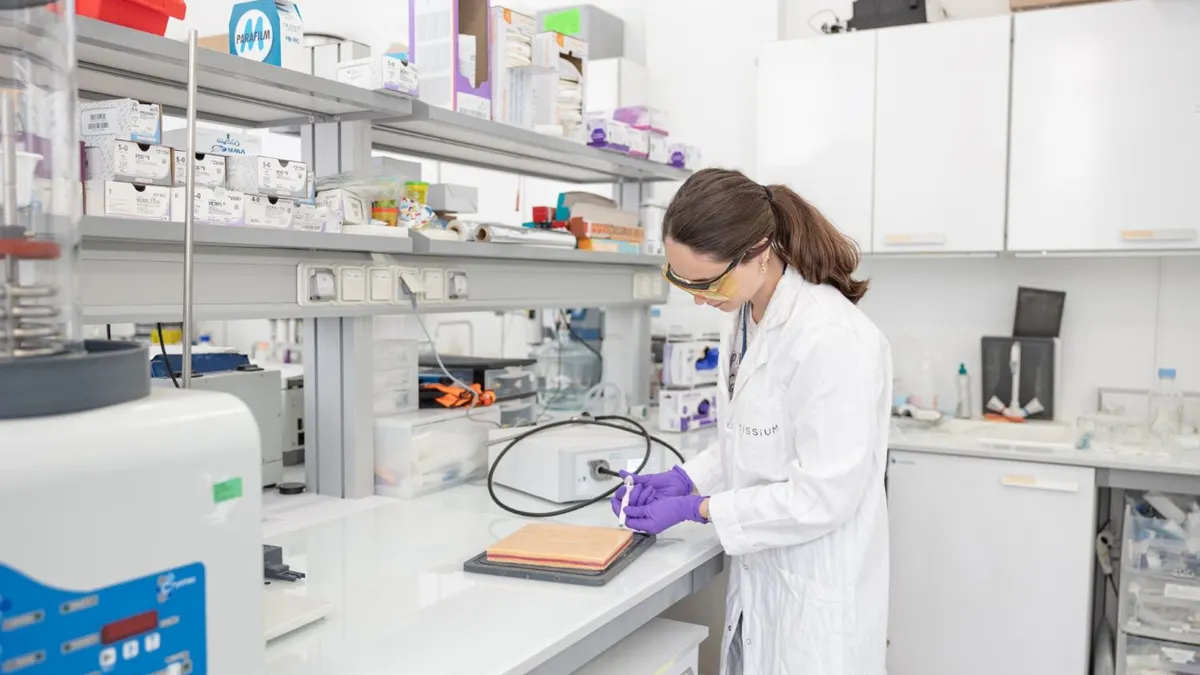
Coaptium, the company’s lead commercial product, bypasses these limitations by utilizing a bioresorbable, light-activated polymer housed within a 3D-printed chamber. Once applied to a severed nerve, the polymer is activated by a specific light source, creating a seamless, secure, and biocompatible seal that allows the nerve to regenerate naturally. This "sutureless" approach is designed to reduce the risk of surgical complications while potentially improving long-term functional recovery for patients suffering from nerve damage.
The Series D2 funding will be deployed across three strategic pillars:
- Commercial Acceleration: Scaling the U.S. rollout of Coaptium.
- Clinical Advancement: Fueling ongoing trials for the company’s pipeline, including the Eclipsium hernia repair system.
- Operational Capacity: Expanding the company’s manufacturing and R&D footprint across its dual hubs in Paris and Massachusetts.
Chronology: A Trajectory of Innovation
The journey of Tissium is a testament to the power of academic-to-industry translation.
- Founding Era: The technology platform was pioneered by a world-class team of scientists, including Maria Pereira, Jeffrey Karp, and Robert Langer. Their work sought to address the inherent biological challenges of tissue integration, focusing on materials that could mimic the elasticity and mechanical properties of human tissue.
- The MIT Spinout: Tissium was formally incorporated as an MIT spinout, with Maria Pereira stepping into the role of Chief Innovation Officer. The company established a bi-continental presence, balancing the deep engineering talent pool in Cambridge, Massachusetts, with the robust biotech ecosystem in Paris, France.
- Initial Pipeline Development: Beyond nerve repair, the company began aggressively pursuing other "unmet clinical needs," specifically focusing on cardiovascular sealing and hernia repair—two areas where traditional surgical methods remain fraught with risk.
- September 2023: A major regulatory milestone was reached when Tissium received an Investigational Device Exemption (IDE) from the U.S. Food and Drug Administration (FDA). This approval cleared the path for a clinical trial to evaluate the safety and efficacy of its Eclipsium treatment for ventral hernia repair.
- Present Day: With the close of the €30 million Series D2 round and the accompanying EIB facility, Tissium is entering its most ambitious phase of growth to date, shifting focus from pure innovation to global commercialization.
Supporting Data: Understanding the EIB Facility and Market Reach
The financing structure for this round is noteworthy for its hybrid nature. The €30 million equity infusion is complemented by an EIB credit facility of up to €30 million. This facility is structured in three tranches of €10 million each, contingent upon the company hitting specific, pre-defined commercial, clinical, and financial milestones.
This structure provides Tissium with a "runway" that incentivizes growth without immediate dilution of shareholder equity. For a medtech firm, this is critical; the transition from clinical trials to full-scale commercial adoption is notoriously capital-intensive.
Total Funding Profile:
- Total Capital Raised: €200 million (cumulative).
- Current Round: €30 million Series D2 + €30 million EIB credit facility.
- Key Pipeline Assets: Coaptium (nerve repair), Eclipsium (hernia repair), and a suite of undisclosed cardiovascular sealants.
The participation of international investors—spanning both European and U.S. markets—reflects a global confidence in Tissium’s platform. By maintaining a footprint in both the U.S. and Europe, the company is strategically positioned to navigate the complex regulatory environments of both the FDA and the European Medicines Agency (EMA) simultaneously.
Official Responses: A Vote of Confidence
Christophe Bancel, CEO and co-founder of Tissium, framed the funding as a clear indicator of the company’s market readiness. In a recent statement, Bancel emphasized that the support from both private equity and the European Investment Bank serves as a validation of Tissium’s long-term vision.
"This financing round is a testament to the progress we have made in proving that our technology is not only safe and effective but also scalable," Bancel noted. "The confidence shown by our investors allows us to aggressively pursue our mission of redefining how surgeons approach tissue reconstruction, moving away from the trauma of mechanical sutures toward a more biological, light-activated approach."
For the EIB, supporting Tissium aligns with their mandate to foster European innovation in the "deep tech" and life sciences sectors. By providing the credit facility, the EIB is effectively acting as a bridge for Tissium to reach full-scale commercialization, ensuring that high-impact European research is successfully translated into patient-facing clinical tools.
Implications: The Future of Sutureless Surgery
The implications of Tissium’s success extend far beyond its current product list. If the Coaptium and Eclipsium platforms prove successful at scale, they could initiate a broader shift in surgical standards of care.

1. Reduced Complication Rates
Sutures, while effective, are essentially foreign objects that pierce healthy tissue, creating potential pathways for infection and localized inflammation. A light-activated, bioresorbable polymer seal could potentially reduce the "foreign body response," leading to faster patient recovery times and lower rates of post-operative infection.
2. Market Disruption in Specialized Surgery
In delicate procedures—such as peripheral nerve repair or cardiovascular sealing—the margin for error is razor-thin. Precision is paramount. By providing surgeons with a tool that seals tissue at the molecular level, Tissium is essentially offering a "precision medicine" approach to physical surgical repair.
3. A New Paradigm for Medtech Financing
The reliance on a multi-tranche EIB facility is a model that other medtech startups may look to emulate. It provides a safeguard against the "valley of death"—that period in a startup’s lifecycle where research is complete but revenue has not yet materialized—by linking funding directly to progress.
4. Expansion of the Platform
Looking ahead, the success of the current pipeline suggests that Tissium’s platform could eventually be applied to virtually any surgical field requiring tissue apposition. From neurosurgery to reconstructive plastic surgery, the ability to "weld" tissue together rather than stitch it is a capability that will undoubtedly command significant market share.
As Tissium moves forward with its U.S. rollout, the medical community will be watching closely. The transition from the laboratory bench to the operating room is the ultimate test of any medtech innovation. With a robust financial backing of €200 million and a technology platform rooted in elite scientific research, Tissium is well-positioned to lead the next generation of surgical reconstruction. The company’s focus on the intersection of light-activated chemistry and advanced 3D printing represents a sophisticated evolution in the tools available to surgeons, promising a future where surgery is less invasive, more precise, and fundamentally more patient-centric.