Maintaining an active, independent lifestyle as we age is a goal shared by millions. While many focus on cardiovascular health or upper-body strength, there is one often-overlooked cornerstone of physical freedom: hip mobility. The health of your hip joints dictates your ability to walk, balance, rise from a chair, and navigate the world with confidence. When hip mobility declines, it creates a domino effect, forcing your knees and lower back to compensate for restricted movement, which often leads to chronic pain and an increased risk of falls.
To understand how to preserve this vital function, we spoke with Dr. Jaime Bayzick, an Associate Professor of Practice in Physical Therapy at Arcadia University in Glenside, PA. Dr. Bayzick argues that the loss of mobility is not an inevitable consequence of aging, but rather a reflection of modern lifestyle habits. By incorporating targeted, chair-based exercises, adults over 60 can restore function, reduce stiffness, and regain the confidence needed to remain independent for years to come.
The Anatomy of Mobility: Why Our Hips Stiffen
It is a common misconception that hip stiffness is simply a result of "getting older." While it is true that biological aging contributes to changes in cartilage density, the elasticity of connective tissues, and joint hydration, Dr. Bayzick emphasizes that movement habits play an equally significant role.
"Even active adults often lose hip mobility because modern movement patterns become repetitive," Dr. Bayzick explains. "Many people continue walking or cycling but stop training rotation, deep squatting, floor transfers, and lateral movement patterns that help preserve full hip function."
The Impact of Sedentary Behavior
In the modern era, sitting is the default state for many. Extended periods in a chair keep the hips in a perpetually flexed position. Over time, this leads to:
- Hip Flexor Shortening: The muscles at the front of the hip tighten, pulling the pelvis into an anterior tilt.
- Pelvic Mobility Loss: Reduced range of motion in the pelvis impacts spinal alignment.
- Gluteal Amnesia: Constant sitting leaves the glutes—the powerhouse muscles of the hips—weak and underutilized.
As the body adapts to a smaller range of motion, the brain begins to limit the body’s output, creating a cycle of decreased movement. "Physical therapists often use the phrase ‘motion is lotion,’" says Dr. Bayzick. "Joints and connective tissues function better when they move regularly. Gentle, consistent movement helps maintain mobility and reduces the friction that causes stiffness."
The Case for Chair-Based Training
For many adults entering their 60s and beyond, the prospect of getting down on the floor for traditional yoga or stretching can be daunting—or even dangerous. Chair-based exercises offer a "low-barrier-to-entry" solution that provides stability and support while still challenging the muscles and joints.
Mobility, in this context, is defined by more than just flexibility; it is about the strength and coordination to move through a full range of motion. Chair training allows individuals to isolate specific muscle groups without the added stress of balancing on uneven surfaces.
Four Essential Chair Exercises for Hip Health
Dr. Bayzick recommends incorporating the following four movements into a daily routine. These exercises are designed to target the hip flexors, rotators, and stabilizers.
1. The Seated March: Building Foundation
The Seated March is a fundamental movement that mimics the mechanics of walking while seated, which reduces the impact on the joints.
- Why it works: It actively trains hip flexion while simultaneously improving circulation, coordination, and trunk stability.
- The Technique: Sit tall in a sturdy chair with your feet flat on the floor. Engage your core and slowly lift one knee toward your chest, then return it to the floor. Alternate legs in a controlled, marching rhythm.
2. Seated Figure-4 Stretch: Restoring Rotation
Rotational mobility is often the first range of motion lost as we age. When we lose the ability to rotate the hip, simple tasks like putting on socks or getting into a car become difficult.
- Why it works: This stretch targets the deep rotators of the hip. It provides the benefits of a floor-based yoga pose without the strain of floor transfers.
- The Technique: While seated, cross one ankle over the opposite knee. Keep your back straight and gently lean forward from the hips until you feel a comfortable stretch in the hip and glute of the elevated leg. Hold for 30 seconds per side.
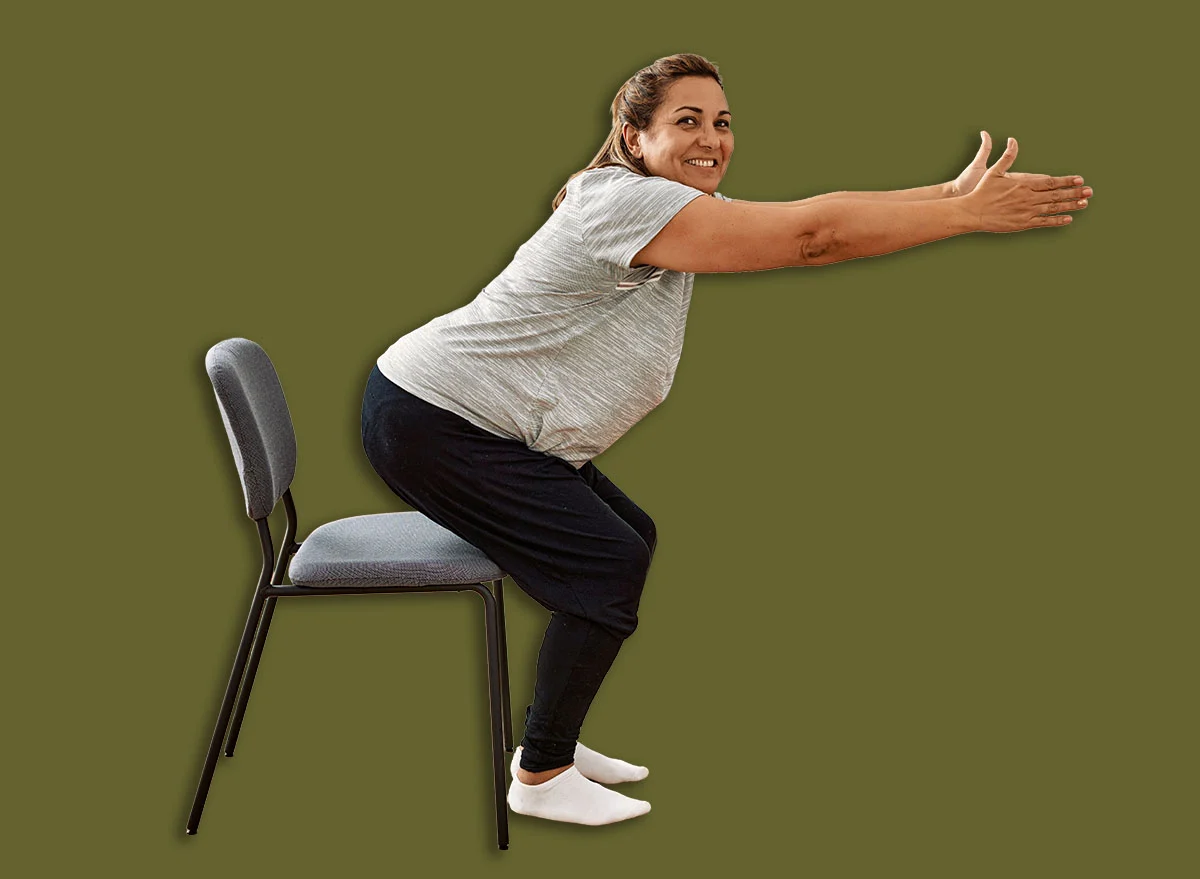
3. Sit-to-Stands: The Gold Standard
If there is one exercise that encompasses the totality of functional movement, it is the sit-to-stand. It is the closest mimicry of the most important daily task: getting up and down safely.
- Why it works: This movement engages the glutes, quadriceps, core, and hip stabilizers. It is the ultimate exercise for fall prevention.
- The Technique: Sit at the edge of your chair. Keep your feet hip-width apart. Lean your torso forward slightly, engage your glutes, and push through your heels to stand fully upright. Lower yourself back down with control, ensuring you don’t "plop" onto the seat.
4. Seated Hip Abduction Presses: Lateral Stability
The lateral (side) muscles of the hip, specifically the gluteus medius, are the unsung heroes of walking. They keep the pelvis level as we shift weight from one leg to the other.
- Why it works: Weakness in these muscles leads to a "waddling" gait and increased pressure on the knees and lower back. Strengthening these helps stabilize the pelvis during every step you take.
- The Technique: Sit with your knees and feet together. Place your hands on the outside of your knees. Attempt to push your knees outward while providing resistance with your hands. Hold the tension for five seconds, then release.
Implications for Long-Term Health
The implications of these exercises go far beyond physical performance. For the aging population, hip health is directly linked to psychological confidence. When a person knows they can move through their home, navigate a curb, or stand up from a deep restaurant booth, their desire to engage with the world remains high.
Addressing the "Stiffness" Myth
Many people report feeling "stiff" even if they have adequate flexibility. Dr. Bayzick points out that this often stems from weakness rather than tightness. When the muscles supporting the hip joint are too weak to handle the weight of the body, the brain perceives the movement as a threat and "locks" the joint to protect it. By strengthening these muscles through the exercises mentioned above, you signal to your nervous system that it is safe to move freely.
A Call to Consistency
The "motion is lotion" philosophy requires consistency. These four exercises take less than 10 minutes to perform, yet their cumulative impact on joint hydration and muscle tone is profound. Whether you are 60, 70, or 80, it is never too late to reclaim your mobility. By dedicating a small portion of your day to these chair-based movements, you aren’t just stretching—you are investing in your future independence.
As Dr. Bayzick concludes: "Mobility after 60 is about maintaining the strength and confidence to keep moving independently. Start where you are, use the chair as your partner, and keep the motion going."