











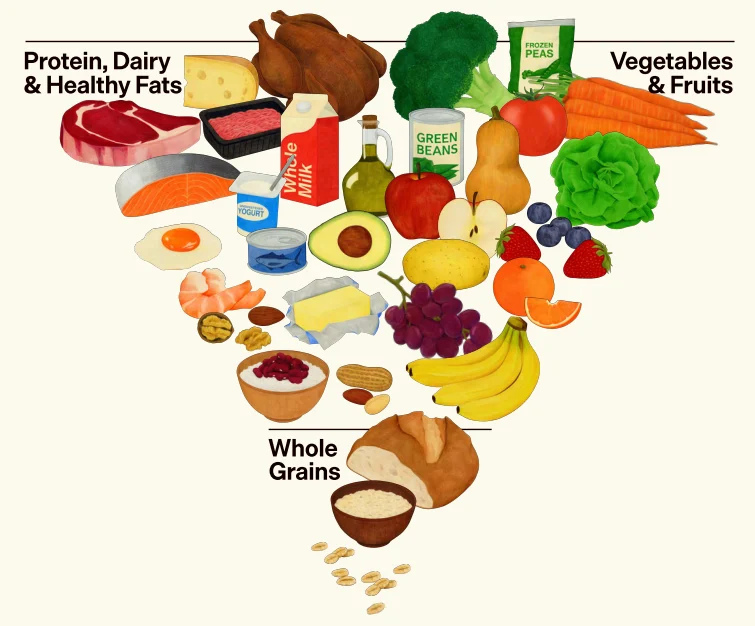
The release of the 2025–2030 Dietary Guidelines for Americans (DGAs) has sparked a firestorm of debate among nutritionists, public health advocates, and policymakers. Framed by the catchy, consumer-friendly tagline "eat real food," the document arrives with a mandate to curtail the nation’s reliance on ultra-processed goods and added sugars. Yet, beneath this headline-grabbing ambition lies a visual and structural framework that has left many experts questioning the scientific integrity of the final product.
While the text attempts to align with modern nutritional science, the inclusion of a controversial new "food pyramid"—which visually elevates animal-based saturated fats—has created a jarring dissonance between the written guidelines and their accompanying imagery. As Americans look for clarity in an increasingly complex food landscape, these latest guidelines have, in many ways, muddied the waters.
The Evolution of Federal Nutrition Policy
For decades, the U.S. Departments of Agriculture (USDA) and Health and Human Services (HHS) have updated the DGAs every five years to provide a blueprint for federal feeding programs, institutional menus, and individual health goals. Historically, this process involved an independent Dietary Guidelines Advisory Committee (DGAC), composed of top nutrition scientists, tasked with synthesizing the current state of evidence.
The trajectory of the 2025–2030 cycle, however, took an unprecedented turn. The independent Committee’s original report was ultimately rejected by the administration, leading to the creation of a "supplemental scientific analysis" conducted by a group of contractors rather than the original expert committee. This departure from the established, transparent, and peer-reviewed process has drawn sharp criticism.
Dr. Deirdre Tobias, an assistant professor in the Department of Nutrition who served on the 2025–2030 DGAC, has been vocal about the lack of procedural transparency. "There is no transparency in the methodology and rigor that was employed," Tobias noted in a recent Q&A. The deviation from the HHS’s historically rigorous standards has led many to question the influence of non-scientific pressures on the final recommendations, particularly concerning the prominent role of the beef and dairy industries in the new visual hierarchy.
Key Shifts: Sugar, Processing, and Proteins
The new guidelines do offer several welcome advancements. For the first time, the DGAs explicitly target the broader category of "highly processed foods." By advising against sugar-sweetened beverages and salty or sweet packaged snacks, the government acknowledges the growing body of evidence linking ultra-processed consumption to chronic diseases like obesity and type 2 diabetes.
Furthermore, the guidelines have tightened the reins on added sugar. In a strict departure from previous iterations, the document asserts that "no amount of added sugars or non-nutritive sweeteners is recommended." The guidance now suggests that children avoid added sugars entirely until age 10—a significant leap from the previous age-two benchmark.
However, these ambitious goals are often decoupled from practical implementation. While the guidelines suggest a cap of 10 grams of added sugar per meal, they fail to provide a framework for how the average consumer—who rarely tracks sugar on a meal-by-meal basis—can realistically achieve this in a food environment saturated with hidden sweeteners.
The "Pyramid" Paradox: A Regression in Saturated Fat
Perhaps the most contentious element of the 2025–2030 release is the return of a pyramid-style graphic. In this inverted iteration, the base and mid-sections emphasize steak, full-fat milk, and butter. This visual prioritization contradicts the written text of the Guidelines, which maintains the longstanding recommendation that saturated fat should be limited to 10% of total daily caloric intake.
The Math of Saturated Fat
For a standard 2,000-calorie diet, the 10% limit allows for approximately 22 grams of saturated fat. When one examines the DGAs’ own recommended daily servings, the math becomes problematic. If a consumer follows the guidelines by choosing full-fat dairy—such as one cup of whole milk (5g saturated fat), three-quarters cup of full-fat Greek yogurt (6g), and an ounce of cheddar cheese (6g)—they have already consumed 17 grams of saturated fat. Should that individual use a tablespoon of butter (7g) or beef tallow (6g) for cooking, they have effectively exceeded their daily limit by lunch.
Frank Hu, professor of nutrition and epidemiology and chair of the Department of Nutrition at the Harvard T.H. Chan School of Public Health, warns that these mixed messages are dangerous. "The visual prominence of saturated-fat-rich foods may lead to confusion and potentially higher intake of saturated fat, leading to increased LDL cholesterol and cardiovascular risk," Hu explains.
The Protein Conundrum
The new DGAs also push for a significant increase in protein intake, suggesting between 1.2 to 1.6 grams per kilogram of body weight per day—an increase of up to 100% over previous minimums. While protein is vital, the guidelines fail to distinguish between the "protein package."
Evidence consistently shows that the health impact of protein depends on what else comes with it: the fiber, the type of fat, and the sodium content. By failing to emphasize the superiority of plant-based proteins, fish, and lean poultry over processed red meats, the guidelines miss a critical opportunity to improve public health. Excess protein consumption, especially when derived from sources high in saturated fats, is readily converted to body fat, potentially contributing to weight gain and metabolic syndrome.
The Omission of Sustainability and Equity
In an era where the relationship between food production and planetary health is undeniable, the 2025–2030 DGAs remain notably silent on environmental impacts. While many international health organizations have integrated sustainability into their dietary recommendations, the U.S. guidelines continue to ignore the carbon footprint of the food supply chain.
Furthermore, the guidelines lack a nuanced discussion of socioeconomic barriers. A healthy diet is not merely a choice but an accessibility issue. By failing to address how food deserts and systemic inequality shape dietary habits, the government’s guidance risks becoming an abstract ideal rather than an actionable public health policy.
Implications for Public Health
Historically, compliance with the DGAs in the United States has been low. With the introduction of conflicting visual cues and a perceived lack of scientific transparency, this trend is unlikely to reverse. The "New Food Pyramid" risks undoing years of public health education regarding the dangers of high saturated fat intake.
When official government messaging contradicts itself, it invites skepticism. When the visual imagery favors industry interests—such as the heavy emphasis on beef and dairy—over established cardiovascular health markers, it erodes the public trust required for meaningful behavioral change.
Conclusion: A Call for Clarity
The 2025–2030 Dietary Guidelines for Americans represent a missed opportunity to provide clear, science-based, and actionable nutrition advice. While they successfully identify the need to reduce sugar and processed foods, the underlying contradictions regarding saturated fats and the lack of transparency in their development process undermine their utility.
For those navigating the often-confusing landscape of nutritional advice, it is essential to look beyond government-issued graphics. Independent resources, such as the Healthy Eating Plate developed by experts at Harvard, offer a more consistent, evidence-based approach to nutrition. As the country grapples with a persistent burden of diet-related chronic illness, the importance of accurate, unbiased, and transparent dietary guidance has never been more critical. Until the DGAs return to a process that prioritizes scientific consensus over industry influence, consumers are encouraged to consult with registered dietitians for personalized, evidence-backed health strategies.