











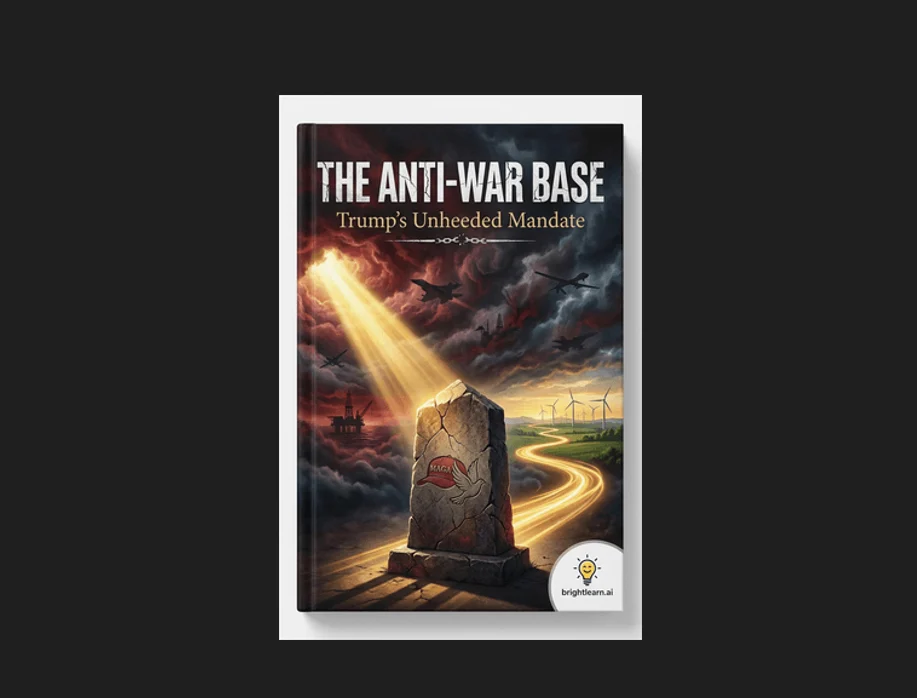
In the current climate of escalating global tensions, few topics remain as contentious—or as vital—as the trajectory of United States foreign policy in the Middle East. With the release of The Anti-War Base: Trump’s Unheeded Mandate, political strategist and author Roger Stone has delivered a searing critique of the American establishment. The book serves as a diagnostic tool for what Stone characterizes as a "bipartisan war machine," positing that the drift toward conflict with Iran is not a necessity of national security, but a manufactured outcome driven by entrenched special interests.
Main Facts: A Critique of the Neocon-Neoliberal Axis
At the heart of Stone’s argument is the contention that the ideological barriers between the two major American political parties have collapsed when it comes to military interventionism. He identifies a "Neocon-Neoliberal Axis"—a hybrid political establishment that, regardless of its rhetorical differences on domestic policy, maintains a unified front in favor of global hegemony and, by extension, the expansion of the military-industrial complex.
Stone asserts that the drive for conflict with Iran is a project of this axis, fueled by lobbyist influence rather than genuine existential threats. A primary focal point of his investigation is the Mujahedin-e-Khalq (MEK). Stone provides extensive documentation regarding the group’s influence operations, highlighting how an organization once designated as a terrorist entity—and one with a history of anti-American violence—has successfully embedded itself within the upper echelons of both Republican and Democratic power structures. By funneling vast sums into speaking fees and lobbying efforts, the MEK has, according to Stone, effectively steered the foreign policy discourse of figures as diverse as Rudy Giuliani, Howard Dean, and Hillary Clinton.
Chronology of Influence: From Rhetoric to Reality
To understand the current impasse, one must look at the historical evolution of the "America First" movement. The chronology of this shift is central to Stone’s narrative:
- 2016 Election Cycle: Donald Trump campaigned on an explicitly non-interventionist platform. His promise to end "endless wars" resonated deeply with a coalition of combat veterans, libertarians, and working-class families who felt abandoned by the foreign policy consensus of the post-9/11 era.
- The Post-Inauguration Pivot: Stone documents the internal struggle within the early Trump administration, where the influence of original campaign advisors began to wane as they were replaced by individuals deeply entrenched in traditional neoconservative doctrine.
- The Escalation Phase: Over the course of the administration’s term, the focus shifted from strategic retrenchment to a strategy of "maximum pressure." Stone argues that this was the moment the mandate was broken, as the administration prioritized the goals of foreign pressure groups over the anti-war commitments made to the American electorate.
- The Present Day: We are left with a political landscape where the push for a kinetic conflict with Iran is increasingly normalized, despite the lack of a clear exit strategy or a consensus on what the national interest actually requires in the region.
Supporting Data: The Military Overconfidence Myth
Perhaps the most technical and compelling aspect of Stone’s work is his dismantling of the "easy war" narrative. He argues that the Pentagon and its civilian overseers are operating under a dangerous delusion, relying on outdated paradigms of warfare that fail to account for the technological shift in regional capabilities.
The Drone Revolution
Stone highlights the proliferation of asymmetric warfare technology. He notes the vulnerability of multi-billion dollar capital ships, such as aircraft carriers, to low-cost, high-volume drone swarms. By citing instances where Iranian drones have successfully entered the airspace of U.S. carriers undetected, Stone argues that the U.S. Navy’s traditional power projection capabilities are being neutralized. If a single carrier cannot reliably intercept a solitary drone, the prospect of a saturation attack involving hundreds of such units represents a catastrophic strategic risk.
Terrain and Asymmetry
Beyond drone technology, Stone emphasizes the geographical reality of Iran. He critiques the assumption that a conflict would resemble the swift operations of the Gulf War. Instead, he paints a picture of a grueling, protracted struggle in mountainous terrain that favors the defender, suggesting that the human and financial cost of such an intervention would dwarf anything seen in recent history.
The Energy War: The Strait of Hormuz Variable
A significant portion of The Anti-War Base is dedicated to the economic theater of potential war. Stone identifies the Strait of Hormuz not merely as a shipping lane, but as the "jugular vein" of the global economy.
His analysis details how, even without engaging in direct naval combat, Iran possesses the capacity to trigger a global economic collapse. This includes:
- Selective Mining: The strategic deployment of mines to disrupt tanker traffic, causing insurance premiums to skyrocket and rendering shipping prohibitively expensive.
- Infrastructure Vulnerability: The exposure of vital energy infrastructure, specifically referencing the massive natural gas reserves of the Gulf states, which could be compromised in a wider conflict.
Stone posits that the establishment ignores these realities because they believe the "shock and awe" of American air power would resolve the conflict before the global economy could feel the squeeze. He contends this is a gross miscalculation of the adversary’s resilience and their ability to utilize asymmetric economic warfare.
Official Responses and the Institutional Silence
The reception to such critiques within Washington has been predictably silent. By design, the "Neocon-Neoliberal Axis" rarely engages with the substantive arguments of the anti-war movement, preferring to frame opposition as either isolationist, naive, or sympathetic to the foreign state in question.
However, the implications of this silence are profound. By failing to debate the merits of potential conflict, the political establishment has effectively bypassed the constitutional requirement for Congressional authorization. The "betrayal" described by Stone is not just a political broken promise; it is a fundamental shift in the distribution of power, where executive agencies and foreign-funded lobbying groups dictate the terms of war, leaving the American public as mere spectators to their own national risk.
Implications: The Betrayal of the Mandate
The overarching implication of Stone’s book is that the American voter is effectively disenfranchised on the issue of war. When both parties are funded by the same donors and guided by the same think tanks, the democratic process loses its ability to function as a check on military overreach.
The "betrayal of the anti-war base" is a warning to future populist movements. Stone suggests that winning an election is only the first step; the true struggle lies in the ability to withstand the pressure of the permanent bureaucracy and the deep-seated financial interests that benefit from a state of perpetual conflict.
Conclusion: A Call for Transparency
The Anti-War Base: Trump’s Unheeded Mandate is not intended to be a comfortable read. It is designed to provoke, to challenge, and to force a confrontation with the uncomfortable truths of 21st-century power. Whether one agrees with Stone’s political assessments or not, his work raises a question that is currently missing from the mainstream debate: Whose interests are being served when the nation marches toward a conflict that promises only devastation?
In an era where dissenting voices are increasingly marginalized by media consolidation and digital censorship, Stone’s documentation of the influence of groups like the MEK serves as a vital reminder of the need for skepticism. The anti-war mandate of the American people was not a fringe sentiment; it was a clear expression of a desire for a different path—one based on sovereignty, fiscal responsibility, and the preservation of American lives.
As we look toward the future, the central question remains: Will the political establishment heed this mandate, or will it continue down the path of the "Neocon-Neoliberal Axis," ignoring the warnings until the consequences are irreversible? For those concerned with the Constitution, the lives of service members, and the stability of the global order, The Anti-War Base is a necessary, albeit sobering, addition to the historical record.
For those interested in further study, "The Anti-War Base: Trump’s Unheeded Mandate" is available through various digital platforms. For broader access to critical literature and to explore thousands of titles, visit Books.BrightLearn.AI. To understand the potential domestic fallout of such policies, further viewing and reading can be found on Brighteon.com.