








As we navigate the decades, our bodies undergo a quiet, steady transformation. Among the most critical physiological shifts in the post-60 demographic is the gradual decline of the quadriceps—the powerful group of muscles spanning the front of the thigh. While this decline is a natural part of the aging process, it is not an inevitable sentence to frailty. In fact, maintaining quad strength is widely considered a non-negotiable pillar of mobility, independence, and overall quality of life.
When the quadriceps weaken, the domino effect on daily living is profound. Simple, once-effortless tasks—rising from a favorite armchair, navigating a flight of stairs, or maintaining a steady gait during a morning walk—begin to feel laborious. This loss of functional strength is often the primary driver behind the loss of autonomy in older adults. However, a modern shift in exercise philosophy suggests that the path to reclaiming this strength lies not in the high-tech isolation machines of a commercial gym, but in the deliberate, functional movements of daily life.
The Case Against "Machine-Only" Training
For years, the fitness industry encouraged older adults to rely on leg extension and leg press machines. While these devices offer a controlled environment for muscle hypertrophy, they suffer from a significant drawback: they lack "functional carryover."
When you sit in a leg press machine, the equipment stabilizes your torso, manages your center of gravity, and dictates your path of motion. This effectively bypasses the smaller, intrinsic stabilizing muscles that are essential for real-world balance and coordination. Research published in PubMed highlights that machine-assisted training often leaves these vital stabilizers undertrained. Consequently, while you may build strength in a specific range of motion, that strength rarely translates to the complex, multi-planar movements required to walk on uneven pavement or recover from a trip.
Supporting Data: Why Functional Movement Wins
The landscape of geriatric exercise science is shifting toward functional, weight-bearing training. A landmark 2025 study underscored that functional standing exercises—those that require the body to support its own weight—significantly outperform isolated machine movements in improving balance, mobility, and lower-body coordination.
Furthermore, compound movements that engage the kinetic chain (ankles, knees, and hips working in unison) are proven to enhance muscular endurance and joint health. By training the body as a single, integrated unit rather than a collection of isolated parts, older adults can improve their movement quality, reduce the risk of falls, and maintain the muscular vigor necessary for an active lifestyle.
Expert Insight: A Conversation with James Brady
To bridge the gap between clinical research and practical application, we consulted with James Brady, CPT, a certified personal trainer at OriGym. Brady advocates for a "back-to-basics" approach, emphasizing that the best gym for a 60+ individual is often one that utilizes gravity and natural body mechanics.
"The goal is to restore the capacity to perform daily life," Brady explains. "When we stand, move, and stabilize, we are not just building quads; we are building the confidence to move through the world without hesitation."
Below, we detail the five foundational standing movements recommended by Brady to revitalize lower-body function.
1. Sit-to-Stand Squats: The Gold Standard of Independence
The sit-to-stand movement is perhaps the most critical functional assessment and training tool for older adults. It is the literal mechanism of rising from a chair, a bed, or a toilet.
The Mechanics:
- Setup: Position a sturdy chair against a wall to prevent it from sliding. Stand with your feet hip-width apart, facing away from the chair.
- The Descent: Slowly hinge at your hips, bending your knees to lower your glutes toward the seat. Keep your chest up and your weight balanced across your entire foot.
- The Ascent: Once your glutes lightly tap the seat, engage your quads and glutes to push back up to a full standing position.
- Expert Tip: Focus on the "eccentric" phase—take three seconds to lower yourself and one second to stand. This increases time under tension, which is crucial for muscle fiber recruitment.
2. Split Squats: Correcting Asymmetry
Most adults have a "dominant" leg, which leads to imbalances that can cause gait issues and knee pain. The split squat isolates each leg, ensuring that both sides of the body contribute equally to strength.
The Mechanics:
- Setup: Stand in a staggered stance, with one foot about two feet in front of the other. Keep your torso vertical.
- The Movement: Lower your back knee toward the ground while keeping your front knee aligned over your ankle. Aim to reach a 90-degree angle with both knees.
- The Return: Drive through the heel of your front foot to return to the starting position.
- Why it works: Because it is a unilateral movement, it forces your core and stabilizing muscles to work overtime to prevent wobbling, directly improving balance.
3. Step-ups: Replicating Daily Obstacles
Climbing stairs is often the first activity that signals a decline in quad strength. Step-ups allow you to train this movement in a controlled, safe environment.
The Mechanics:
- Setup: Use a low, sturdy step or a platform. Ensure it is stable and does not slide.
- The Ascent: Place your entire right foot onto the step. Press through your heel to lift your body up until your leg is straight.
- The Controlled Descent: Slowly lower your left foot back to the floor, maintaining control of the movement. Do not let your body "drop" down.
- Volume: Perform all repetitions on one leg before switching to ensure equal development.
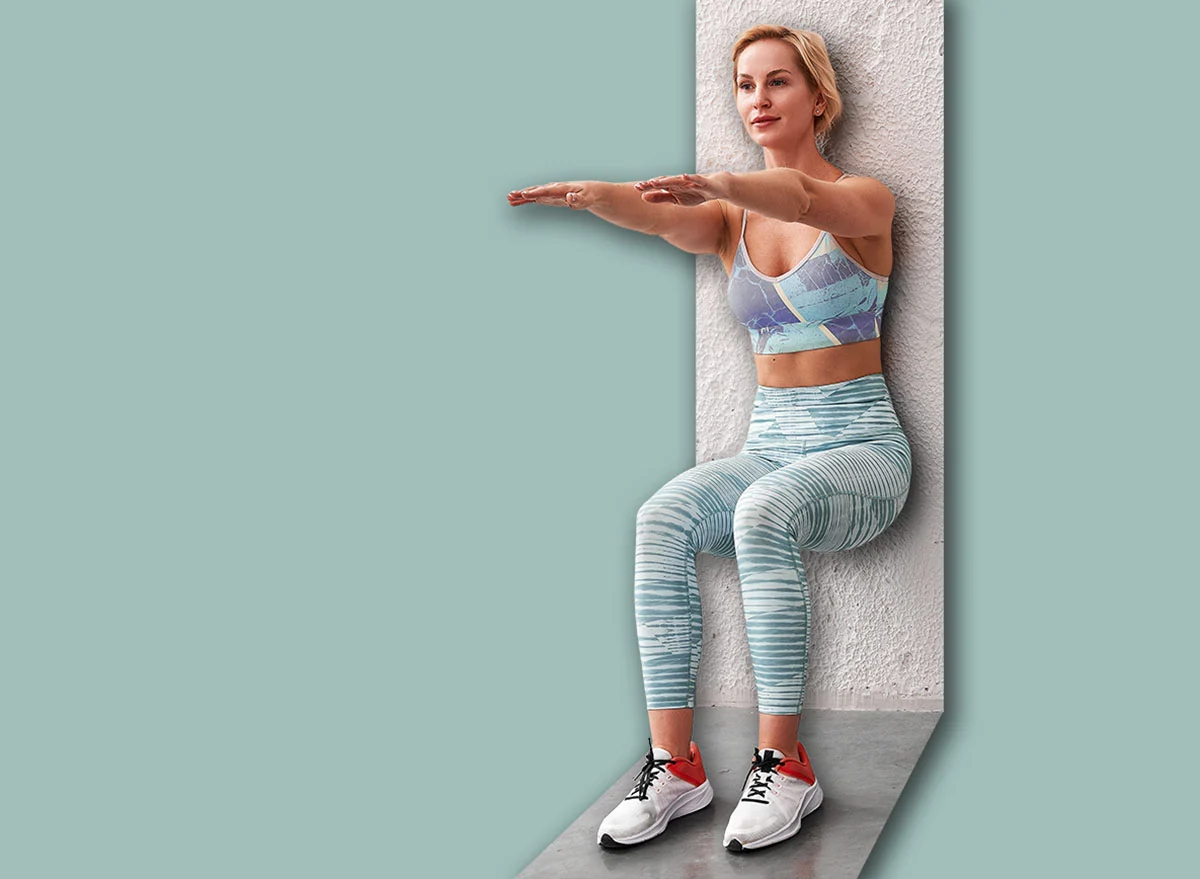
4. Wall Sits: Isometric Endurance
Isometric training—where the muscle is under tension without changing length—is a secret weapon for joint health. Wall sits build immense quad endurance without the shearing force of repetitive motion.
The Mechanics:
- Setup: Stand with your back flat against a smooth wall. Walk your feet out until you are in a seated position with your thighs parallel to the floor.
- The Hold: Keep your spine pressed firmly against the wall. Hold this position for 20 to 45 seconds.
- Safety Note: If your knees feel discomfort, raise your hips slightly higher; you do not need to be at a perfect 90-degree angle to reap the benefits.
5. Reverse Lunges: Knee-Friendly Power
While forward lunges can sometimes put excessive pressure on the knee joint, the reverse lunge allows for a more natural distribution of force, making it significantly more accessible for those over 60.
The Mechanics:
- Setup: Stand tall with your feet together. Engage your core.
- The Movement: Take a controlled step backward with your right foot. Lower your back knee toward the floor until both legs form 90-degree angles.
- The Return: Push off the ball of your back foot to return to your standing, neutral position.
- The Benefit: The backward motion naturally shifts the weight slightly more into the glutes and hamstrings, protecting the knees while still providing a rigorous workout for the quadriceps.
Implications for Long-Term Health
The implications of adopting these movements are far-reaching. Consistent practice of these exercises does more than just "tone" the legs; it promotes neuroplasticity—the brain’s ability to coordinate complex movements—and increases bone density in the hips and knees through weight-bearing impact.
By dedicating just 15 to 20 minutes, three times a week, to these foundational movements, you are investing in your future self. You are choosing the ability to play with grandchildren, travel with ease, and maintain the dignity of independence.
A Final Note on Progression
Always listen to your body. If you are new to these exercises, start with a limited range of motion or use a wall for balance support. As your strength improves, you can increase your repetition counts or the duration of your holds. Before beginning any new exercise regimen, particularly if you have pre-existing joint conditions or chronic health concerns, consult with your primary care physician or a physical therapist.
Strength is not a destination; it is a habit. By focusing on these five movements, you are ensuring that your "quality of life" remains high, regardless of the number on your birthday cake.