









For thousands of years, the Indian subcontinent has nurtured a sophisticated system of medicine that views the human body not merely as a biological machine, but as a dynamic interplay of elements, energies, and consciousness. At the heart of this ancient tradition—Ayurveda—lies the profound practice of massage. Far more than a contemporary spa indulgence, Ayurvedic massage is a therapeutic discipline designed to restore the body to its natural state of equilibrium, or svasthya.
By integrating the wisdom of the brhat trayi (the "Great Three" texts: Caraka Samhita, Sushruta Samhita, and Vagbhata’s Astanga Hrdayam), practitioners have utilized intentional touch to address everything from athletic recovery and postpartum support to profound mental health concerns.
The Philosophical Foundation: Elements and Doshas
To understand the mechanics of Ayurvedic massage, one must first grasp the Ayurvedic view of the universe. All matter, according to this tradition, is composed of five great elements (panchamahabhutas): Space, Air, Fire, Water, and Earth. Within the human physiology, these elements coalesce into three fundamental biological energies known as doshas:
- Vata: Composed of Space and Air, governing movement and the nervous system.
- Pitta: Composed of Fire and Water, governing metabolism and transformation.
- Kapha: Composed of Earth and Water, governing structure and lubrication.
Health, in the Ayurvedic paradigm, is the state of balance among these three forces. When an individual’s constitution (prakruti) is disrupted by lifestyle, diet, or environmental stressors, an imbalance (vikruti) occurs. Ayurvedic massage serves as a corrective measure, utilizing the principle of "opposites" to pacify excess doshas. For instance, the dry, light, and cold nature of an aggravated Vata dosha is best countered by the heavy, warm, and unctuous qualities of medicated oils.
Chronology and Historical Context
The practice of massage in Ayurveda is not a modern invention; it is deeply rooted in the Vedic era. Ancient texts such as the Bhavaprakasha and Yogaratnakara detail specific protocols for manual therapy that were once standard for warriors preparing for battle, athletes seeking to maintain agility, and individuals undergoing restorative therapies.
In the historical context of the Panchakarma (the five-fold purification process), massage—or Snehan (oleation)—was never an isolated event. It was a foundational, preparatory step designed to soften the tissues and mobilize toxins (ama) from the deep layers of the body into the digestive tract for elimination. This historical application highlights that the goal of the practice was always systemic, targeting the physiological root cause of disease rather than merely symptomatic relief.
The Art of Individualized Care
Modern wellness often adopts a "one-size-fits-all" approach, but the hallmark of authentic Ayurvedic massage is its radical commitment to individualization. A practitioner’s assessment begins with an analysis of the recipient’s Prakruti and current Vikruti. Furthermore, the practitioner must evaluate the status of Agni (digestive fire) and the presence of Ama (metabolic toxins).
The Strategic Use of Oils and Herbs
The selection of oil is a highly deliberate act of "herbal infusion." Sesame oil, with its deeply warming and heavy nature, is the preferred medium for calming Vata. Coconut or sunflower oils, which possess cooling properties, are selected to soothe Pitta. Mustard oil, being hot and penetrating, is often reserved for Kapha-related congestion.
The quantity of oil used is equally important:
- Vata: Requires generous amounts of oil to ground the erratic energy.
- Pitta: Requires a moderate application.
- Kapha: Requires minimal oil, often applied with firmer, more stimulating techniques.
Managing Toxins: When Oil is Not the Answer
A critical distinction in Ayurvedic practice is the management of Ama. Because oils share similar "sticky" and heavy qualities with toxins, applying oil to a body already laden with Ama can be counterproductive. In such instances, practitioners pivot to Udvartana—a vigorous massage using dry, hot herbal powders. This technique acts as an exfoliant, stimulating circulation and breaking down stagnation without adding unnecessary moisture.
Specialized Techniques and Modalities
Ayurvedic massage is categorized by its intent and the medium used. The primary categories include:
Abhyanga: The Practice of Loving Oleation
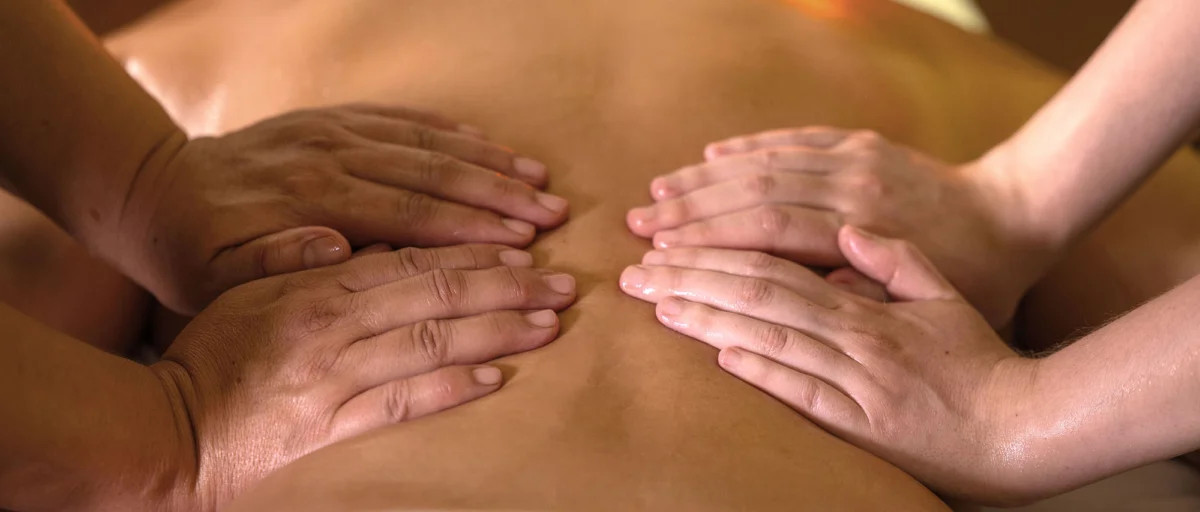
Abhyanga is the most widely recognized form of Ayurvedic massage. The Sanskrit word Snehan carries a dual meaning: it means both "oil" and "love." Thus, the practice is considered an act of bathing the cells in a vibration of affection and nourishment. Whether performed as self-massage (dinacharya) or administered by one or two practitioners in a four-handed sequence, the goal is to carry the medicinal properties of infused herbs through the skin and into the deeper tissues.
Massage with Powders and Pastes
Beyond oiling, the tradition utilizes:
- Udsadana: Dry herbal treatments focused on beauty and skin health.
- Udgarshana: The use of herbal pastes (herbs mixed with water or oil) to treat specific dermatological imbalances.
Strokes and Directionality
The direction of movement is not arbitrary. Anuloma (away from the heart) is used to ground and calm, while Pratiloma (toward the heart) is employed to stimulate lymph flow and improve circulation. The practitioner draws from a toolkit of specific strokes:
- Garshana/Mardana (Friction)
- Peedana (Kneading)
- Udvesthana (Twisting/Wringing)
- Praharana (Percussion)
- Trashana (Stroking)
- Sandhi Calana (Joint mobilization)
Marma Therapy: The Energetic Gateway
Perhaps the most sophisticated dimension of Ayurvedic massage is Marma Therapy. Marmani are specific energy points—the junctions where muscles, veins, ligaments, bones, and joints meet. Unlike the points used in Chinese acupuncture, which are often uniform in size, Marma points vary in dimension and serve as "gateways" to the energetic channels (nadis) of the body.
By stimulating these points, a practitioner can influence the flow of Prana (life force energy), providing a powerful intervention for mental, emotional, and physical distress. Because the skin is the site of Bhrajaka Pitta—the sub-dosha responsible for skin luster and complexion—the intentional stimulation of these points feeds the skin’s Agni, allowing nourishment to penetrate to the muscles, nerves, and even the internal organs.
Implications for Modern Well-being
The implications of Ayurvedic massage extend far beyond relaxation. In an era dominated by high-stress, sedentary lifestyles, the grounding effects of Vata-pacifying treatments provide a necessary antidote to the "fight-or-flight" nervous system state.
For those suffering from chronic pain, hormonal imbalances, or digestive sluggishness, the ability to tailor a treatment to the exact state of the individual’s doshas offers a precision that few other modalities can match. Furthermore, the emphasis on the "skin-to-organ" connection acknowledges that the body’s largest organ is a gateway to systemic health. By regularly nourishing the skin with herbalized oils, individuals can support the resilience of their nervous system and the efficiency of their detoxification pathways.
Conclusion: A Living Lineage
The practice of Ayurvedic massage is an evolving yet deeply preserved science. As practitioners like Beatrice Voss emphasize, the lineage of this tradition—anchored in heart-centered care and the mastery of subtle therapies—remains a vital resource for modern health.
Whether it is the soothing application of Dhanvantaram tailam to calm an anxious mind, or the rigorous application of herbal powders to cleanse stagnant tissues, Ayurvedic massage invites us to return to a state of connection. It reminds us that we are not separate from the natural world; we are a manifestation of the same five elements that shape the mountains, the wind, and the oceans. Through the simple, intentional act of touch, we can harmonize these forces, awakening our own inner pharmacy and restoring the natural radiance of the human spirit.
Disclaimer: This article is for educational purposes and is based on traditional Ayurvedic principles. Always consult with a qualified health professional or an Ayurvedic Practitioner (CAP) before beginning any new therapeutic regimen.