







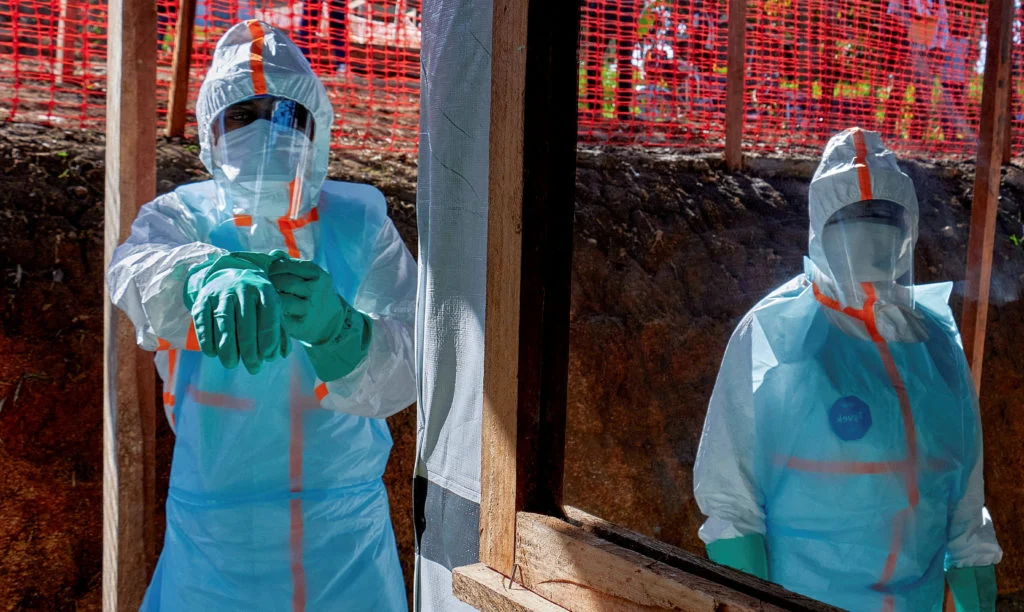
By Investigative Desk
The World Health Organization (WHO) has offered a glimmer of cautious optimism this week, declaring that the international and domestic response to the latest Ebola outbreak in the Democratic Republic of the Congo (DRC) is finally "catching up" with the rapid viral transmission. However, as medical teams gain ground, health officials warn that the crisis remains precarious. With more than 340 confirmed cases and the virus breaching international borders into Uganda, the situation has evolved into one of the most complex public health challenges of the decade.
The outbreak is occurring against a backdrop of systemic instability. In a region already fractured by decades of armed conflict, mass displacement, and fragile infrastructure, the arrival of Ebola acts as a threat multiplier, pushing already strained health systems to the brink of total collapse.
The Geography of the Outbreak: From Isolation to Proliferation
When the current outbreak was formally declared on May 15, the geographical footprint of the virus was initially contained. Early surveillance indicated that the contagion was limited to three primary areas: Rwampara, Mongbwalu, and Bunia, the latter serving as the provincial capital of North Ituri.
However, the virus has demonstrated a startling capacity for movement. Within a matter of weeks, the number of affected health zones has ballooned to over 20. The speed of this transmission has overwhelmed local facilities, forcing medical personnel to turn away patients for lack of hospital beds—a harrowing triage decision that underscores the severity of the crisis.
For observers in the West, the scale of the DRC is often difficult to visualize. Kinshasa, the nation’s capital and the hub of the government’s response, sits roughly 950 miles from the epicenter of the outbreak in the northeast—a distance comparable to the span between Jackson, Mississippi, and Washington, D.C. This vast, rugged terrain complicates the logistics of delivering vaccines, medical supplies, and trained personnel, turning a standard epidemic response into a logistical marathon.
Chronology: A Timeline of Escalation
- Mid-May: The DRC government officially declares an Ebola outbreak following the identification of cases in the North Ituri province.
- Late May: The virus spreads from three initial clusters to encompass over 20 health zones. The death toll begins to climb as treatment centers reach maximum capacity.
- Early June: International aid begins to mobilize. Significant funding is raised, and emergency supplies are airlifted to Ituri. Despite these efforts, the virus is confirmed to have crossed the border into Uganda.
- Present Day: The WHO notes a stabilization in the "race" against the virus, yet the combination of ongoing militia violence and cross-border movement keeps the outbreak in a high-risk category.
The Conflict Barrier: Why Containment Is Failing
The most significant obstacle to eradicating the virus is the intractable nature of the security situation in eastern DRC. The region is home to a dense network of armed factions, including the Cooperative for the Development of the Congo (CODECO), the Allied Democratic Forces (ADF), and various "Zaire" militias.
The Refugee Trap
Violence perpetrated by these groups has forced thousands of civilians to abandon their homes and flee to displaced persons camps. These sites are frequently overcrowded, with sanitation and social distancing rendered impossible. In such environments, Ebola can propagate with terrifying efficiency. Health workers have identified these camps as "fertile ground" for the virus, yet they face immense danger when attempting to enter these areas to conduct surveillance or provide vaccinations.
The Breakdown of Contact Tracing
The bedrock of Ebola containment is rigorous contact tracing—the process of identifying, tracking, and isolating every individual who has had physical contact with an infected person. In the eastern DRC, this is a dangerous, if not impossible, task. With vast swathes of territory under the control of the M23 rebel group and others, medical teams cannot move freely. The inability to safely reach patients not only leaves the infected without care but allows the chain of transmission to remain unbroken and invisible to health authorities.
Supporting Data and Medical Realities
The human cost of this outbreak is reflected in the grim statistics currently being tracked by the Ministry of Health and international partners:
- Confirmed Cases: 344 and rising.
- Confirmed Deaths: 60.
- Health Zone Impact: Over 20 zones currently reporting active transmission.
- Resource Mobilization: Millions of dollars in emergency funding have been deployed, resulting in the establishment of new, specialized treatment centers designed to isolate patients and mitigate further spread.
The international response, led by the WHO, has focused on a "scale-up" strategy—airlifting medical equipment, increasing the number of beds, and deploying specialized teams to the most remote areas of Ituri province. However, data suggests that until the security situation stabilizes, the transmission rate will continue to fluctuate despite medical interventions.
Official Responses and Diplomatic Friction
The international community is currently grappling with a classic public health dilemma: the balance between border security and economic survival.
Uganda, fearing the spillover of the virus, has moved to close its borders with the DRC. This policy has been met with significant pushback from the World Health Organization. While the WHO acknowledges that every nation has the sovereign right to protect its citizens, they have cautioned that blanket border closures often cause more harm than good.
"Border closures disrupt the livelihoods of thousands," a WHO representative noted. "Instead of shutting down, countries should focus on stepping up screening at border crossings and improving surveillance systems."
In the DRC, the economic impact is already being felt. The border regions depend heavily on cross-border petty trade for survival. With trade routes severed and markets closing, the population is facing a secondary crisis: extreme economic hardship. This financial instability, in turn, may discourage people from coming forward if they feel sick, as the economic cost of quarantine—or the fear of losing their only source of income—far outweighs the perceived risk of the disease.
Implications: The Long Road Ahead
As the situation evolves, the implications for the region are profound.
The Necessity of a Ceasefire
The DRC government and international partners are now issuing urgent appeals to the various warring factions to enact a localized humanitarian ceasefire. The goal is to create "medical corridors" that allow health workers to operate without the constant threat of violence. Without a cessation of hostilities, the international community fears that the virus could become endemic in the region, turning a temporary outbreak into a multi-year crisis.
The Vulnerability of Global Health
This outbreak serves as a stark reminder of the fragility of global health security. The ease with which the virus moved from a remote corner of the DRC into a neighboring country highlights the interconnectedness of modern human mobility.
Moving Toward Stability
The coming weeks will be critical. If the WHO’s assessment that the response is "catching up" proves accurate, the focus will likely shift to a post-outbreak recovery plan that addresses not only the medical needs of the survivors but the underlying socioeconomic damage caused by the closures and the persistent threat of conflict.
For the people of Ituri, the fight against Ebola is not just a battle against a pathogen; it is a battle for their right to move, trade, and live without the constant shadow of the next crisis. Whether the international community can provide the stability required to end the outbreak remains the defining question of the year. As the world watches, the medical teams on the ground continue their work—one village, one contact, and one vaccine at a time—in one of the most challenging environments on the planet.