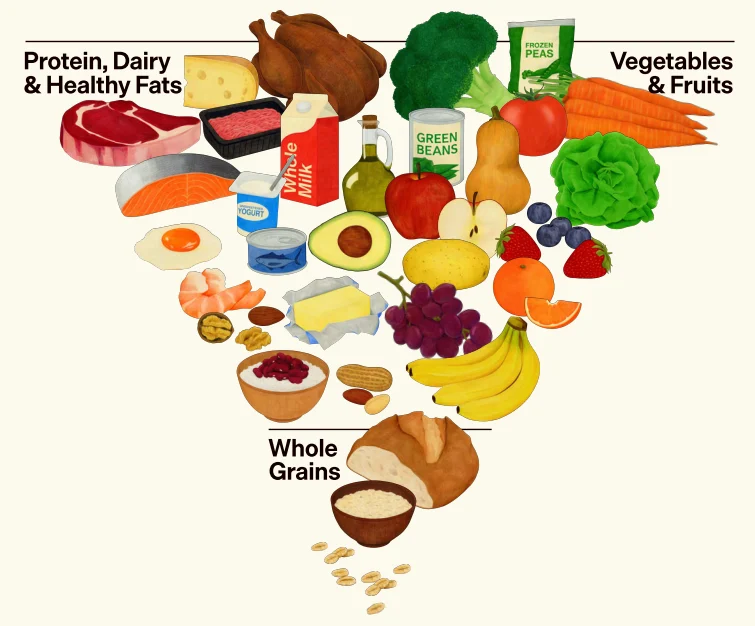
The release of the 2025–2030 Dietary Guidelines for Americans (DGAs) was met with significant anticipation, arriving with a bold, consumer-facing mantra: "Eat real food." While the document takes a commendable and long-overdue stand against the ubiquity of ultra-processed foods and added sugars, the unveiling of its centerpiece visual—a re-imagined, inverted "New Food Pyramid"—has sparked a firestorm of controversy among nutrition scientists, public health advocates, and independent researchers.
While the Guidelines ostensibly aim to simplify nutrition for the average American, critics argue that the visual messaging directly undermines the scientific text. By elevating animal-based proteins and full-fat dairy to prominent positions, the new pyramid appears to clash with established cardiovascular health benchmarks, leaving the public caught between a clear textual mandate to reduce saturated fat and a visual guide that suggests the opposite.
Main Facts: What the New Guidelines Propose
The 2025–2030 DGAs represent a shift in tone for federal nutrition policy. For the first time, the document explicitly calls out "highly processed foods" as a category to avoid. The text directs consumers away from sugar-sweetened beverages, refined grains like white bread, and pre-packaged snacks.
Simultaneously, the guidelines have adopted a significantly more stringent stance on added sugars. The new recommendations effectively move away from the "10% of total daily calories" threshold used in previous iterations, suggesting that no amount of added sugar is considered part of a healthy diet. Furthermore, the guidelines now recommend that children avoid all added sugars until the age of 10, a dramatic increase from the previous age-2 threshold.
However, these progressive steps are shadowed by a confusing approach to fats and proteins. While the written guidelines maintain the longstanding consensus that saturated fat should be limited to 10% of daily caloric intake, the visual "New Food Pyramid" flips traditional health advice on its head. It prominently features steak, butter, and whole-fat dairy—foods that are notoriously difficult to integrate into a diet if one is attempting to adhere to that 10% saturated fat ceiling.
A Chronology of Policy: From Committee to Contracting
The path to the 2025–2030 DGAs has been anything but standard. Typically, the process begins with the Dietary Guidelines Advisory Committee (DGAC), an independent body of nutrition scientists who synthesize the latest peer-reviewed research. This process is designed to be rigorous, transparent, and shielded from industry influence.
Following two years of exhaustive review, the 2025–2030 Advisory Committee submitted their comprehensive Scientific Report. However, in an unprecedented move, the current administration rejected significant portions of the Committee’s findings. Instead, the final document was synthesized through a private, "federal contracting process" involving a separate, undisclosed group of reviewers.
This deviation has drawn sharp rebukes from within the scientific community. Deirdre Tobias, an assistant professor in the Department of Nutrition at the Harvard T.H. Chan School of Public Health and a member of the official Advisory Committee, has publicly lamented the lack of transparency. "There has not been transparency in who wrote the new DGAs," Tobias noted. "The reviews themselves… deviate significantly from the rigorous process that the HHS developed to ensure the evidence base was replicable, unbiased, and free from non-scientific influences."
Compounding these concerns, investigative reports have surfaced highlighting that several members of the external review panel held documented financial ties to the beef and dairy industries—a detail that, for many, explains the unusual prominence of those specific food groups in the final, government-sanctioned graphic.
Supporting Data: The "Saturated Fat Math" Problem
The tension between the guidelines’ text and their imagery is best illustrated through basic nutritional arithmetic. For an average 2,000-calorie diet, a 10% limit on saturated fat allows for approximately 22 grams per day.
The DGAs recommend three daily servings of dairy. If a consumer follows the "New Food Pyramid" and opts for the suggested full-fat versions—such as one cup of whole milk (5g saturated fat), three-quarters of a cup of full-fat Greek yogurt (6g), and one ounce of cheddar cheese (6g)—the consumer has already hit 17 grams of saturated fat. If that individual then uses a single tablespoon of butter (7g) or beef tallow (6g) for cooking, they have exceeded their total daily allowance before consuming a single bite of meat, vegetable, or grain.
Dr. Frank Hu, chair of the Department of Nutrition at Harvard, notes that the lack of nuance regarding "healthy fats" is particularly problematic. "The mixed messages surrounding saturated-fat-rich foods such as red meat, butter, and beef tallow may lead to confusion and potentially higher intake of saturated fat and increased LDL cholesterol and cardiovascular risk," Dr. Hu warned.
Furthermore, while the pyramid does include olive oil, it characterizes it primarily as a source of "essential fatty acids." Dr. Hu points out that this is scientifically incomplete. While olive oil is a heart-healthy choice, it is lower in specific essential fatty acids like alpha-linolenic acid compared to canola or soybean oil. More importantly, the guidelines fail to emphasize that plant-based oils consistently outperform animal fats in every major study concerning cardiovascular health.
Official Responses and the "Protein Hype"
The 2025–2030 edition also introduces a dramatic increase in recommended protein intake, moving to 1.2 to 1.6 grams per kilogram of body weight—a 50% to 100% increase over previous minimums.
While proponents argue this helps maintain muscle mass, critics point out that the average American is already consuming more than enough protein. The guidelines fail to provide a distinction between the "protein package"—the fiber, vitamins, and unsaturated fats found in fish or legumes—and the saturated fats, sodium, and cholesterol that accompany red meat. By failing to categorize proteins by quality, the guidelines risk encouraging an intake pattern that could lead to weight gain and poor lipid profiles, as excess protein that the body cannot use for repair is often converted into stored fat.
Regarding alcohol, the messaging has shifted to a vague suggestion to "consume less for better health." Without defining what "less" means, health officials fear the recommendation is functionally useless for a public that historically struggles with interpreting dietary nuance.
Implications: A Crisis of Public Trust
The primary goal of the Dietary Guidelines for Americans is to provide a roadmap for the public to prevent chronic disease. However, when the visual representation—which is what most consumers actually remember—contradicts the internal science, the result is mass confusion.
The decision to omit environmental and socioeconomic impacts also represents a missed opportunity. Food choices are inextricably linked to the environment, and they are heavily dictated by the food environments in which people live. By ignoring these systemic factors, the DGAs remain an abstract, top-down policy document that is increasingly disconnected from the lived reality of the American public.
Perhaps the most troubling implication is the potential erosion of institutional trust. When the rigorous work of an independent committee is sidelined in favor of a process that includes industry-tied reviewers, the guidelines cease to be a purely scientific document and instead become a political one.
Moving Forward: Alternatives for the Consumer
Given the contradictory nature of the new DGAs, nutrition experts are encouraging the public to look toward more consistent, evidence-based resources. Organizations like the Harvard T.H. Chan School of Public Health continue to advocate for their Healthy Eating Plate and Healthy Eating Pyramid. These models emphasize a much clearer hierarchy: prioritizing vegetables, fruits, whole grains, and healthy plant oils while limiting red meat and avoiding processed dairy and sugars.
Ultimately, the 2025–2030 DGAs are a reminder that nutrition is not merely a matter of government decree. As the scientific community continues to push for greater transparency, the most effective strategy for the average person remains the same: focus on whole, minimally processed foods, prioritize plant-based proteins, and consult with a registered dietitian who can provide personalized guidance that is not beholden to the competing interests of industry and policy. If the goal of the new guidelines was to simplify healthy eating, they have instead highlighted the urgent need for a more transparent and science-led approach to our national health.