











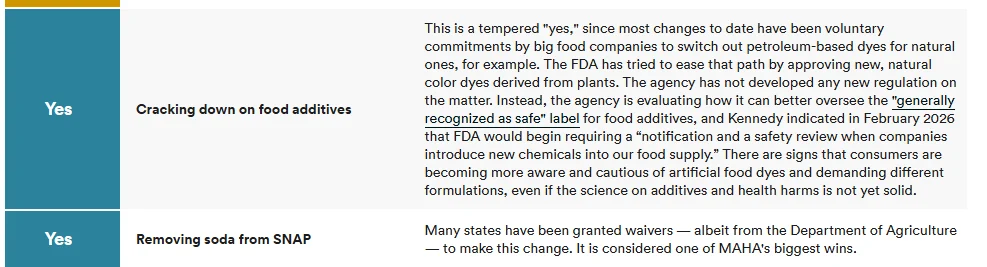
The administration’s "Make America Healthy Again" (MAHA) initiative has stood as a polarizing centerpiece of domestic policy. Since its inception, the platform—which prioritizes radical shifts in food policy, agricultural regulation, and chronic disease mitigation—has promised to dismantle long-standing institutional norms. Recently, a granular analysis conducted by StatNews journalists Isabella Cueto and J. Emory Parker examined 80 specific campaign promises tied to the MAHA agenda, providing the most rigorous evaluation to date of where the administration stands after its first year.

For stakeholders in the nutrition, public health, and agricultural sectors, the report serves as a critical scorecard. While some initiatives have gained significant momentum, others remain stalled in bureaucratic limbo, highlighting the complex friction between campaign rhetoric and the realities of federal implementation.

The Landscape of Change: Main Facts and Strategic Objectives
The core mission of the MAHA platform is the reduction of chronic illness through systemic changes in the American food supply. The administration’s strategy focuses on three primary pillars: the reform of federal food subsidies, the restriction of chemical additives in food manufacturing, and the overhaul of regulatory oversight at agencies like the FDA and the USDA.

According to the StatNews analysis, the administration has successfully prioritized high-visibility issues, such as the labeling of ultra-processed foods and the scrutiny of endocrine-disrupting chemicals. By framing these as "health freedom" issues, the administration has successfully navigated a political landscape that often pits corporate industrial interests against consumer advocacy groups.

However, the analysis also reveals a notable disparity between administrative intent and agency output. While executive orders have set a tone of urgency, the actual process of rulemaking—which requires public comment periods, scientific validation, and inter-agency coordination—has proven to be a significant bottleneck.
A Year in Review: The Chronology of Implementation
To understand the trajectory of these policies, it is necessary to look at the timeline of the administration’s first year. As documented in the comprehensive chronology provided by Food Tank, the administration hit the ground running with aggressive directives aimed at "cleansing" the food supply.
Phase 1: The Executive Sprint (Months 1–3)
The administration began by appointing key figures to high-ranking roles within the USDA and HHS who were openly critical of the status quo. Early actions focused on the cancellation of specific research grants and the initiation of "deep dives" into the food pyramid and dietary guidelines, which they argued had been captured by industry lobbyists.

Phase 2: Regulatory Friction (Months 4–8)
As the administration moved toward binding regulations, they encountered the "administrative state." Attempts to drastically limit the use of certain pesticides and food colorings were met with immediate legal challenges from agricultural trade groups. This period marked the transition from bold proclamations to the technical, often tedious, work of administrative law.

Phase 3: The Mid-Year Reckoning (Months 9–12)
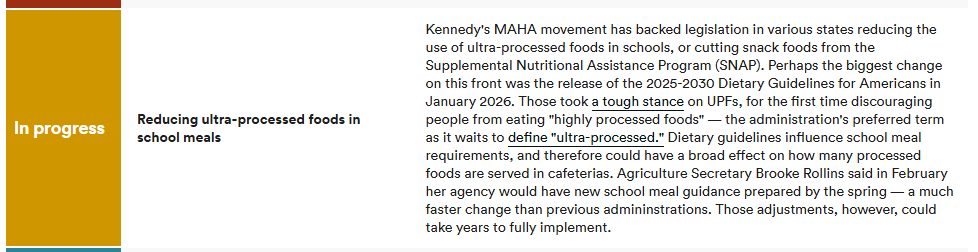
By the one-year mark, the administration’s focus shifted to "low-hanging fruit" that could be achieved through internal policy shifts rather than new legislation. This included tightening internal standards for school lunch programs and increasing transparency requirements for imported agricultural products.
Data-Driven Assessment: What Has Worked, What Is Stalled, and What Is Ignored
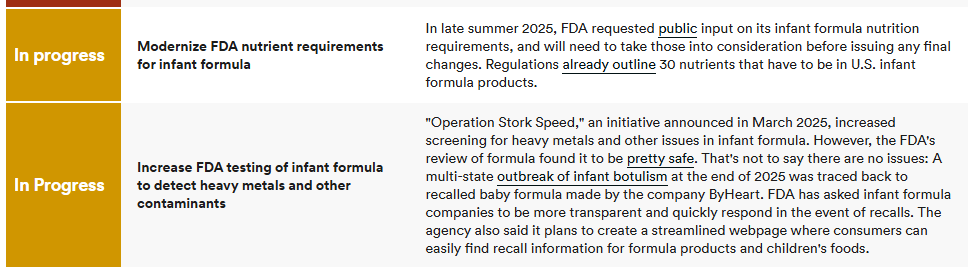
The StatNews scorecard breaks the 80 promises into three distinct categories: those that have seen clear progress, those currently in the works, and those that have not yet been touched.

Successes: Shifting the Overton Window
The administration has successfully moved the needle on the public conversation regarding "ultra-processed" foods. By forcing a dialogue about the relationship between industrial food manufacturing and chronic metabolic disease, they have achieved a level of public awareness that was largely absent under previous administrations. Several small-scale initiatives, including increased funding for local produce access and the tightening of labeling laws for "natural" food products, are now in advanced stages of implementation.

In the Works: The Regulatory Grind
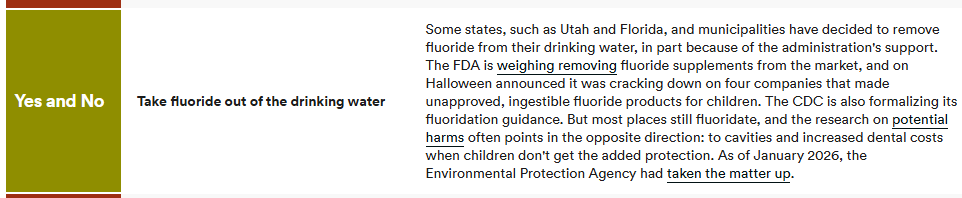
A significant portion of the MAHA agenda remains "in the works." This includes the complex process of reevaluating the GRAS (Generally Recognized as Safe) list at the FDA. The scale of this task is massive, involving thousands of chemicals that have been in the food supply for decades. While the intent is to demand more rigorous safety testing, the capacity of the FDA to manage such a shift remains a point of contention among experts.
The Stalled Agenda: Unfulfilled Promises
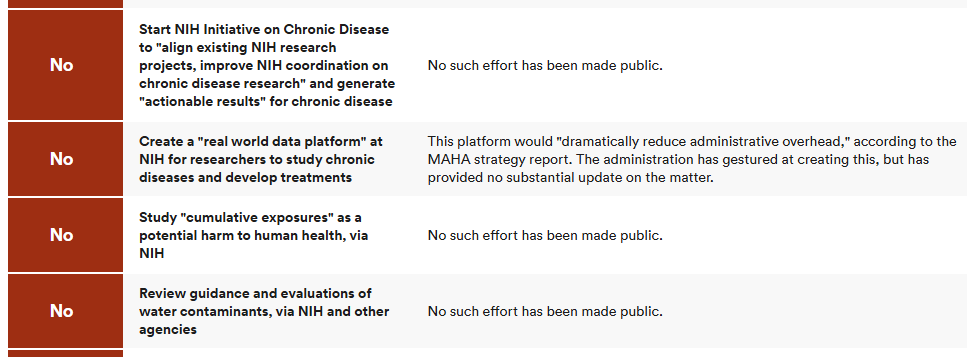
Not all promises have seen movement. Several high-profile goals—specifically those requiring significant congressional action—have stalled. Promises to fundamentally rewrite the Farm Bill to favor regenerative agriculture over corn and soy monocultures have hit a wall in the legislature. Furthermore, attempts to reform the lobbying system within the Department of Agriculture have failed to gain traction, largely due to the immense political capital required to take on entrenched agricultural interests.

Official Responses and Institutional Reactions
The reaction from the scientific and regulatory community has been one of cautious observation. The American Academy of Pediatrics and various nutrition societies have generally praised the focus on reducing artificial additives, noting that the health of the American public is in a state of crisis. However, they have also expressed deep concerns regarding the administration’s methods.

Many career scientists at the FDA and USDA have privately expressed alarm over the administration’s tendency to bypass traditional peer-review processes in favor of rapid, top-down directives. Critics argue that by politicizing science, the administration risks damaging the credibility of these institutions, even if their ultimate goals (such as a healthier food supply) are widely supported by the public.

Agricultural industry groups, meanwhile, have adopted a strategy of "compliance and challenge." While they have publicly signaled a willingness to work with the administration on food safety improvements, they have simultaneously filed multiple lawsuits aimed at delaying any regulation that would disrupt current supply chain efficiencies or cost structures.

Implications: The Long-Term Impact on Food and Nutrition
The implications of the MAHA agenda extend far beyond the immediate legislative scorecard. Regardless of whether every promise is kept, the administration has fundamentally changed the calculus of American food policy.

1. Market Response
The most immediate effect has been the "MAHA effect" on the private sector. Major food corporations, anticipating stricter regulations, have begun proactively reformulating products to remove controversial ingredients. This market-driven shift is perhaps the most tangible success of the administration’s platform, as companies seek to avoid the reputational risk of being labeled "unhealthy" by federal authorities.

2. The Future of Agricultural Subsidies
The long-term success of the MAHA agenda will ultimately be decided by the next Farm Bill. If the administration cannot secure a victory in reallocating subsidies away from commodity crops toward nutrient-dense, regenerative produce, the structural barriers to a healthier America will remain. This represents the ultimate "stress test" for the administration’s influence.

3. Public Health Outcomes
The ultimate goal—the reduction of chronic diseases like diabetes, obesity, and heart disease—is a long-term metric. It is unlikely that any measurable impact on population-level health will be visible within a single presidential term. However, by establishing a new standard for transparency and accountability, the administration is laying the groundwork for a generational shift in how Americans consume and value food.

Conclusion: A Complex Legacy
The StatNews and Food Tank analyses demonstrate that the "Make America Healthy Again" agenda is neither the total disaster its critics feared nor the instant panacea its proponents promised. It is, instead, a massive, ongoing experiment in using executive power to force an industry-wide pivot.
As we look toward the remainder of the administration’s term, the focus will likely move from the "easy" wins of regulatory labeling to the "hard" work of structural reform. For the average consumer, the shift is already being felt in the grocery aisle. For the policymaker, the challenge remains: can the administration turn these 80 promises into a sustainable, long-term system that improves the health of the nation without sacrificing the stability of the food supply?
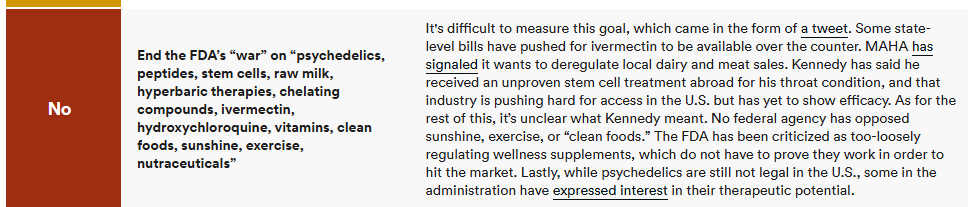
The scorecard provided by StatNews is a vital tool for holding the administration accountable. As the data suggests, the journey from promise to policy is fraught with obstacles, but the impact of these efforts is already rippling through the American agricultural and nutritional landscape. Whether these changes endure will depend on the administration’s ability to transition from a campaign-style platform to the nuanced, consensus-building work of long-term governance.