










The release of the 2025–2030 Dietary Guidelines for Americans (DGAs) was intended to be a definitive roadmap for national health. With the catchy, consumer-facing tagline "Eat Real Food," the document positions itself as a modern, accessible guide to nutrition. However, beneath the polished, user-friendly interface and the eye-catching "New Food Pyramid," public health experts are raising alarms. While the guidelines take a commendable, firmer stance against ultra-processed foods and added sugars, they simultaneously introduce a visual and structural contradiction that threatens to undermine decades of cardiovascular health research.
Main Facts: A Shift in Tone and Texture
The newest edition of the DGAs arrives at a pivotal moment in the American health crisis. With obesity and metabolic disease rates remaining persistently high, the government has pivoted toward a more simplified, directive communication style. The core tenets of the document focus on three primary pillars:
- The War on "Highly Processed" Foods: For the first time, the DGAs explicitly target a broad spectrum of highly processed items. This goes beyond mere "sodium reduction" to advocate for the avoidance of sugar-sweetened beverages and ready-to-eat, nutrient-poor packaged snacks.
- A Strict Stance on Added Sugars: The guidelines have tightened the noose on sugar, declaring that no amount of added sugar or non-nutritive sweetener is part of a healthy diet. Most notably, the guidance for children has been shifted, recommending the total avoidance of added sugars until the age of 10—a significant increase from the previous threshold of age two.
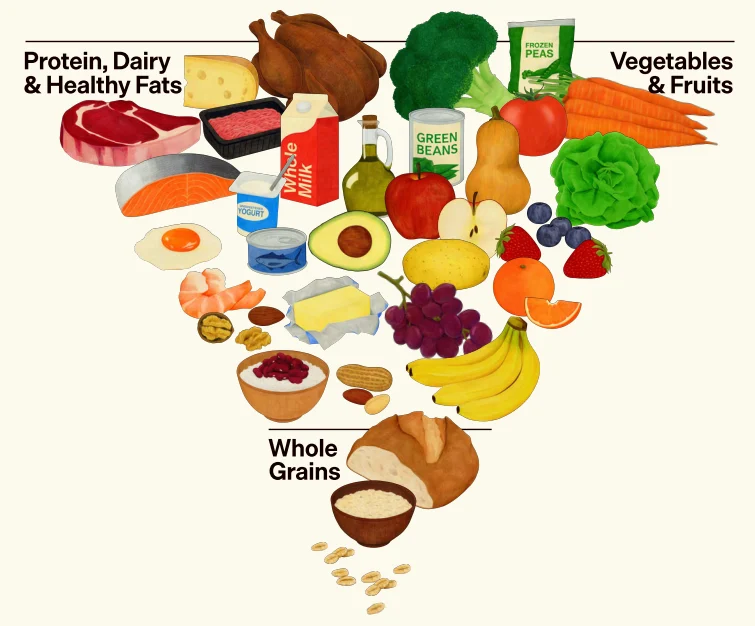
- The "New Food Pyramid" Contradiction: The most controversial aspect of the launch is the return of a pyramid-style graphic. Unlike its predecessor, this version is inverted, placing high-saturated-fat foods like steak, butter, and whole milk in a position of visual prominence.
Chronology: From Scientific Rigor to Administrative Shift
The path to the 2025–2030 Guidelines deviated significantly from historical precedent. Typically, the DGAs are the product of a multi-year, highly transparent process led by an independent Dietary Guidelines Advisory Committee (DGAC). This group of experts evaluates the state of nutritional science, free from industry influence, to draft a Scientific Report.
In this cycle, however, the process took an unexpected turn. The DGAC’s original report was effectively set aside by the current administration. Instead, the final guidelines were informed by a "supplemental scientific analysis" conducted by a group selected through a federal contracting process. This move has sparked intense scrutiny from the scientific community.
Critics argue that this transition lacked the rigorous, peer-reviewed transparency that historically protected the guidelines from political and industry bias. Deirdre Tobias, an assistant professor in the Department of Nutrition at the Harvard T.H. Chan School of Public Health, who served on the original 2025-2030 DGAC, noted, "There has been no transparency in who wrote the new DGAs. The methodology deviates significantly from the rigorous process… to ensure conclusions were replicable, unbiased, and free from non-scientific influences." Furthermore, investigative reports have highlighted financial ties between several reviewers of the supplemental analysis and the beef and dairy industries—an irony not lost on those noting the prominence of those exact products in the new visual pyramid.
Supporting Data: The Saturated Fat Math
Perhaps the most glaring inconsistency in the new guidelines is the "saturated fat math." While the written text of the DGAs maintains the long-standing scientific consensus that saturated fat should be limited to 10% of total daily calories, the visual imagery suggests a dietary pattern that makes this goal nearly impossible to achieve.
For a standard 2,000-calorie diet, a 10% limit equates to approximately 22 grams of saturated fat. The guidelines recommend three daily servings of dairy. If a consumer follows the imagery and chooses whole-fat options—such as one cup of whole milk (5g), three-quarters cup of full-fat Greek yogurt (6g), and one ounce of cheddar cheese (6g)—they have already consumed 17 grams of saturated fat.
When you add the "suggested" cooking fats like butter (7g) or beef tallow (6g), the consumer exceeds their daily limit in a single day’s dairy and cooking fat intake, even before accounting for the saturated fat naturally present in proteins like red meat. Dr. Frank Hu, chair of the Department of Nutrition at the Harvard T.H. Chan School of Public Health, warns that this creates "mixed messages" that could lead to increased LDL cholesterol and cardiovascular risk.
Furthermore, while the pyramid features olive oil, it does so primarily as a source of "essential fatty acids." Dr. Hu points out that this is a missed opportunity: "Olive oil contains mostly oleic acid, but relatively small amounts of essential fatty acids such as alpha-linolenic acid… compared with other oils that are rich sources of these fatty acids, such as soybean or canola oil. All these plant oils have been shown to lower LDL cholesterol and cardiovascular risk compared with animal fats."
Official Responses and Expert Critique
The official release of the DGAs has been met with a mix of cautious optimism regarding the anti-processed food stance and deep skepticism regarding the protein and fat recommendations.
The Guidelines now suggest a daily protein intake of 1.2 to 1.6 grams per kilogram of body weight—a 50% to 100% increase over previous minimums. While proponents argue this helps address age-related muscle loss, experts like Dr. Hu warn that "substantially raising overall protein intake without distinguishing between different sources may have unintended long-term health implications."
The "protein package" is the missing link in the current guidelines. A piece of red meat and a portion of legumes both provide protein, but the former comes packaged with saturated fat and cholesterol, while the latter brings fiber and phytonutrients. By failing to differentiate between these "packages," the guidelines potentially encourage a high-protein diet that inadvertently increases the risk of chronic disease.
Implications: A Culture of Confusion
The implications of these mixed messages are profound. Nutrition is a field where clarity is essential for public adherence. Historically, Americans have struggled to follow the guidelines; by introducing a document that contradicts itself—telling people to limit saturated fat while visually promoting a diet centered on saturated-fat-rich animal products—the government may be fostering a climate of apathy or confusion.
Moreover, the omission of environmental and socioeconomic considerations remains a significant blind spot. The production of food is inextricably linked to planetary health and the economic reality of the average household. By ignoring these variables, the 2025–2030 DGAs risk feeling out of touch with the modern consumer’s lifestyle.
Conclusion: Navigating the New Normal
The 2025–2030 Dietary Guidelines are undeniably more consumer-friendly in their presentation, utilizing interactive platforms and simplified language. However, the scientific community is concerned that this shift toward "accessibility" has come at the cost of nuance and, in some cases, evidence-based safety.
For the average American, the message remains clear: the guidelines are a starting point, not a final authority. The most effective approach to nutrition remains the one that has been supported by years of consistent, transparent research: a diet centered on whole, plant-based foods, healthy fats like those found in olive oil, and the minimization of ultra-processed items and excessive added sugars. When in doubt, looking toward resources like the Healthy Eating Plate—which avoids the pitfalls of industry-influenced visuals—may be the best way to navigate the conflicting advice currently emanating from federal agencies. As we look toward the next five years, the challenge will be to reconcile these new, potentially misleading directives with the realities of human health and the established pillars of nutrition science.