











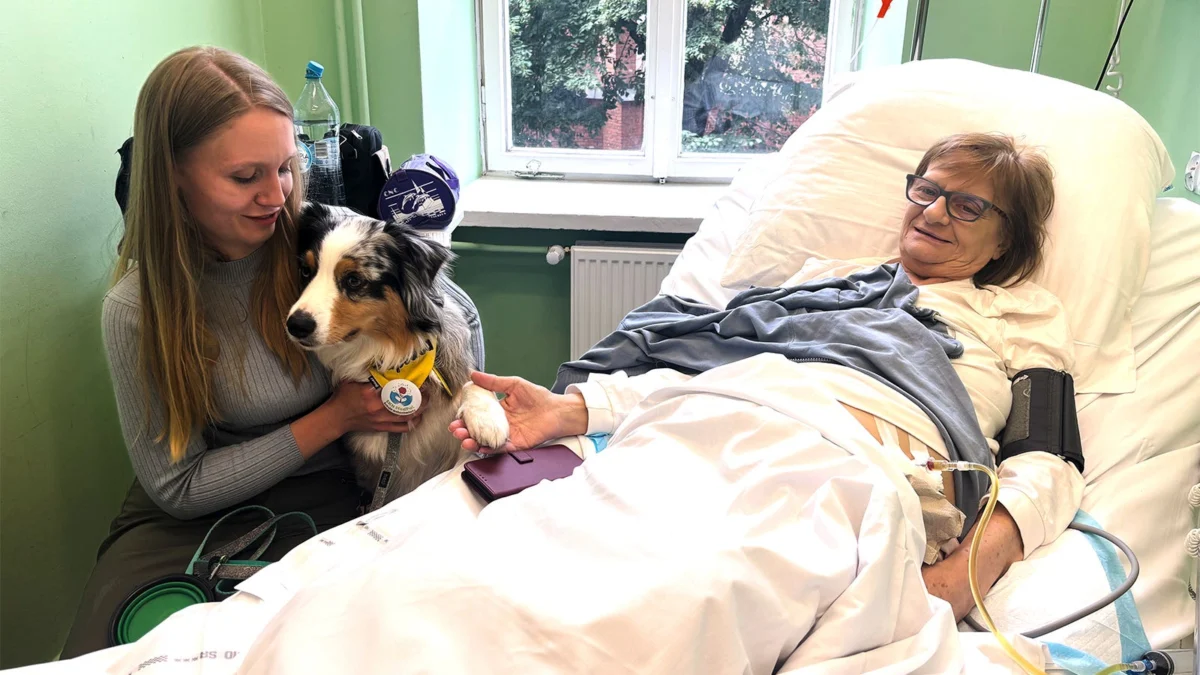
WARSAW, Poland — For Ewa Lutka-Krawczyk, the sterile white walls of the palliative ward at the Medical University of Warsaw were a world away from the warmth of her home. Diagnosed with advanced gallbladder cancer, the 70-year-old’s primary source of distress was not her prognosis, but the fate of Gaja, a shelter dog she had rescued three years prior. In the quiet moments of her hospital stay, as a draining tube connected to her abdomen signaled the harsh reality of her condition, Lutka-Krawczyk’s thoughts remained tethered to her companion.
"She is waiting for me," Lutka-Krawczyk whispered, her eyes softening at the mention of the dog who had been pining for her at home.
Lutka-Krawczyk’s story has become a poignant focal point in a growing movement in Poland to codify the right for terminally ill patients to be visited by their pets. While many hospitals currently allow such visits at the discretion of individual directors, there is no universal legal framework protecting this right. A new legislative proposal, currently under review by the Polish parliament’s health committee, seeks to change that, positioning animal companionship as a fundamental element of compassionate end-of-life care.
The Catalyst: Combating the ‘Epidemic of Loneliness’
The legislative effort is spearheaded by Dr. Tomasz Dzierżanowski, the director of the Palliative Medicine Clinic at the Medical University of Warsaw. For Dr. Dzierżanowski, the mission to integrate pets into the clinical environment is not merely a sentimental gesture; it is a clinical response to what he identifies as an "epidemic of loneliness" permeating modern society.
"We make sure that no patient dies alone," Dr. Dzierżanowski told the Associated Press. "When someone is suffering, it is important that someone is there for them. Ideally, that should be another human being. Sometimes, however, there is no one."
Dr. Dzierżanowski’s observations span a grim demographic spectrum. He notes that older patients are increasingly isolated, having outlived their peers and family members. Simultaneously, younger patients in palliative care often struggle with a profound sense of alienation, a byproduct of a digital age where virtual connections have failed to replace the deep, tangible friendships of previous generations.
The inspiration for this policy shift came from a patient named Waldemar, who arrived at the clinic riddled with anxiety—not for his own mortality, but for the welfare of his two cats. When Dr. Dzierżanowski facilitated a reunion in the ward, the sight of the man’s tears of relief, combined with the visible emotional response of the cats, left an indelible mark on the physician.
"That made me realize that this issue finally needed to be addressed," he said.
Legislative Framework: From Custom to Law
The proposal was introduced to the Sejm, Poland’s lower house of parliament, by lawmaker Katarzyna Piekarska. The bill aims to standardize what is currently a patchwork of hospital policies.
"In reality, animals in hospitals are already there anyway," Piekarska argued, emphasizing the pragmatic nature of the legislation. "That’s why it needs to be regulated in the law."
Under the current status quo, pet visitation is often subject to the arbitrary decision-making of hospital administrators or infection control protocols. Proponents of the bill argue that the emotional and psychological benefits of such visits far outweigh the manageable logistical challenges. By enshrining this right in law, the Polish government hopes to remove the barriers that prevent patients from seeing their animal companions, ensuring that dignity and comfort are prioritized during a patient’s final days.
The Therapeutic Impact: Beyond the Comfort of Fur
The inclusion of animals in palliative care is supported by a growing body of anecdotal and clinical evidence suggesting that the human-animal bond significantly reduces stress, blood pressure, and feelings of depression.
During a recent visit to the Warsaw clinic, the therapeutic efficacy of this approach was on full display. Kluska, an Australian shepherd—her name translates to "dumpling"—was making her rounds with her owner, Małgorzata Brzozowska. As Kluska moved from bed to bed, the atmosphere in the ward palpably shifted.
Lutka-Krawczyk, when visited by the dog, reached out to hold Kluska’s paw, a rare, genuine smile breaking across her face. Nearby, 58-year-old Wojciech Zelik, who is battling a tumor, propped himself up to watch as Brzozowska guided Kluska through a series of gentle tricks.
"She has such lovely fur to pet, so fluffy," Zelik said, his voice lifting as he rubbed the dog’s head.
The benefits, however, extend beyond the patients. Brzozowska, a medical student, noted that the hospital staff—nurses, orderlies, and kitchen workers—often seek out the dogs as well. In an environment defined by high-stakes emotional labor and the frequent loss of life, the presence of an animal provides a necessary emotional reset. It is common to see staff members crouching in hallways to greet Kluska, or the kitchen staff offering her slices of ham, momentarily diverted from the rigors of their duties.
The Reciprocal Bond: Animals in Grief
A critical argument for the legislation is the welfare of the animals themselves. Brzozowska observes that when pets are reunited with their owners in a clinical setting, the animals exhibit signs of relief.
"The dog isn’t as stressed," Brzozowska noted. "We interpret this as meaning that he simply knows what’s happening, that he knows where the owner, who was always there before, has disappeared to."
The confusion and anxiety displayed by pets when a human disappears from their lives are well-documented. By allowing them into the hospice environment, the hospital provides a form of closure for both the human and the animal. This bidirectional comfort is essential, as many patients derive their remaining strength from the belief that their animal companions are being cared for and are not suffering from abandonment.
Implications for Future Healthcare Policy
As the bill moves through the health committee, its progress is being watched by medical professionals across Europe. If enacted, Poland would set a progressive standard for palliative care that explicitly recognizes the role of non-human companions in the end-of-life process.
The implications are significant:
- Humanizing Medical Infrastructure: The legislation challenges the traditional view of hospitals as purely clinical environments, advocating for spaces that prioritize emotional and spiritual well-being alongside medical intervention.
- Psychosocial Support Models: By codifying pet visitation, hospitals will be forced to develop protocols that balance sanitation and allergy concerns with the right to visit, leading to more sophisticated, inclusive care models.
- Societal Reflection: The bill forces a broader conversation about the nature of isolation in the 21st century. It acknowledges that as human networks shrink, the role of animals as "family" has expanded, necessitating legal protection for these relationships.
For patients like Ewa Lutka-Krawczyk, the legislation represents more than just a political victory; it is a promise of a final, meaningful connection. As Dr. Dzierżanowski continues his work, he remains firm in his conviction that medicine must encompass the entirety of a person’s life, not just the biological symptoms of their illness.
"We are not just treating bodies," Dzierżanowski concluded. "We are caring for souls. And sometimes, the most profound comfort comes from a cold nose and a wagging tail."
As the Polish parliament deliberates, the silence in the hallways of the Warsaw palliative ward is occasionally punctuated by the soft clicking of paws on linoleum—a sound that, for many, is the heartbeat of a more compassionate approach to the end of life.