









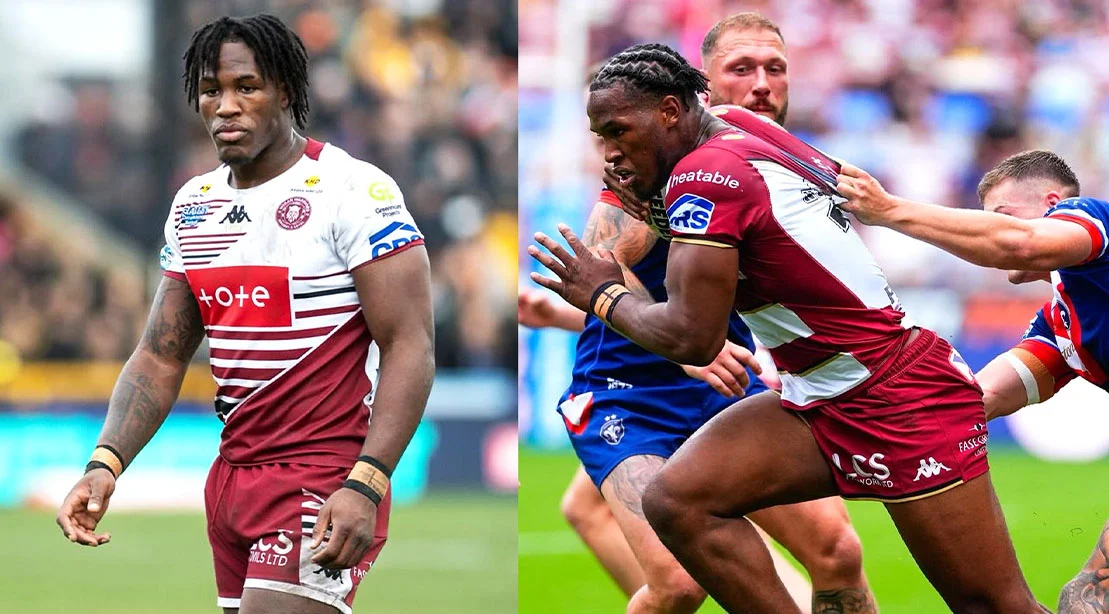
The 2026 Super League season has been a masterclass in resilience for the Wigan Warriors, and at the heart of their resurgence stands a towering figure: Junior Nsemba. Standing at 6-foot-5, the forward has evolved from a promising talent into an indispensable cornerstone of the Warriors’ tactical structure. As the team prepares for the spectacle of the 2026 “Magic WKND”—a high-octane festival of rugby held at Everton’s Hill Dickinson Stadium—all eyes are on Nsemba to see if his physical conditioning can translate into a definitive performance against rivals St Helens.
For Nsemba, the upcoming fixture on July 5 is not merely another game; it is an opportunity to validate the grueling hours spent in the gym and on the training paddock. In an exclusive insight into his preparation, Nsemba has shared his “Big Three” exercises, a regimen designed not just for aesthetics, but for the brutal, high-impact reality of professional Rugby League.
The Path to Wembley: A Season of Grit and Growth
The 2026 season has been a testament to the Warriors’ depth. Despite a campaign defined by a “bumpy” injury list, the squad has managed to maintain its momentum, culminating in a historic triumph at Wembley against Hull Kingston Rovers.
Chronology of a Resilient Campaign
- Early Season: The Warriors faced significant personnel setbacks, testing the resolve of the entire squad.
- May 9, 2026: A pivotal victory over St Helens set the tone for the season, proving that the Warriors could overcome their biggest rivals under pressure.
- The Challenge Cup Final: A hard-fought battle at Wembley cemented the team’s status as a dominant force, showcasing the maturity of younger players like Noah Hodkinson, Jack Farrimond, and Taylor Kerr.
- July 5, 2026: The upcoming clash at Magic WKND represents the next major milestone in the Warriors’ quest for league supremacy.
“This season has been bumpy with injuries, but not many things have changed,” Nsemba reflects. “The players that have stepped in, like Noah, Jack, and Taylor—they have all played a massive role. Getting that win against St. Helens to reach the Challenge Cup Final and then executing at Wembley was special. It means everything to us.”
The Philosophy of Intensity: Why Training Matters
Nsemba is quick to dismiss the notion that gym work is separate from game-day success. To him, the gym is the laboratory where the game is won before the whistle even blows. He views training as a direct simulation of the physical and mental demands of the pitch.
“If you aren’t doing the things the coaches tell you to do in training with commitment, it’s pointless because you’re not going to produce results on the pitch,” Nsemba asserts. “If there’s no intensity to training, it’s not game-relatable. It’s by doing things with intensity—whether that’s in the gym, wrestling, or out on the field—that we actually benefit. We need our training to be of a high standard, every single session.”
This philosophy extends beyond mere lifting; it is about cultivating a mindset that refuses to compromise. When the margin between victory and defeat is a single tackle or a few inches of ground gained, the standard of training becomes the ultimate differentiator.
Junior Nsemba’s 3 Go-To Exercises for Rugby Dominance
To sustain his dominance at 6-foot-5, Nsemba relies on three primary movements that prioritize explosive power, functional back strength, and injury-resilient shoulder stability.
1. Trap Bar Jumps: The Explosive Foundation
The trap bar jump is a staple for rugby players who need to combine heavy resistance with high-velocity movement. Unlike a traditional deadlift, this movement requires the athlete to leave the ground, forcing the body to manage acceleration and deceleration.
- Execution: The athlete loads the trap bar, descends into a partial squat, and drives upward with maximum force, ensuring the feet leave the floor while maintaining core rigidity.
- Rugby Application: It mimics the counter-movements essential for tackling and breaking the defensive line. It conditions the lower body to remain agile while under heavy, unexpected physical loads.
- Nsemba’s Insight: “Trap bar jumps prepare us well for our CMJ (countermovement jump) testing. There’s always a lot of competition in the squad—everyone wants to see who the ‘springiest’ player is!”
2. Multi-Grip Bar Row: Building the Engine
For a forward, the back is the primary engine of the body. Whether grappling in a ruck or carrying the ball into contact, a powerful back is non-negotiable. The multi-grip bar (or Swiss bar) allows for a neutral grip, which reduces shoulder strain while allowing for heavier loads on the lats and rhomboids.
- Execution: Using a neutral grip, the athlete performs a bent-over row, focusing on pulling the elbows back and squeezing the scapulae at the peak of the contraction.
- Rugby Application: This exercise translates directly to “carrying power.” It enhances a player’s ability to remain upright during collisions and provides the stability needed to dominate in close-quarter battles.
- Nsemba’s Insight: “These are an important pulling exercise. They help improve key attributes like tackling strength, collision performance, and carrying power. We perform them explosively and with good technique to maximize the gains.”
3. Face Pulls: The Guardian of Longevity
Rugby is a game of contact, and the shoulders are often the first point of impact. Face pulls are Nsemba’s primary tool for injury prevention, targeting the rear deltoids, rotator cuffs, and upper back.
- Execution: Using a cable station with a rope attachment, the athlete pulls the weight toward the forehead, focusing on external rotation of the shoulders.
- Rugby Application: By strengthening the postural muscles of the upper back, face pulls stabilize the shoulder joint, which is crucial for preventing the repetitive strain injuries common in professional rugby.
- Nsemba’s Insight: “Face pulls are great for injury prevention and shoulder health. I find that you can steadily increase the weight over time. The variety of angles keeps the training engaging while protecting the shoulders from the wear and tear of the season.”
Intellectual Growth: The Shift to “Smart” Rugby
While Nsemba’s physical profile has made him a household name, he is adamant that his growth has been as much mental as it has been physical. He credits his coaching staff—including Sean O’Loughlin, Paul Deacon, and Tommy Leuluai—for guiding his evolution from a pure athlete to a strategic playmaker.
“Previously, my specific job would just be to run with the ball,” Nsemba admits. “But I’ve been working hard on seeing more of the game. That’s come with age and with what coaches like Harry Smith have been saying. There’s more ‘smart’ to my game now. It’s not just about running into what’s in front of you; it’s about seeing the gaps, adapting to the defensive shift, and making the right decision under fatigue.”
This intellectual shift has transformed Nsemba from a force of nature into a tactical weapon. By combining the raw power built in the gym with the strategic guidance of seasoned mentors, he has managed to increase his impact without necessarily needing to increase his workload.
Looking Ahead: The Magic WKND Challenge
As the Super League prepares to descend upon Liverpool for the 2026 Magic WKND, the narrative surrounding the Wigan Warriors is one of calculated ambition. The match against St Helens on July 5 is more than a grudge match; it is a showcase of the physical and technical progress the team has made under a high-pressure, high-intensity training regime.
For the fans, the Magic WKND offers a unique “festival” atmosphere, but for players like Nsemba, it is the next stage in a season-long campaign for dominance. As he continues to refine his game—both through the precision of his lifts and the evolution of his tactical vision—Nsemba remains a symbol of the modern Rugby League athlete: powerful, resilient, and, above all, constantly learning.
Event Details:
The 2026 Magic WKND will be held at Everton’s Hill Dickinson Stadium on July 4 and 5. With the high stakes of the league standings and the pride of local rivalries on the line, it promises to be the definitive event of the summer. Fans looking to witness the spectacle firsthand can secure their tickets via the official Super League portal.
To keep up with Junior Nsemba’s journey through the 2026 season, follow him on Instagram for further insights into his training, recovery, and preparation for the challenges that lie ahead.