











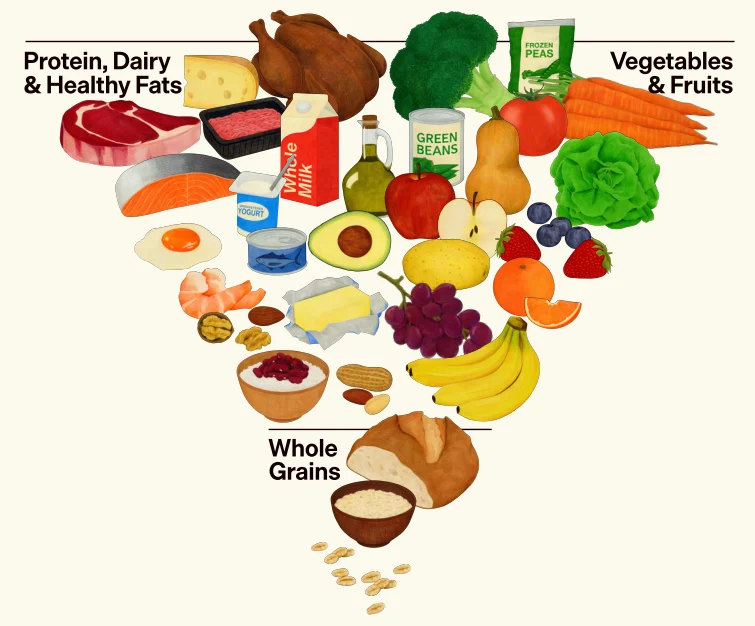
The release of the 2025–2030 Dietary Guidelines for Americans (DGAs) was met with significant anticipation, arriving with the catchy, consumer-focused mantra: "Eat real food." While the document takes a commendable, long-overdue stance against the proliferation of ultra-processed foods and added sugars, it has simultaneously ignited a firestorm of controversy. A new, inverted pyramid graphic—which prominently elevates red meat, full-fat dairy, and butter—has left nutrition scientists, public health advocates, and everyday consumers grappling with a jarring contradiction: the written guidelines warn against saturated fats, while the visual imagery celebrates them.
Main Facts: The New Guidelines at a Glance
The DGAs serve as the cornerstone of federal nutrition policy in the United States, influencing everything from school lunch programs to clinical dietary recommendations. The 2025–2030 edition introduces several pivotal changes:
- The War on "Highly Processed" Foods: For the first time, the DGAs explicitly target a broad category of "highly processed" foods. The guidance encourages a move away from sugary beverages, salty snacks, and refined, white-flour-based carbohydrates in favor of whole, fiber-rich alternatives.
- A Strict Stance on Added Sugars: The new guidelines are more aggressive than ever regarding sweeteners. They suggest that no amount of added sugar or non-nutritive sweetener is part of a healthy diet. Most notably, the guidance for children has been tightened; the recommendation to avoid all added sugars now extends to age 10, a significant jump from the previous age-two threshold.
- The Protein Paradox: The guidelines propose an increase in recommended protein intake, suggesting between 1.2 and 1.6 grams per kilogram of body weight—a 50% to 100% increase over previous minimums.
- The "New Food Pyramid": The most striking element of this release is the return of a pyramid graphic. However, unlike its predecessors, this version is inverted, placing high-saturated-fat foods like steak and cheese in a position of prominence that many experts argue conflicts with the written text.
A Chronology of the 2025–2030 Development
The road to the 2025–2030 DGAs was marked by a departure from standard operating procedures. Every five years, the U.S. Departments of Agriculture (USDA) and Health and Human Services (HHS) typically rely on a Dietary Guidelines Advisory Committee—an independent panel of scientists—to synthesize the latest nutrition research.
- Evidence Review: An independent committee spent two years reviewing current scientific literature, free from industry or government influence. Their findings were submitted as a formal Scientific Report.
- Administration Rejection: In a move that surprised the public health community, the current administration declined to fully adopt the committee’s report.
- The Supplemental Process: In lieu of the committee’s findings, a new, private "federal contracting process" was initiated to perform a supplemental scientific analysis.
- Final Release: The resulting document, while maintaining some scientific rigor, was written by a group whose selection process and methodology remain opaque. Critics, including former committee members, have pointed out that the new, industry-friendly graphic was added during this final, less transparent phase.
Supporting Data: The Saturated Fat Math
The core of the scientific criticism lies in the "saturated fat math." The DGAs maintain the long-standing, evidence-based limit that saturated fat should account for no more than 10% of total daily caloric intake. For a standard 2,000-calorie diet, this equates to approximately 22 grams per day.
When analysts break down the suggested daily servings—which include three servings of dairy—the math becomes problematic. A single cup of whole milk (5g), a serving of full-fat Greek yogurt (6g), and an ounce of cheddar cheese (6g) total 17 grams of saturated fat. Adding a tablespoon of butter (7g) for cooking puts the individual at 24 grams, effectively blowing past the daily limit before a single gram of protein or vegetable is even considered.
Dr. Frank Hu, chair of the Department of Nutrition at the Harvard T.H. Chan School of Public Health, emphasizes the danger of this messaging. "The mixed messages surrounding saturated-fat-rich foods such as red meat, butter, and beef tallow may lead to confusion and potentially higher intake of saturated fat and increased LDL cholesterol and cardiovascular risk," he warns.
Furthermore, while the pyramid depicts olive oil, it lacks the nuance required to steer the public toward essential fatty acids. Oils such as canola and soybean are rich in alpha-linolenic and linoleic acids, which are better suited for heart health than the high-oleic acid content of olive oil or the saturated fats found in animal products.
Official Responses and Transparency Concerns
The lack of transparency surrounding the authorship of the 2025–2030 Guidelines has sparked formal pushback. Deirdre Tobias, an assistant professor who served on the original Advisory Committee, has been vocal about the deviation from established protocols.
"There has not been transparency in who wrote the new DGAs," Tobias stated. "The reviews themselves, as well as their overall presentation and integration, deviate significantly from the rigorous process that the HHS developed… to ensure the evidence base and its committees’ conclusions were replicable, unbiased, transparent, and free from non-scientific influences."
Compounding these concerns, investigative reports have surfaced linking some of the reviewers involved in the supplemental analysis to financial ties with the beef and dairy industries. While these ties were disclosed in the final documents, their presence has cast a long shadow over the "New Food Pyramid," leading many to wonder if policy was shaped more by lobbying than by metabolism.
Implications for Public Health
The potential consequences of these guidelines are twofold: confusion for the consumer and a missed opportunity for policy reform.
1. Consumer Confusion
Visual communication is often more memorable than written policy. When a citizen sees a government-issued pyramid encouraging steak and full-fat dairy, they are likely to ignore the fine print regarding saturated fat limits. This "halo effect" can lead to poor dietary choices that, over time, manifest as increased risks for metabolic syndrome and cardiovascular disease.
2. Environmental and Social Omissions
The new guidelines also conspicuously ignore the environmental impact of food production. As climate change becomes increasingly tied to food systems, many global health organizations have called for guidelines that consider sustainability. Furthermore, the guidelines lack a "socioeconomic lens," failing to acknowledge that for many Americans, the ability to "eat real food" is dictated by food deserts and income inequality, not just willpower.
3. The Protein Overload
By suggesting a drastic increase in protein intake without specifying the source of that protein, the DGAs risk encouraging an over-consumption of red and processed meats. As Dr. Hu notes, the "protein package"—the fats, fiber, and sodium that accompany protein—is as important as the protein itself. A diet high in plant-based proteins and fish is consistently linked to better health outcomes than one reliant on red meat, yet the guidelines fail to make this distinction clear.
A Path Forward: Seeking Clarity
While the 2025–2030 DGAs succeed in labeling "highly processed" foods as detrimental, the document ultimately falls short of being a clear, science-backed roadmap for the average American. The internal contradictions between the written text and the visual graphics suggest a tug-of-war between public health science and industry interests.
For those navigating these conflicting messages, experts suggest returning to time-tested resources. The Harvard Healthy Eating Plate and the Healthy Eating Pyramid remain robust, evidence-based alternatives that emphasize unsaturated fats, whole grains, and lean proteins without the confusing, industry-influenced caveats. Ultimately, if the goal of the Dietary Guidelines is to improve the health of the nation, they must prioritize clarity and scientific integrity above all else. As it stands, the 2025–2030 iteration is a reminder that in the world of nutrition policy, one must always look past the image to find the truth.