











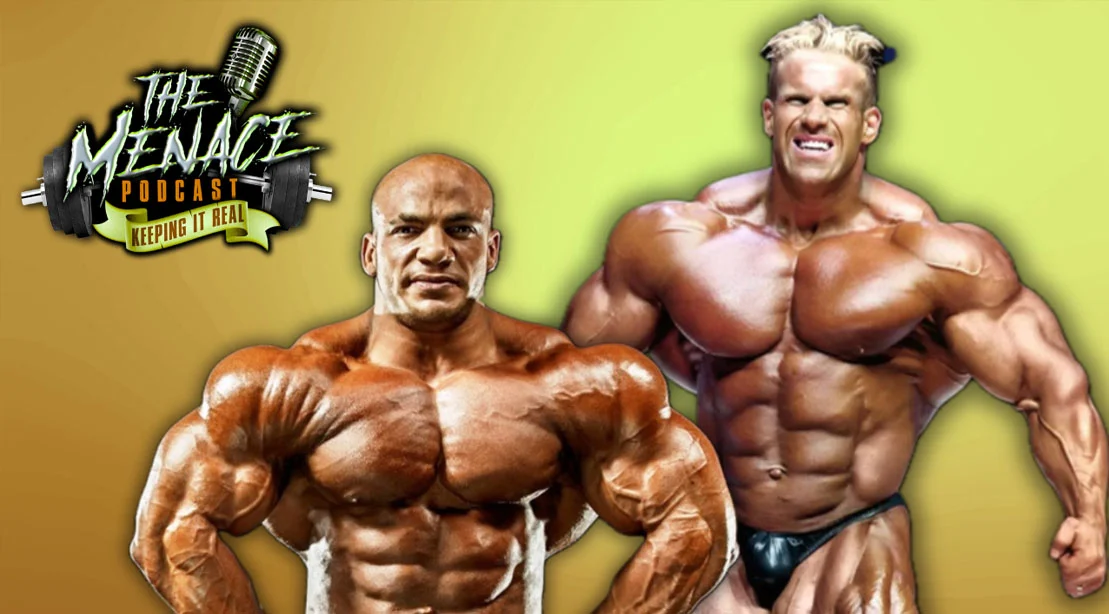
In the high-stakes world of professional bodybuilding, comparisons between legends are inevitable. These debates serve as the lifeblood of the sport, bridging generational gaps and testing the criteria by which greatness is measured. On the 295th episode of The Menace Podcast, host and bodybuilding legend Dennis James, alongside veteran panelists Milos Sarcev and Jose Raymond, tackled one of the most provocative "what-if" scenarios in recent history: Who was the superior bodybuilder, the four-time Mr. Olympia Jay Cutler or the two-time champion Mamdouh "Big Ramy" Elssbiay?
This discourse, while centered on a hypothetical head-to-head, highlights the evolving standards of the IFBB Pro League, the nature of "mass monsters," and the subjective difficulty of judging physiques that represent entirely different eras of aesthetics.
The Legacy of the Contenders: A Chronological Overview
To understand the weight of this debate, one must first analyze the historical trajectories of both athletes.
Jay "The Quad Stomper" Cutler
Jay Cutler’s career is defined by his legendary rivalry with Ronnie Coleman and his unprecedented resilience. After multiple runner-up finishes, Cutler finally ascended to the throne in 2006. His reign—spanning 2006, 2007, 2008, and a historic comeback victory in 2010—solidified his status as one of the most complete bodybuilders in history. Cutler was known for his "grainy" conditioning, incredible structural width, and an unmatched work ethic that pushed the sport into a new era of professional athlete marketing.
The Rise of Big Ramy
Mamdouh Elssbiay, better known as "Big Ramy," brought a level of sheer, unadulterated mass to the stage that had not been seen since the peak of the Coleman era. Bursting onto the scene with a dominant victory at the 2012 IFBB Amateur Mr. Olympia, Ramy signaled a shift toward the "freak factor." By 2013, he was already making waves on the professional Olympia stage. His journey culminated in back-to-back Mr. Olympia titles in 2020 and 2021, cementing his legacy as one of the largest men to ever compete in the sport.
Analyzing the 2013 Mr. Olympia Intersection
The debate on The Menace Podcast gained traction by focusing on the 2013 Mr. Olympia—a pivotal year where the past met the future. In that contest, a veteran Jay Cutler, well past his physical prime, placed sixth, while a young, burgeoning Big Ramy secured eighth place.
For many fans, the standings of that specific year were contentious. During the podcast, panelist Jose Raymond offered a candid assessment, arguing that the results were not reflective of the physiques presented on stage. Raymond suggested that Cutler was "gifted that spot" due to his legendary status, noting that Ramy appeared "significantly bigger and in better shape" than the four-time champion during that specific encounter.
Dennis James, who has coached and mentored some of the best in the world, echoed this sentiment. He observed that during the 2013 posing routines, the sheer visual impact of Ramy’s physique made the veteran Cutler appear diminished in several key poses.
The Physics of "Mass Monsters": Size, Symmetry, and Conditioning
When comparing the two, the conversation inevitably drifts to the definition of "best." Is it the most aesthetic? The most conditioned? Or simply the most imposing?
The Case for Big Ramy
Dennis James, speaking from his unique perspective as a former competitor and expert observer, did not shy away from elevating Ramy. "Those two were the widest bodybuilders I’ve ever seen," James noted. However, he argued that Ramy possessed a genetic freakishness that bordered on the surreal.
"The most impressive one was Ramy, in my eyes," James asserted. "Just because of the width, then the waist, and then the f***ing flare in the quads." James went on to describe Ramy at his peak as a "cartoon character"—a testament to his size being so extreme that it defied conventional human proportions. The "Ramy factor" was his ability to hold extreme mass while maintaining a level of structural flare that made other elite competitors look small by comparison.
The Case for Jay Cutler
Conversely, Jay Cutler’s strength was never just his size; it was his consistency. While Ramy struggled with "peaking" at the right time—a recurring issue that often hindered his consistency on the Olympia stage—Cutler was a master of the "total package." Cutler’s conditioning, particularly in the lower back and hamstrings, set the standard for what a champion needed to look like. His ability to hit the stage with full, dry, and separated muscle mass year after year remains his greatest attribute.
Official Perspectives and the Evolution of Judging
The debate highlights a broader shift in bodybuilding judging criteria. In the early 2010s, the sport was transitioning from the "tight-waist, vacuum" era to the "mass monster" era.
- The "Mass" Bias: During the mid-2010s, the IFBB judges clearly rewarded increased muscle volume. This environment favored athletes like Big Ramy, who could provide a silhouette that dominated the stage through sheer bulk.
- The "Legacy" Bias: As Jose Raymond pointed out, bodybuilding is a sport with a long memory. Established champions often receive the benefit of the doubt, a phenomenon that likely assisted Cutler in his later years. This "reputation judging" is a frequent point of contention in the fitness community, as it can delay the transition of the crown to the next generation.
Implications for Future Generations
The discussion on The Menace Podcast is not merely an exercise in nostalgia; it informs how we view the current crop of Olympia competitors.
The Standard of Excellence
If "Big Ramy" is the benchmark for width and leg flare, and "Jay Cutler" is the benchmark for work ethic and consistent conditioning, modern athletes are expected to synthesize both. The current Mr. Olympia, Derek Lunsford, or his predecessor Hadi Choopan, must navigate a judging landscape that demands the size Ramy brought to the table while maintaining the aesthetic precision that defined the Cutler era.
The Role of Podcasts in Bodybuilding Culture
The Menace Podcast serves as an essential medium for the sport’s ecosystem. By allowing veterans like James, Sarcev, and Raymond to analyze historical performances, they provide context to fans who may not have been present for the 2013 clash. These discussions strip away the "marketing" of the athletes and focus on the technical aspects of muscle insertions, conditioning, and stage presence.
Conclusion: The Subjectivity of Greatness
Ultimately, the question of whether a prime Jay Cutler could defeat a peak Big Ramy remains a fascinating, unsolvable mystery. It is a clash of philosophies: the methodical, iron-willed consistency of Cutler versus the overwhelming, genetic architectural dominance of Big Ramy.
As Dennis James concluded, the "cartoonish" proportions of Ramy represented a peak in the sport’s obsession with size. Yet, the longevity and tactical brilliance of Cutler represent the pinnacle of professional bodybuilding management. While the judges of 2013 saw fit to place the veteran above the newcomer, history has vindicated both. They remain two of the most influential figures in the history of the sport, each having redefined what it means to be a "mass monster" in their own time.
For those interested in the full, unvarnished breakdown of this debate, the 295th episode of The Menace Podcast remains a must-watch, offering a masterclass in how to evaluate the legends who have graced the Olympia stage. As the sport continues to evolve, the ghosts of these past battles will continue to loom large, serving as the yardstick against which all future champions will be measured.