










A high-stakes Senate Budget Committee hearing this week laid bare the widening chasm between Republican and Democratic lawmakers regarding the future of the Medicaid program. As the federal government grapples with rising healthcare costs and concerns over fiscal stewardship, the hearing evolved into a clash of ideologies: Republicans focused on aggressive oversight and allegations of systemic fraud, while Democrats warned that proposed cuts and bureaucratic hurdles threaten to dismantle essential healthcare access for the nation’s most vulnerable populations.
The Confrontation: Allegations of Fraud and "Pants on Fire"
The proceedings took a volatile turn during testimony from Andy Schneider of Georgetown University’s Center for Children and Families. When prompted by Sen. John Kennedy (R-La.) on whether states were intentionally incentivized to overlook ineligible Medicaid enrollees—thereby padding their rolls to secure more federal matching funds—Schneider maintained that states were not acting in bad faith.
The response triggered an immediate and aggressive retort from Kennedy. “I’m glad you have some water in front of you, because your pants are on fire,” Kennedy remarked, questioning Schneider’s perception of reality. He proceeded to compare the witness’s assertion to beliefs in mythical figures such as the Easter Bunny and the Tooth Fairy. In a sharp rebuke that underscored the tension in the room, Kennedy told Schneider, “I don’t mean to be rude, but if you really believe there’s no cheating, you need to put down the bong. That’s one of the most extraordinary statements I’ve ever heard a witness make.”
Data and Disagreement: The Cost of Improper Enrollment
While Schneider defended the integrity of state administration, other experts invited to the hearing provided data intended to support the GOP’s narrative of widespread waste. Brian Blase, PhD, founder and president of the Paragon Health Institute, presented findings from a recent report suggesting that improper enrollment cost the federal government approximately $33 billion in 2024.
Blase argued that the current financial structure of Medicaid creates perverse incentives. He noted that the federal government provides a significantly higher matching rate for enrollees under the Affordable Care Act (ACA) Medicaid expansion compared to traditional enrollees. “Medicaid should prioritize the most vulnerable,” Blase testified. “Instead, its financing formula discriminates against them.” He pointed to data suggesting that the influx of expansion enrollees has constrained capacity for traditional Medicaid recipients, effectively making it more difficult for the populations the program was originally designed to serve to secure appointments with providers.
The Shadow of H.R. 1: Legislative Impacts on Healthcare Access
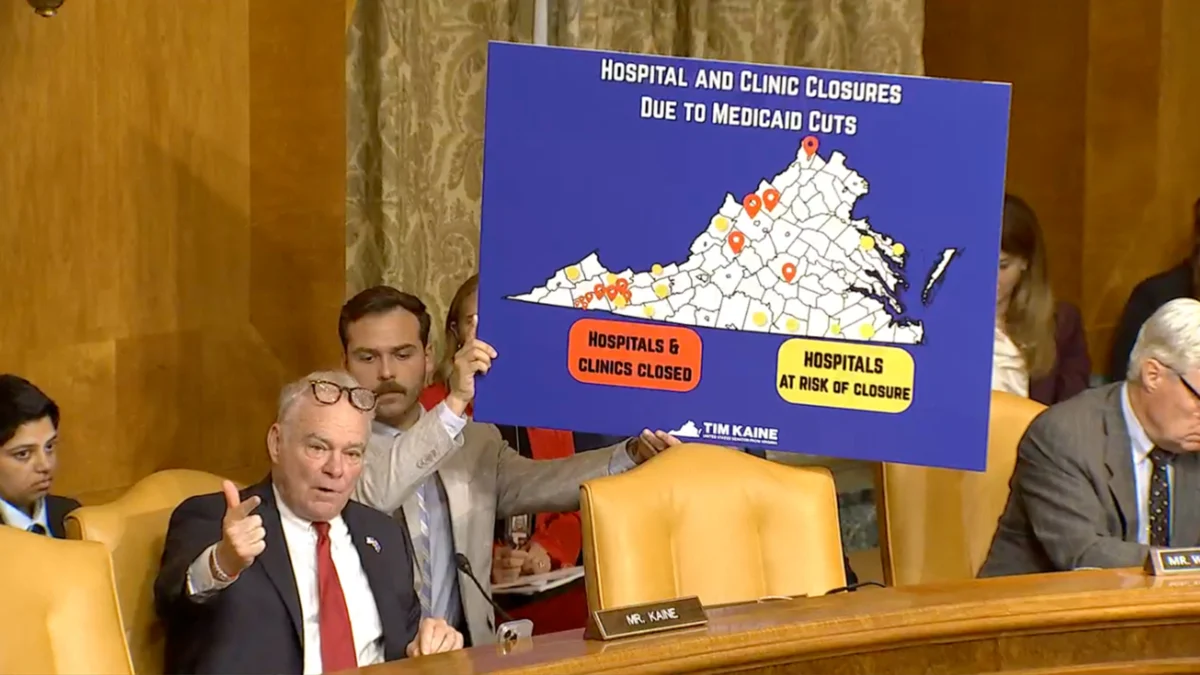
Democratic senators pivoted the conversation toward the human cost of fiscal austerity, specifically targeting the impact of H.R. 1, which aims to cut $1 trillion from the Medicaid program over the next decade. Sen. Tim Kaine (D-Va.) highlighted the preemptive damage these legislative threats have already caused.
“Since the bill passed, 12 hospitals or clinics in Virginia have closed, citing H.R. 1 as the reason,” Kaine stated. He explained that healthcare institutions operate on long-term fiscal projections; consequently, the mere prospect of future funding cliffs has forced providers to shutter operations today. The closures cited include three primary care clinics, six school-based clinics, and three hospital units, signaling a thinning of the healthcare safety net in Virginia even before the formal implementation of the cuts.
Sen. Ben Ray Luján (D-N.M.) underscored the implications of these closures for rural healthcare. Drawing on his own experience recovering from a stroke, Luján emphasized that in medical emergencies, geography is often a determinant of survival. “What I learned is time is not on your side if you have a stroke,” he said. “You need to get to the doctor immediately. [That won’t be] what happens with the trillion-dollar cuts, when Medicaid facilities start closing and rural clinics start closing.”
The "Red-Tape Grenade": Work Requirements and Bureaucracy
A significant portion of the hearing focused on the upcoming implementation of Medicaid work requirements. Under these mandates, enrollees aged 19 to 64 who fall under the ACA expansion population must prove they are working, volunteering, or enrolled in school for at least 80 hours per month to maintain coverage.
Sen. Sheldon Whitehouse (D-R.I.) labeled the policy a “red-tape grenade,” warning that the administrative burden will disproportionately harm those with legitimate barriers to employment. “In Rhode Island, those on Medicaid include people with really significant learning disabilities, mental health issues, and people in addiction recovery,” Whitehouse noted. He argued that forcing individuals with severe health conditions to navigate complex reporting requirements would result in millions being purged from the rolls. Estimates suggest that over 11 million people could lose coverage, either because they fail to meet the requirements or simply fail to successfully navigate the paperwork.
Fraud Control: A Case Study in Institutional Failure
The hearing also featured a specific critique of Medicaid fraud enforcement, with Sen. Rick Scott (R-Fla.) focusing on the performance of New York State’s Medicaid Fraud Control Unit (MFCU). Scott presented data suggesting that despite an annual budget of $16 million and 270 employees, the unit secured only 85 fraud convictions between 2020 and 2025.
Comparing this to other states, Scott noted that Indiana and Arizona—which operate with roughly one-tenth of the staff and budget—have managed to secure five to seven times as many indictments in 2025 alone. Jonathan Ingram of the Foundation for Government Accountability corroborated Scott’s concerns, noting that New York’s lackluster performance has been an ongoing issue. “They are delivering more convictions and more civil recoveries with a fraction of the resources,” Ingram stated, suggesting that the problem lies in the management and prioritization of these units rather than a lack of available fraud cases.
The Political Backlash: White House Accountability
The partisan divide was further solidified when Sen. Patty Murray (D-Wash.) intervened, calling for a broader definition of accountability. Murray challenged her Republican colleagues to reconcile their focus on state-level fraud with the actions of former President Donald Trump.
“I hope my Republican colleagues will use some part of this hearing to condemn President Trump for pardoning criminals who were convicted of major Medicaid fraud,” Murray said. She highlighted that Trump had granted clemency to five former Florida executives responsible for defrauding the program of tens of millions of dollars. “I’m all for a major crackdown on fraud,” Murray added, “but it looks like we’ve got some pretty good leads starting in the White House.”
Implications for the Future of Medicaid
As the Senate Budget Committee continues its oversight, the hearing signals a turbulent road ahead for Medicaid policy. The divergence is clear: Republicans view the program as a bloated, fraud-prone entity that requires structural reform and strict eligibility enforcement to ensure long-term fiscal solvency. Conversely, Democrats view Medicaid as a critical civil right and a primary engine of public health, arguing that current legislative efforts to trim the budget are not “cost-saving measures” but are instead systemic attacks on the poor, the elderly, and the disabled.
With the next election cycle looming, the debate over Medicaid is expected to remain a central theme in national discourse. Whether through the implementation of work requirements, the enforcement of fraud control, or the broader impact of budget reconciliation bills, the fundamental question remains: Can the United States balance the need for fiscal responsibility with the moral imperative to provide healthcare to its most vulnerable citizens? For now, the hearing has confirmed that while both parties agree that fraud is a problem, they are miles apart on how to fix it—or even what the program’s ultimate purpose should be.