







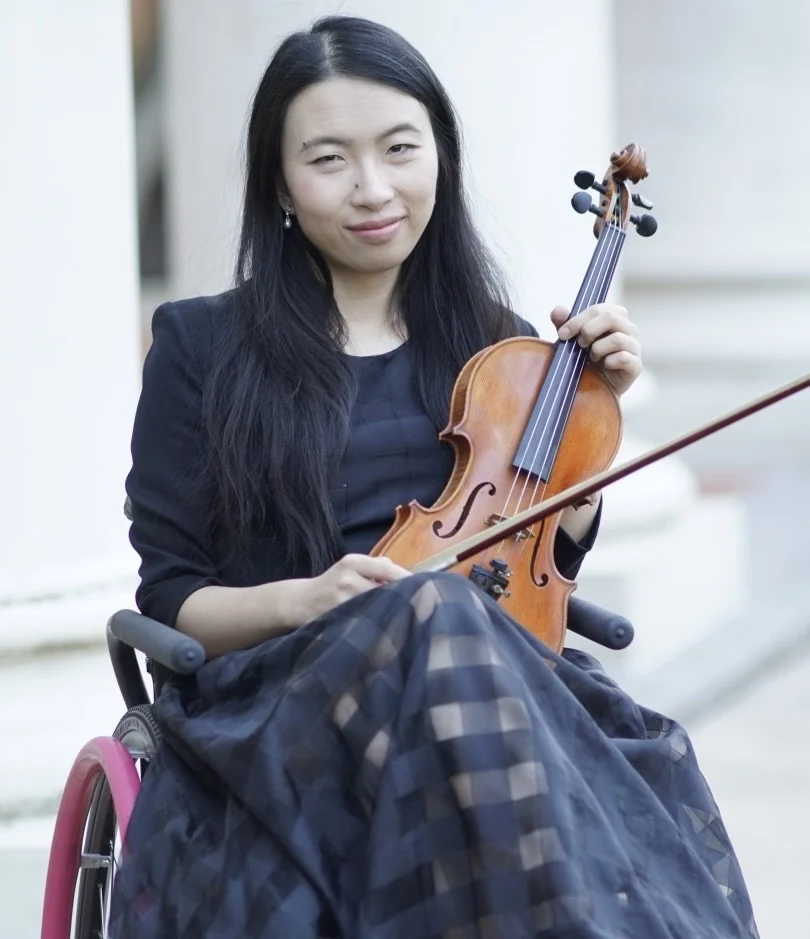
In the quiet, focused space of a music studio, a violin bow moves across strings with a precision that defies the physical limitations of its player. For Amy Wang-Hiller, this act is more than a performance; it is a profound reclamation of self. A classically trained violinist, educator, and fierce disability advocate, Wang-Hiller has spent the last several years navigating the complex, often fractured world of rare neuro-connective tissue disorders. Today, she is shifting the narrative, moving from a patient struggling to be heard to a founder building bridges for others through her organization, the InclusiVibe Foundation.
The Genesis of a Musician
Amy Wang-Hiller’s relationship with music began at the age of three and a half. While her initial introduction to the violin was a pragmatic choice made by her parents—who sought an instrument that was portable and an activity that provided engagement—it quickly evolved into a lifelong vocation.
"I think what really made me fall in love with it was watching the older students perform," Wang-Hiller recalls. "I remember sitting at recitals, watching these older kids playing these amazing pieces and thinking, ‘Oh my God, they’re so good.’ I wanted to play like them."
This aspiration transformed into a disciplined habit that transcended her early childhood health struggles. Even when afflicted by high fevers or physical illness, her desire to practice remained a constant, serving as a primary tether to her identity. This commitment eventually led her to a professional path, bridging the gap between a curious child and a skilled performer who now instructs intermediate and advanced musicians navigating their own complex neurological transitions.
A Chronology of Undiagnosed Complexity
Wang-Hiller’s health journey, which culminated in a diagnosis of hypermobile Ehlers-Danlos syndrome (hEDS) and related conditions, was marked by years of medical fragmentation. As a child, she experienced a recurring series of seemingly unrelated symptoms: chronic tonsillitis, persistent fevers, jaw pain, and gastrointestinal distress. Because these issues were addressed in isolation by various specialists, the underlying connective tissue disorder remained obscured for decades.
The year 2012 marked a significant turning point following a car accident, followed by a severe fall in 2015. "I started having unexplained falls, balance problems, and difficulty eating," she explains. "I simply didn’t have the language to describe symptoms that were unfamiliar to me and didn’t fit what clinicians expected."
The acceleration of her condition reached a breaking point in 2020 after a neck hyperextension injury. Over the following two years, Wang-Hiller faced a cascade of life-altering symptoms: postural orthostatic tachycardia syndrome (POTS), dystonia, drop attacks, fainting, and temporary paralysis. Further diagnostic investigation eventually confirmed hEDS, alongside critical findings such as occult tethered cord and craniocervical instability with a severe upper cervical ligament injury.
Defining the Spectrum of Quadriplegia
One of the most persistent hurdles in Wang-Hiller’s advocacy is dismantling the public and clinical misconceptions surrounding quadriplegia. While the term is colloquially understood as total, permanent paralysis, Wang-Hiller’s case illustrates the reality of "incomplete" quadriplegia.
"I often tell people to imagine their body encased in cement," she says. "You know exactly what you want your body to do, but the signals simply aren’t able to easily pass through those injured segments."
Classified as AIS B (sensory incomplete), Wang-Hiller possesses limited sensation and movement, but lacks the motor function necessary for independent living. She relies on 24/7 care for daily tasks, from hygiene to community mobility. Her experience highlights a critical failure in medical education: the tendency to view paralysis as a binary state rather than a spectrum, which often leads to the underestimation of a patient’s needs and the misinterpretation of their physical capabilities.
The Cost of Medical Gaslighting
A recurring theme in Wang-Hiller’s journey is the systemic failure of the healthcare system to address "invisible" or complex neurological symptoms without resorting to psychological labels. At various points, her genuine physical decline was misattributed to Functional Neurological Disorder (FND) or psychiatric causes.
The impact of this labeling was profound. "Years of gaslighting and psychiatric misattributions made me question my own symptoms," she notes. "At one point, I even believed those psychiatric explanations."
This diagnostic bias culminated in a fractured relationship with her neurology team in 2022, when her ability to play the violin—a feat of immense effort—was cited as evidence of "inconsistency" in her weakness. Even as her condition progressed to the point of needing ventilator support, the echoes of these initial labels remained in her medical record. This experience underscores a systemic danger: once a patient is labeled with a "functional" or "psychological" diagnosis, it becomes an anchor that drags through every subsequent encounter, hindering objective assessment and shattering the patient-provider trust necessary for effective treatment.
Diversity and the EDS Conversation
As a Chinese-born patient, Wang-Hiller has observed a distinct lack of representation for Asian patients within the connective tissue disorder community. She argues that the clinical "picture" of EDS often focuses on specific phenotypes that may not reflect how these conditions manifest across diverse ethnic populations.
"When people only encounter one picture of EDS, patients from different ethnic backgrounds tend to be overlooked or diagnosed much later," she explains. By sharing her own story and highlighting the experiences of others—such as friends with severe respiratory complications—she aims to challenge the outdated assumptions that contribute to diagnostic delays in minority populations.
The InclusiVibe Foundation: A New Paradigm
Out of the frustrations of her personal experience, Wang-Hiller founded the InclusiVibe Foundation. The nonprofit was created to address the systemic gaps she encountered: the lack of coordination between specialists, the isolation of patients with complex neuro-connective tissue conditions, and the absence of a unified voice for those with spinal manifestations.
The foundation serves as a hub for storytelling, advocacy, and interdisciplinary collaboration. By bringing together patients, clinicians, researchers, and artists, InclusiVibe seeks to transform healthcare from a fragmented, transactional process into a holistic, compassionate system. "We’re a community-led organization," she explains. "We believe that lived experience should help inform research, education, and care."
Implications for the Future of Chronic Pain Management
The story of Amy Wang-Hiller is a call to action for the medical community. It highlights the urgent need for:
- Interdisciplinary Integration: Patients with complex systemic conditions require care teams that communicate, rather than specialists who operate in silos.
- Diagnostic Humility: Clinicians must be trained to recognize the spectrum of neuro-connective tissue disorders and avoid the immediate pivot to "functional" or "psychological" labels when symptoms do not follow textbook patterns.
- Patient-Centered Research: Including the patient voice in research and policy ensures that the care provided actually addresses the lived reality of the condition.
Finding Meaning in the Interdependence of Fortune
Reflecting on the Chinese proverb "Fortune and misfortune are interdependent" (fú huò xiāng yī), Wang-Hiller offers a poignant message to those currently in the "middle of a difficult chapter."
"Healing doesn’t always mean getting better physically," she says. "Sometimes it means discovering that your life can still have meaning, connection, creativity, and hope, even if it looks very different from what you imagined."
Her journey, while marked by significant loss, has simultaneously birthed a new purpose. Through her podcast, The Hidden Diagnoses Impact, and her foundation, Wang-Hiller is ensuring that no patient has to face the complexities of a rare diagnosis in isolation. She serves as a reminder that even when the body is constrained, the capacity for advocacy, connection, and the pursuit of a meaningful life remains boundless.