







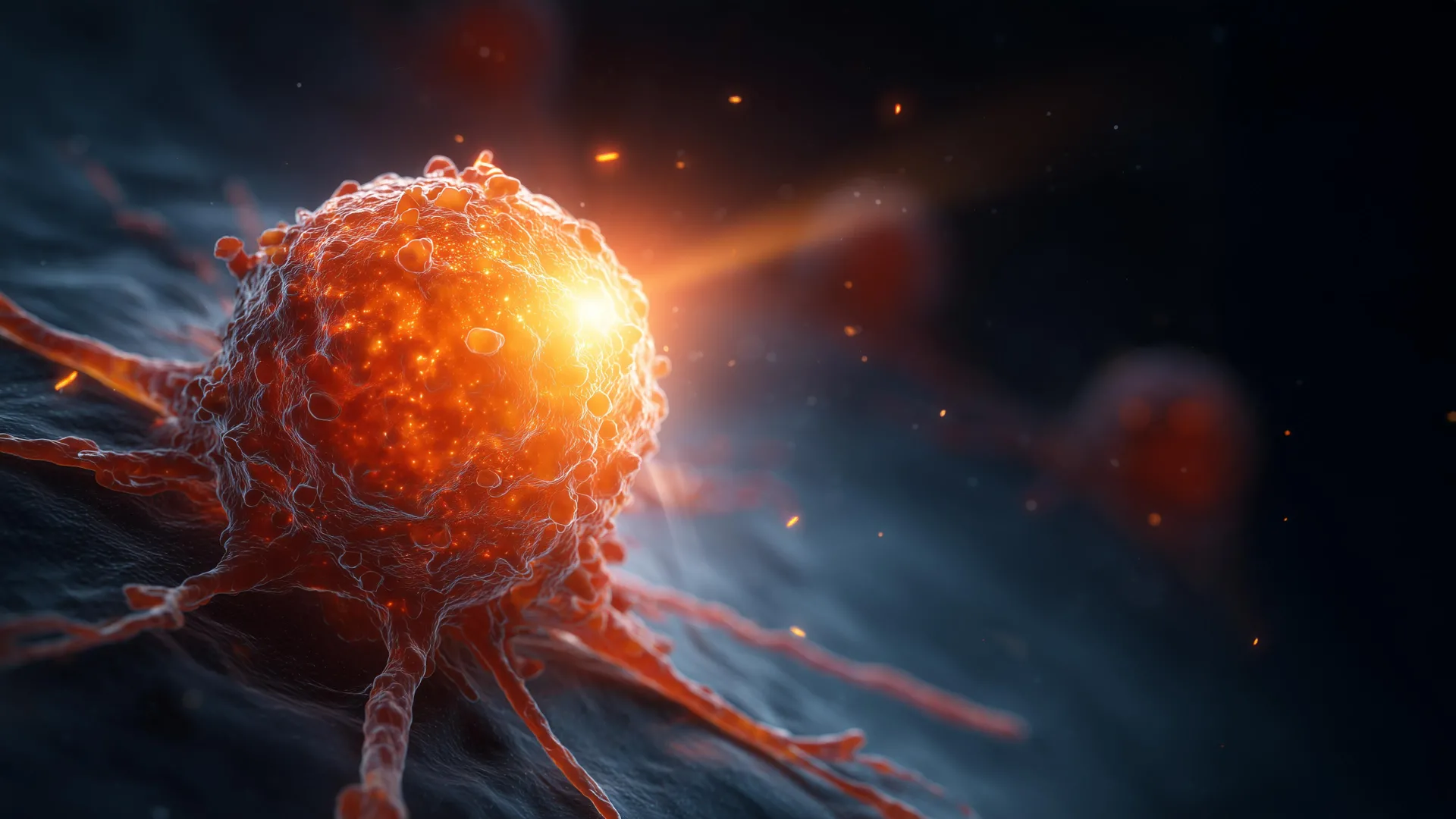
In the ongoing battle against cancer, one of the most formidable enemies is not the rapid, aggressive growth of a tumor, but its silence. For years, oncologists have grappled with the phenomenon of "dormancy"—a strategic, sleep-like state that allows cancer cells to evade the lethal effects of chemotherapy and radiation. By becoming largely inactive, these cells effectively "hide" from treatments designed to target rapidly dividing cells.
However, a pioneering study from ETH Zurich has unveiled a sophisticated new strategy: a light-activated molecular "switch" that forces these dormant cells to wake up, rendering them vulnerable to destruction. By manipulating the body’s own protein-recycling mechanisms, researchers have developed a platform that could transform how we treat some of the most stubborn forms of cancer.
The Mechanism of Dormancy: Glucocorticoid Receptors
To understand the significance of this discovery, one must first understand how cancer cells achieve this elusive state of dormancy. In many cancers, including specific subsets of lung cancer, the body’s own stress hormones serve as an inadvertent accomplice.
These hormones are detected by specialized proteins known as glucocorticoid receptors (GRs) residing within the tumor cells. When these receptors are activated by stress signals, they trigger a cascade of intracellular events that push the cancer cell into a state of profound metabolic inactivity. During this phase, cell division slows to a crawl. Because most conventional cancer therapies—such as chemotherapy—are designed to target cells that are actively dividing, these dormant cells effectively become "invisible" to medical intervention.
The clinical dilemma is that glucocorticoid receptors are ubiquitous; they are essential for regulating systemic inflammation and maintaining healthy immune function. Consequently, a broad-spectrum drug that inhibits these receptors would cause catastrophic systemic side effects, stripping the body of its ability to manage stress and inflammation. The challenge for modern medicine has been to devise a way to disable these receptors strictly within the tumor, leaving healthy tissue untouched.
Chronology of a Molecular Innovation
The path to this discovery was a multi-disciplinary effort, drawing on expertise in epigenetics, organic synthesis, and molecular biology.
- Initial Discovery: Researchers identified that the glucocorticoid receptor was the primary gatekeeper for the dormant state in certain lung cancer lines.
- The Conceptual Design: The ETH Zurich team hypothesized that if they could force the cell to recycle—or "eat"—its own receptors, the dormant cells would be forced back into a proliferative state.
- Collaboration: A cross-departmental team was formed. While the biological framework was established, the team turned to the group of Professor Erick Carreira, an expert in organic synthesis, to engineer a molecular component that could respond to external stimuli.
- The Switch: Through rigorous testing, the team created a "molecular bridge" consisting of three parts: a receptor-binder, an enzyme-recruiter, and a flexible, light-sensitive connector.
- Validation: Laboratory testing confirmed that the system could be toggled on or off using specific wavelengths of light, effectively controlling the destruction of receptors in cell cultures.
Harnessing the Cell’s Internal Recycling Depot
The genius of the ETH Zurich approach lies in its biomimetic nature. Rather than introducing a toxic agent, the researchers adapted a natural cellular process known as targeted protein degradation.
Cells are equipped with an internal "waste management" system. When a protein is defective or damaged, the cell attaches a molecular tag—a process called ubiquitination—which signals the cell’s proteasome to dismantle and recycle the protein. The researchers designed a synthetic bridge that mimics this process. One end of the molecule latches onto the glucocorticoid receptor, while the other grabs an E3 ligase, the enzyme responsible for tagging proteins for destruction.
The "bridge" between these two ends is the linchpin of the technology. Under standard, non-illuminated conditions, the bridge remains extended, keeping the enzyme in close proximity to the receptor. The enzyme tags the receptor, and the cell promptly destroys it. However, when exposed to light of a specific wavelength, the bridge undergoes a structural change—a "bend"—that prevents the enzyme from aligning with the receptor. This effectively shuts off the destruction process.
This allows for unprecedented control: clinicians could, in theory, apply the treatment systemically but only activate it (or deactivate it) in precise, illuminated regions, ensuring that healthy tissue remains protected while the tumor is stripped of its defensive dormancy.
Supporting Data and Laboratory Observations
In early-stage experiments on lung cancer cell lines, the results were striking. The researchers observed that the application of their molecular switch led to a rapid and significant depletion of glucocorticoid receptors.
Gene activity analysis provided the most promising metric of success. Upon the destruction of the receptors, the cells displayed a marked shift in their gene expression profiles, moving from a dormant state to an active, metabolically engaged state. This transition is exactly what clinicians need to re-sensitize the tumor to existing chemotherapy agents.
While these results are robust in vitro, the team is cautious. "Of course, this will now need to be verified in living organisms as well," noted Robin Scheuplein, the study’s joint first author. The transition from cell culture to animal models—and eventually human clinical trials—will be the true test of the technology’s therapeutic index.
Official Perspectives: A New Era of Precision
The research team, led by Professor Katharina Gapp, views this not merely as a cancer treatment, but as a modular platform for future medicine.
"This system is based on existing medical technology and therefore offers a realistic prospect of localized therapies," Scheuplein said. The team emphasizes that their invention is "programmable." By swapping the receptor-binding end of the molecule, the same light-sensitive backbone could be used to target different proteins in different disease states.
The implications for "spatial control" are profound. By using an endoscope or fiber-optic light source, surgeons could theoretically illuminate the margins of a tumor, ensuring that the treatment stays localized. "Activity can therefore be strictly limited to the tumor core, preserving the surrounding tissue and causing significantly fewer side effects. The effect is reversible and can be controlled precisely," Scheuplein explained.
Future Implications: Beyond Lung Cancer
While the current focus is on lung cancer, the potential applications for this light-activated degradation system are vast.
Expanding the Therapeutic Horizon
The researchers are already looking toward other hormone-dependent cancers. For example, the estrogen receptor (ER), which drives the majority of breast cancers, and the androgen receptor (AR), central to prostate cancer progression, are prime candidates for this technology. If scientists can use light to precisely manage these receptors, it could offer a new line of defense for patients who have developed resistance to standard hormone therapies.
Overcoming the "Light Penetration" Hurdle
One of the primary challenges for the future is the physics of light. Currently, visible light penetrates only a few millimeters into human tissue. To treat deeper-seated tumors, the research group is investigating the use of near-infrared light. Near-infrared wavelengths travel much deeper into human tissue with less scattering and lower energy, which would be far less damaging to healthy cells while still being capable of triggering the molecular switch.
A New Tool for Research
Beyond its clinical potential, this technology serves as an invaluable research tool. By allowing scientists to "turn off" specific proteins at will in a live laboratory setting, they can observe, in real-time, how these proteins influence complex signaling pathways. This will likely accelerate the discovery of new cancer vulnerabilities that were previously masked by the complexity of cellular feedback loops.
As the team prepares for the next phase of development, the scientific community is watching with keen interest. By turning the lights on—quite literally—within the dark, dormant corners of a tumor, we may be on the verge of a new paradigm in precision oncology: one where we don’t just fight cancer, but actively force it to reveal itself.