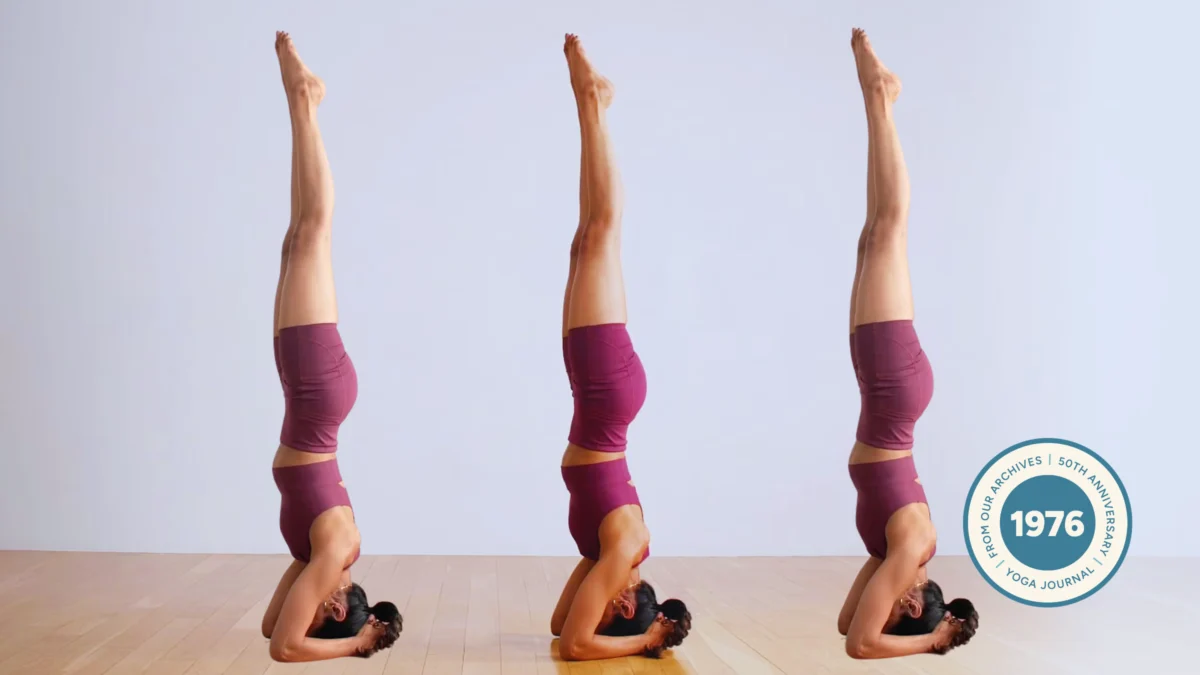
From the Yoga Journal Archives: Originally published in the September-October 1976 issue, this deep dive into the Headstand (Shirshasana) remains a cornerstone of yogic philosophy and practice.
In the vast lexicon of yoga, few postures command as much respect, intimidation, and reverence as Shirshasana, or the Headstand. Often hailed as the "King of Asanas," this inverted posture is more than a mere display of physical prowess; it is a gateway to physiological, psychological, and spiritual transformation. As we look back at the 1976 archives of Yoga Journal, the insights provided remind us that yoga is not merely a workout—it is an internal excavation.
Main Facts: The Physiology of Inversion
At its core, Shirshasana is a structural reversal of the human experience. By shifting the body’s center of gravity, the practitioner invites a profound shift in internal systems.
Hemodynamic and Organ Health
Physiologically, the Headstand is a masterclass in venous return. In our standard upright existence, the heart works tirelessly against gravity to circulate blood from the lower extremities back to the core. In Shirshasana, gravity becomes an ally. By elevating the legs above the heart, the body experiences a natural drainage of venous blood, relieving the pressure on the lower body and the cardiovascular system.
Furthermore, the abdominal organs undergo a subtle, beneficial displacement. Gravity, which typically pulls our viscera downward—contributing to the inevitable sagging associated with aging—is redirected. This inversion is believed to aid in the healthy functioning of the digestive and reproductive organs, providing a "reset" for the abdominal cavity.
The Energetic Flow
In the tradition of Pranic healing and Hatha Yoga, the body is divided by the diaphragm into two primary energetic zones: prana (the energy of the upper body) and apana (the energy of the lower body). Under normal circumstances, these energies pull in opposite directions. Shirshasana is unique in its ability to reverse this flow, encouraging apana to rise toward the heart and brain. This redirection is historically cited as a method to impart harmony, boost cognitive clarity, and foster the natural evolution of the practitioner’s consciousness.
Chronology: A Half-Century of Inversion
To understand the place of Shirshasana in modern practice, one must look at its trajectory from the mid-20th century to the present day.
- The 1970s (The Formative Era): When this article was first penned in 1976, yoga in the West was moving from a counter-culture curiosity to a disciplined practice. The focus was heavily on the "integral whole"—the idea that the body, mind, and spirit were inextricably linked.
- The 1990s (The Mainstream Shift): As yoga studios began to populate urban centers, Shirshasana became a benchmark of an "advanced" practitioner. The emphasis shifted toward technical alignment and safety.
- The 2020s (The Scientific Integration): Today, we see a convergence of ancient wisdom and modern biomechanics. Researchers are increasingly investigating the neurological benefits of inversions, exploring how the shift in blood flow influences the vestibular system and autonomic nervous system regulation.
Supporting Data: The Psychological Landscape
Beyond the muscles and veins, Shirshasana is a profound psychological tool. The act of turning the world upside down acts as a metaphor for cognitive flexibility.
The Discipline of Poise
Just as an infant must develop the physical and mental coordination to stand on two feet, the yogi must develop the "poise of the head." This is not simply a matter of balance; it is a matter of equanimity. When a student learns to remain calm and centered while inverted, they are essentially training their nervous system to remain composed when faced with "upside down" situations in their personal and professional lives.
The Confrontation of Fear
The practice of Shirshasana often triggers an unconscious response. Many practitioners report an inexplicable wave of fear when first learning the pose. Philosophically, some schools of thought suggest that this visceral reaction taps into the primal memory of the birth canal—the very first journey the human body takes, head-first, into the world. By staying with the posture, the student is forced to face this fear, bring it to the surface, and ultimately release it. This process of self-discovery transforms the mat into a laboratory of the mind.
Official Responses and Safety Protocols
Despite the immense benefits attributed to the "King of Asanas," the yoga community has maintained a consistent, professional stance regarding its risks. The consensus among masters and modern physical therapists remains unchanged: Shirshasana is not a pose to be self-taught.
Expert Guidance
The potential for injury—particularly to the cervical spine, the neck, and the lumbar region—is significant. The posture requires not only strength but also a nuanced understanding of anatomical alignment. Practicing without an experienced teacher is strongly discouraged, as the structural integrity of the neck is paramount.
Contraindications
Safety guidelines have remained rigid over the decades to protect the practitioner:
- Hypertension: Those suffering from high blood pressure should avoid the posture, as the increase in intracranial pressure can be dangerous.
- Menses: Traditional practice often advises against inversions during menstruation to honor the downward energetic flow (apana) inherent to that cycle.
- Pregnancy: While some experienced practitioners continue the practice, it is strictly advised that this be done only under the direct, specialized supervision of a teacher trained in prenatal yoga.
Implications: The Path to Unfoldment
The final implication of Shirshasana is that it serves as a microcosm for the entirety of the yoga discipline. If the body is a temple, the inversion is a renovation. By challenging the status quo of our physical position, we invite a change in our mental perspective.
As the 1976 archives suggest, the pose is merely "part of the integral whole." It is a preparation for the inevitable unfoldment of consciousness. In a world that is increasingly fast-paced and chaotic, the ability to find "center" while upside down is more relevant than ever.
Conclusion: Seeing Things Differently
The headline of our archival piece summarizes the essence of the practice perfectly: It teaches you to see things from a different angle. Whether you are a novice attempting your first wall-supported tuck or a seasoned yogi practicing in the center of the room, Shirshasana demands awareness. It is a reminder that when we change our orientation to the world, we change our orientation to ourselves.
By infusing the "hidden corners of the mind" with the light of self-understanding, we do more than just stand on our heads—we learn how to stand more firmly in our own truth.
Disclaimer: This article is intended for educational purposes based on historical archives. Always consult with a qualified medical professional and a certified yoga instructor before attempting advanced inversions.