









"I want to know I’m doing absolutely everything I can to preserve my health for as long as possible."
It is a sentiment echoed in gyms, boardrooms, and family dinner tables across the globe. As the conversation around longevity moves from the fringes of biohacking into the mainstream, people are increasingly obsessed with outliving their peers and defying the traditional aging process. The vision is seductive: stay lean, fit, and cognitively sharp well into your 90s and beyond.

But there is a glaring problem with the current "optimization" culture. It suggests that peak health requires an extraordinary, almost industrial amount of effort, time, and money. Is this relentless pursuit of the "optimal" necessary, or has it become a barrier to the very health it promises to protect?
The Myth of Optimization: Why More Isn’t Always Better
Longevity advice is everywhere. From high-profile podcasts hosted by experts like Dr. Peter Attia and Dr. Andrew Huberman to the extreme protocols of biohackers like Bryan Johnson, the message is clear: if you aren’t tracking every biomarker and optimizing every waking minute, you are failing.

However, for those of us who have coached hundreds of thousands of people, we know that "optimal" is rarely realistic—and, more importantly, it isn’t necessary.
The Power of the Basics
The most pervasive myth in the longevity space is that the "basics" are no longer enough. Many believe that without ice baths, continuous glucose monitors, and a cabinet full of experimental supplements, they cannot achieve a long healthspan.

In reality, the basics—regular exercise, a nutrient-rich diet, adequate sleep, stress management, and social connection—work exceptionally well. The reason most people aren’t living as long or as well as they could be isn’t because they lack cutting-edge technology; it’s because they aren’t performing the fundamental habits with 80 to 90 percent consistency.
The Law of Diminishing Returns
There is a fundamental misunderstanding of the "dose-response" relationship in fitness. Much like medicine, where underdosing fails to treat a condition and overdosing can lead to toxicity, health habits follow a U-shaped curve.

When you move from a sedentary lifestyle to a moderately active one, your health benefits skyrocket. However, as you push toward the "extreme" end of the spectrum, the marginal gains decrease significantly, while the risks—such as overtraining injuries, social isolation, and financial strain—begin to climb.
A Chronology of Health: From Survival to "Biohacking"
To understand where we are, we must look at how health messaging has evolved:

- The 20th Century (Public Health Era): Focus was on basic sanitation, vaccination, and preventing infectious disease. The "basics" were the primary driver of the massive increase in average life expectancy.
- The Early 21st Century (The Fitness Boom): The focus shifted to "aerobics" and weight loss. The goal was body composition and cardiovascular endurance.
- The Current Era (The Optimization Era): Driven by wearable technology and the "quantified self" movement, we have entered an age where we treat the human body like a computer operating system that requires constant patching and upgrading.
This shift has created a culture where "good enough" is seen as failure, leading to a paralysis where many decide that if they cannot be perfect, they will do nothing at all.
The Foundation: What Actually Moves the Needle
If you want to reduce the risk of chronic disease and extend your healthspan, you don’t need a complex protocol. You need to master the pillars of human biology.

1. Exercise: The Medicine of Movement
Data from Harvard alumni studies confirms that any amount of physical activity reduces the risk of all-cause mortality. The greatest "bang for your buck" comes from achieving 7.5 to 15 MET-hours of activity per week.
Crucially, this should be a blend of aerobic training and resistance training. Resistance training is the primary tool for preventing sarcopenia (muscle loss) and maintaining bone density, which are the two biggest factors in preventing falls and fractures in later life.

2. Nutrition: The 80/20 Rule
You do not need to eat like a professional athlete to see results. The most significant longevity benefits come from a diet that minimizes ultra-processed foods (UPFs) and maximizes whole, minimally-processed options.
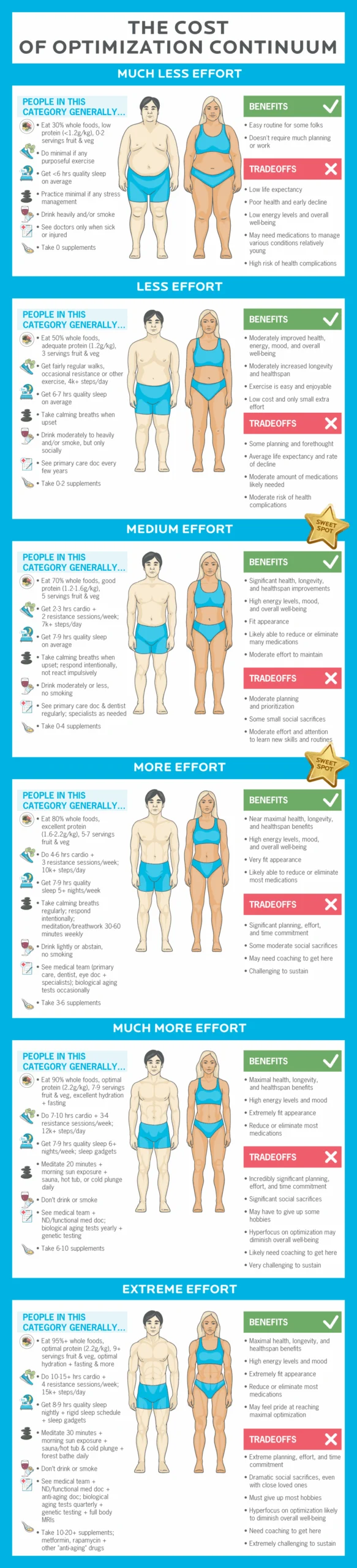
Data shows that the "sweet spot" for nutrition is getting 70 to 80 percent of your calories from whole foods, consuming five servings of fruits and vegetables daily, and ensuring adequate protein intake (1.2g to 1.6g per kilogram of body weight) to support muscle retention.

3. Sleep: The Underrated Variable
Sleep is the most potent recovery tool in existence. Studies indicate that men who prioritize quality sleep live nearly five years longer than those who don’t. The target remains 7 to 9 hours. Going below this is associated with increased risk of cardiovascular disease, while obsessively trying to "hack" sleep beyond 9 hours often indicates underlying health issues.
4. Social Connection: The Longevity Multiplier
Perhaps the most overlooked factor is social connection. The Harvard Study of Adult Development—an 87-year-long study—found that the strength of our relationships is the single greatest predictor of life satisfaction and longevity. Loneliness is as damaging to health as smoking 15 cigarettes a day.

The Cost of Optimization: Is the Juice Worth the Squeeze?
The financial and temporal costs of the "optimizer" lifestyle are massive. When we tally the time spent on specialized gym programs, meal prep, advanced tracking, and clinical testing, it often takes three to four times the effort of a "healthy" lifestyle.
For the vast majority of people, this 300 to 400 percent increase in effort yields only a marginal, theoretical improvement in lifespan. Worse, the "opportunity cost" is the loss of a well-rounded life. When your entire schedule is dictated by recovery protocols and rigid dietary rules, your existential and social health often suffer.

The Verdict: Reclaiming Your Health
The evidence suggests that "optimal" is a trap. If you find yourself so stressed by the pursuit of health that you are losing sleep, neglecting your friends, or feeling anxious about your next meal, you have moved past the point of diminishing returns.
Practical Implications for You
- Clarify Your Goals: Ask yourself what kind of life you want to lead. If your goal is to be present for your family and remain active into old age, the basics will get you there.
- Audit Your Consistency: Before adding a supplement or a new high-tech tracking device, look at your last 30 days. Did you hit the gym three times a week? Did you eat vegetables at most meals? If not, focus there.
- Tune Out the Noise: The "figureheads" on social media are not experts on your life. They are often selling a lifestyle or a product. Your health is not a software update; it is a life to be lived.
By focusing on the foundational behaviors—the ones that are proven, accessible, and sustainable—you can achieve 80 to 90 percent of the results without sacrificing your joy. In the end, the longest, healthiest lives are often the ones that are lived with purpose, balance, and a little less "optimization."