








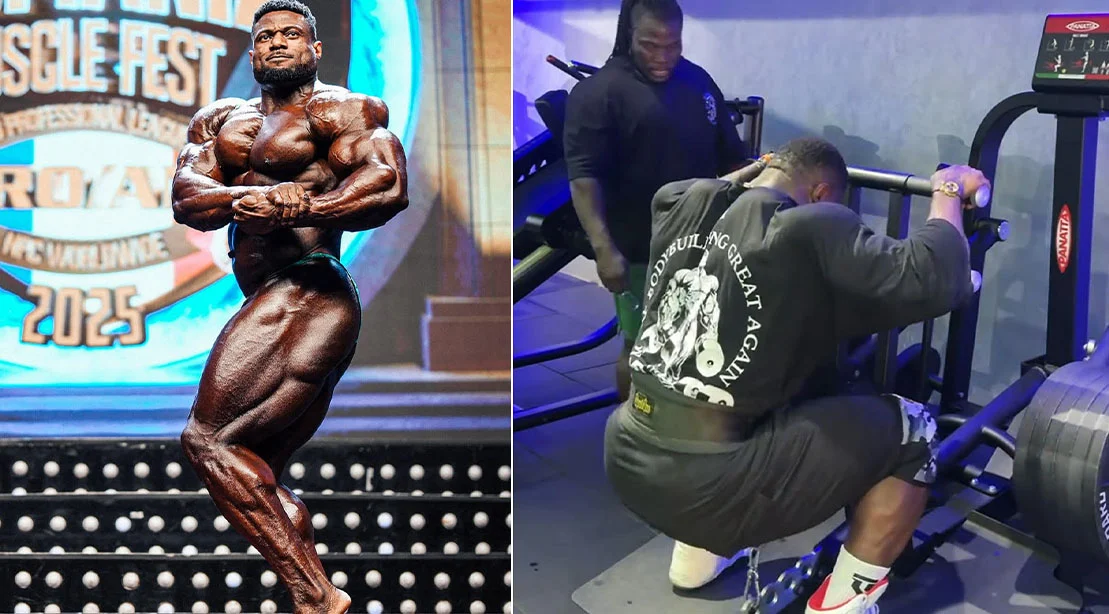
With the 2026 Joe Weider’s Olympia Fitness & Performance Weekend rapidly approaching in Las Vegas, the pressure is mounting for the elite of the bodybuilding world. Among the top-tier contenders, none appear more focused—or more systematically driven—than Chinedu "Andrew Jacked" Obiekea. Often referred to as the "Mona Lisa" of the sport for his aesthetic symmetry and fluid, artistic presentation, Jacked is currently fine-tuning his physique to secure the most coveted trophy in professional bodybuilding.
As the countdown to the September 24–27 event hits the final month, Jacked has provided a rare glimpse into the grueling reality of his preparation. By sharing his high-intensity lower-body training protocol, the Nigerian powerhouse has signaled to his rivals that his legs, long considered the foundation of his championship run, are undergoing a rigorous transformation.
The Ascent of the "Mona Lisa": A Chronology of Dominance
To understand the weight behind Andrew Jacked’s current training, one must look at his meteoric rise through the IFBB Pro League. His journey has been defined by a rare combination of sheer size and impeccable, flowing lines.
- 2025: The Breakthrough: Jacked made his presence felt on the global stage with a commanding third-place finish at the Mr. Olympia. This podium placement solidified his position as a legitimate challenger to the reigning champion.
- 2026: The Arnold Classic Supremacy: Building on his Olympia momentum, the first half of 2026 saw Jacked dominate the Arnold Classic circuit. By securing victories in both the U.S. and the U.K., he became the man to beat. These wins were not just trophies; they were statements of intent.
- The Current Phase: As of late August 2026, Jacked has transitioned into the final "sharpening" phase of his contest prep. His focus has shifted from off-season mass-gaining to structural refinement, metabolic conditioning, and the "brick-by-brick" construction of his lower body to ensure he brings a complete package to the Las Vegas stage.
The Science of the "Brick-by-Brick" Philosophy
"Brick by brick," is the mantra Jacked frequently invokes on social media. It speaks to the patience required to build a world-class physique—a process that ignores shortcuts in favor of consistent, high-intensity mechanical overload.
In his latest training cycle, Jacked has moved away from traditional barbell ego-lifting to focus on machine-based hypertrophy. This approach minimizes the risk of injury as the contest approaches while maximizing the tension placed on specific muscle fibers. By utilizing leverage-based equipment, Jacked ensures that he can reach a state of muscular failure without compromising the structural integrity of his joints or spine.
Anatomy of the Session: Andrew Jacked’s Lower Body Protocol
For those looking to replicate the volume and intensity of a pro-level leg session, Jacked’s current workout serves as a masterclass in biomechanics and hypertrophy.
1. Leverage Squat Machine: Deep Range of Motion
Jacked begins his session on the leverage squat machine. Unlike a standard free-weight squat, the fixed path of the machine allows for an unconventional foot placement. By positioning his feet lower on the platform, Jacked forces his knees into deeper flexion, placing an immense, isolated load on the quadriceps. This deep-tissue stimulus is the first step in his session, effectively "pre-exhausting" the quads for the movements to follow.
2. Belted Squats: Spine-Sparing Intensity
The second movement is the belted squat. This is a staple in the routines of elite bodybuilders who want to avoid the axial loading (pressure on the spine) associated with back squats. By securing the belt just above the hips, the weight is pulled through the pelvic floor, shifting the demand squarely onto the glutes and quads. Peer-reviewed research, such as studies published in the Journal of Strength and Conditioning Research, confirms that belt squats offer an equivalent level of muscular recruitment to barbell squats while significantly reducing lumbar stress—a vital consideration for an athlete training at Jacked’s intensity level.
3. Leg Press: The Quadriceps Focus
Jacked then moves to the leg press, maintaining a narrow, low-platform stance. This configuration demands high levels of knee flexion. Because he is leaning back, he can focus entirely on the "push" phase of the movement, ensuring that the tension remains within the quadriceps rather than dissipating into the lower back or hips.
4. Leg Extensions: Time Under Tension
The fourth exercise is the leg extension machine. Here, Jacked emphasizes the contraction. He holds the peak of the lift for a one-second "squeeze," forcing blood into the muscle and creating the intense metabolic stress required for sarcoplasmic hypertrophy. The focus here is not on the weight stack, but on the feeling of the muscle fibers shortening under maximum resistance.
5. Plate-Loaded Hip Thrusts: Glute Isolation
Finally, Jacked attacks the hip thrust machine. This movement is the cornerstone of his posterior chain development. He pays meticulous attention to form, avoiding hyperextension of the lumbar spine. Instead, he uses his glutes to drive the weight vertically. This isolation ensures that his glutes remain full and striated, a crucial aesthetic detail for the judges at the Olympia level.
Supporting Data: The Value of Hypertrophy-Specific Training
What separates an amateur from a contender like Andrew Jacked is the adherence to specific training variables:
- Rep Ranges: Jacked sticks to an 8–12 rep range, which is widely regarded in exercise science as the "hypertrophy window."
- Volume: He limits his session to 2–3 sets per exercise. This is a common strategy for elite bodybuilders who possess the intensity to reach near-failure in a single set, negating the need for the excessive volume that can often lead to overtraining.
- Time Under Tension (TUT): By focusing on the descent (eccentric) and the pause (isometric), Jacked ensures that the muscle is under load for a longer duration, which promotes greater micro-trauma to the muscle fibers—the precursor to muscle growth.
Official Perspectives and Industry Implications
Industry analysts have noted that Andrew Jacked’s shift toward controlled, machine-heavy training signals a broader trend in professional bodybuilding. As the athletes get larger, the reliance on traditional barbell movements has decreased in favor of specialized equipment that allows for a "cleaner" stimulus.
"Jacked is evolving," notes a veteran bodybuilding coach. "He’s no longer just trying to be the biggest guy on stage. He’s trying to be the most detailed. By utilizing these specific machines, he is sculpting his legs to match his upper body’s aesthetic perfection. If he hits his peak in Vegas, his lower body will finally be the piece of the puzzle that completes his case for the Sandow trophy."
The implications for the 2026 Olympia are significant. With his Arnold Classic titles, Jacked has proven he can beat the best in the world. However, the Olympia stage requires a different level of conditioning. By refining his lower body, Jacked is addressing the only remaining critique from the 2025 season.
Conclusion: The Road to Las Vegas
The "Mona Lisa" of bodybuilding is painting his final masterpiece. With the Olympia just weeks away, Andrew Jacked’s commitment to his training routine illustrates the discipline required to stand at the pinnacle of the sport. His session is not merely about moving weight; it is a calculated effort to create the perfect illusion of power and grace.
As the industry turns its eyes toward Las Vegas, all eyes will be on those legs. Whether or not this "brick-by-brick" approach leads to a historic victory remains to be seen, but one thing is certain: Andrew Jacked is leaving nothing to chance.
Key Information:
- Event: Joe Weider’s Olympia Fitness & Performance Weekend
- Dates: September 24–27, 2026
- Location: Las Vegas, Nevada
- For more information, visit the official Olympia website.
- Follow Andrew Jacked’s journey on Instagram.